6 min read

© IE Online Media Services Pvt Ltd



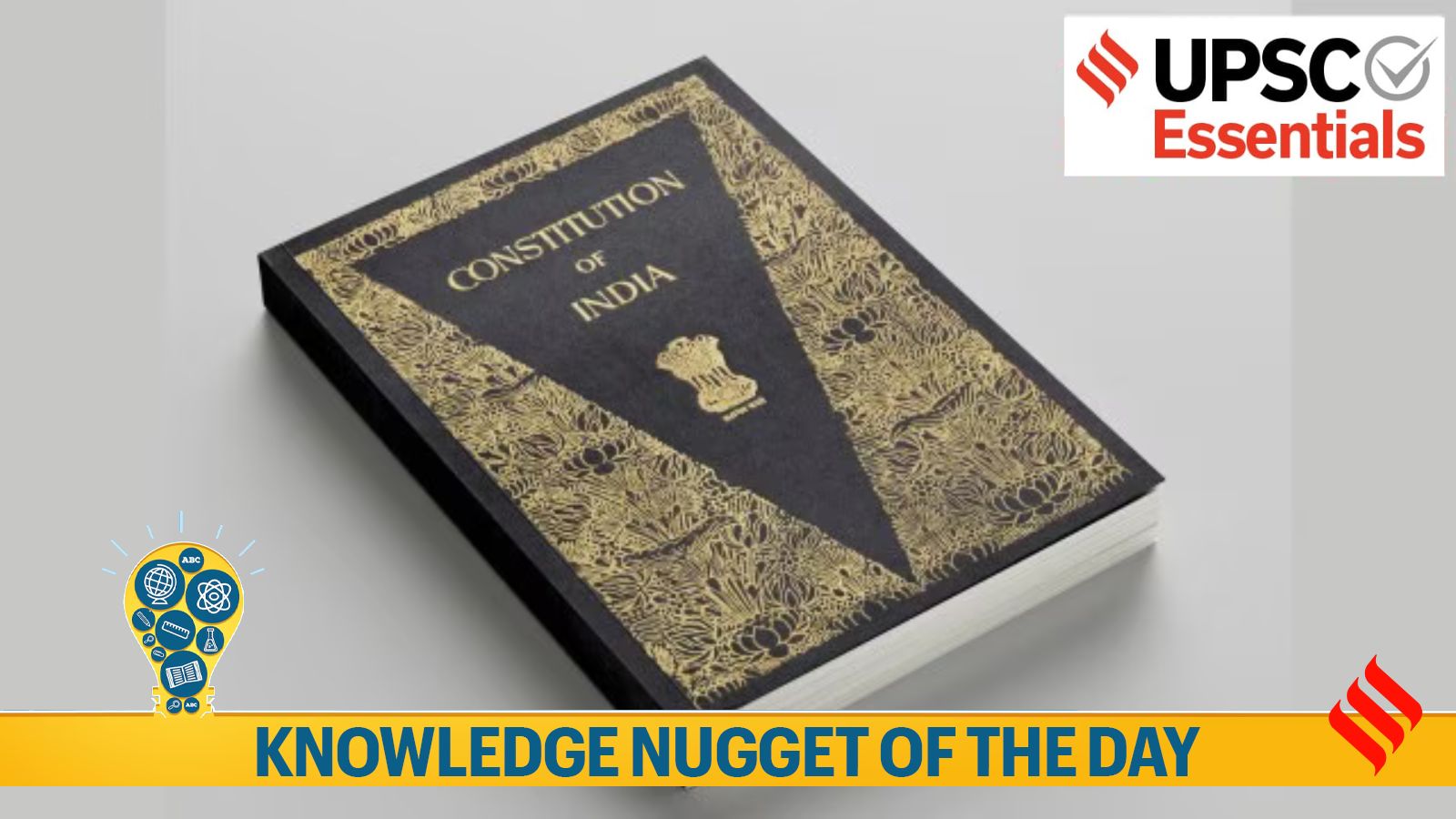 The Doctrine of Basic Structure is a form of judicial review that is used to test the legality of any legislation by the courts. (Representative Image)
Take a look at the essential concepts, terms, quotes, or phenomena every day and brush up your knowledge. Here’s your upsc current affairs knowledge nugget on the Basic structure doctrine.
(Relevance: In 2020, UPSC asked a question on the basic structure of the question in the Prelims. It has appeared in Mains questions as well. This is one of the most important topics for your UPSC exam.)
Ahead of the scheduled briefing of the 23rd Law Commission before the Joint Committee of Parliament on the simultaneous elections Bills on December 4, it is learnt to have firmed up its view that the Bills do not disturb the basic structure of the Constitution, when it comes to federalism and the right of the voter.
The commission, it is learnt, is of the view that the Bills do not need ratification by states as they do not propose to make any changes to the subjects under Article 368 (2), clauses (a) to (e), relating to subjects that require ratification by states. In response to a query by the committee, which is chaired by BJP MP P P Chaudhary, the commission is also learnt to have found that there is no requirement to give the Model Code of Conduct statutory recognition.
1. The Doctrine of Basic Structure is a form of judicial review that is used to test the legality of any legislation by the courts. It restricts the power of Parliament to alter the fundamental features of the Constitution. The origins of this doctrine are found in the post-war German Constitution law which, after the Nazi regime, was amended to protect some basic laws.
2. The doctrine was evolved by the Supreme Court in the 1973 landmark ruling in Kesavananda Bharati v State of Kerala. In a 7-6 verdict, a 13-judge Constitution Bench ruled that the ‘basic structure’ of the Constitution is inviolable, and could not be amended by Parliament.
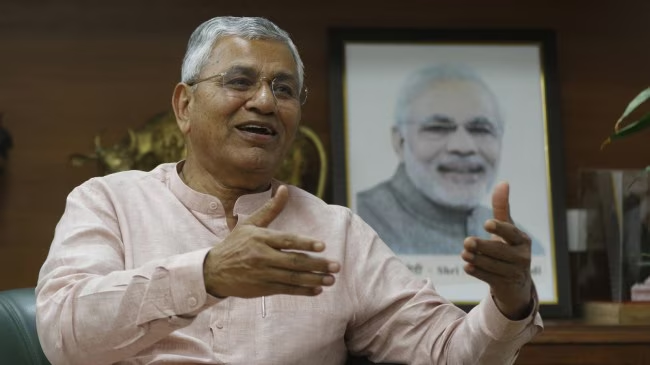 The Joint Committee of Parliament on the Constitution (One Hundred and Twenty-Ninth Amendment) Bill, 2024 and the Union Territories Laws (Amendment), chaired by BJP MP P P Chaudhary, is set to meet on December 4. (Express photo by Anil Sharma)
3. If a law is found to “damage or destroy” the “basic features of the Constitution”, the Court declares it unconstitutional. The test is applied to constitutional amendments to ensure the amendment does not dilute the fundamentals of the Constitution itself. The test is widely regarded as a check on majoritarian impulses of the Parliament since it places substantive limits on the power to amend the Constitution.
4. On the occasion of the Constitution Day 2025, former Supreme Court judge Justice Abhay S Oka in an exclusive chat with The Indian Express, said that the basic structure is “one theory that makes democracy in India superior to that of many other democracies worldwide. This is one decision that makes it obligatory even for the Legislature to protect the basic structure of our Constitution.”
5. The Kesavananda ruling was a culmination of a series of tussles between the judiciary and the executive led by then Prime Minister Indira Gandhi. Many key legislatures were brought by the government along with the power that Parliament can amend any part of the constitution and it can’t be reviewed in the courts.
6. To examine the scope of amendment power of parliament and legality of land reforms, the court set up a 13-judge bench which ruled that while Parliament has vast powers to amend the Constitution, it cannot amend certain “basic features.” The Supreme Court cited several aspects of the Constitution that could be identified as “basic features” of the document but added that it was not an exhaustive list.
7. The ‘basic structure’ doctrine has since been interpreted to include the supremacy of the Constitution, the rule of law, Independence of the judiciary, doctrine of separation of powers, federalism, secularism, sovereign democratic republic, the parliamentary system of government, the principle of free and fair elections, welfare state, etc.
The Union government has set up the 23rd Law Commission for three years (September 1, 2024, to August 31, 2027) to identify laws that have become obsolete and can be repealed. Justice (Retd.) Dinesh Maheshwari is the Chairperson of the Commission.
The commission consists of a full-time chairperson, four full-time members, the Secretaries of the Legal Affairs and Legislative departments as ex-officio members, and up to five part-time members.
A constitutional amendment is a formal process to make changes in the provisions provided in the Indian Constitution. Part XX of the Constitution deals with its amendment. Under Article 368(2), Parliament can amend the Constitution by passing a Bill in “each House by a majority of the total membership of that House and by a majority of not less than two-thirds of the members of that House present and voting”. After that the Bill is presented to the President who shall give assent and with that the amendment to the constitution is enacted.
An amendment to the Constitution that seeks to make changes to certain specific provisions, including Articles 54, 55, 73, Lists in the Seventh Schedule, or the representation of States in Parliament, requires to be ratified by the Legislatures of not less than one-half of the States. Simply put, an amendment that changes the centre-state relations requires ratification from states. Any amendment to Article 368 itself, requires ratification by the states.
A Joint Parliamentary Committee (JPC) is set up by the Parliament for a special purpose, like the detailed scrutiny of a subject or Bill. As the name suggests, it has members from both the Houses and from the ruling parties and the opposition. It is dissolved after its term ends or its task has been completed.
1. Simultaneous elections, popularly referred to as “One Nation, One Election”, means holding elections to Lok Sabha, all state Legislative Assemblies, and urban and rural local bodies (municipalities and panchayats) at the same time.
2. A high-level committee headed by former President Ram Nath Kovind recommended holding simultaneous elections. The committee had recommended 15 amendments to the Constitution of India — in the form of both new provisions and changes to existing provisions — to be carried out through two Constitution Amendment Bills.
3. The concept of “Simultaneous Election” is not alien to India. India has a history of holding simultaneous elections. Our democratic journey began with the first general election, where both the Lok Sabha and state assembly elections were conducted at the same time.
4. Simultaneous elections were by and large in vogue until the fourth general elections of 1967. However, as successive central governments used constitutional provisions to dismiss state governments before the end of their term, and as coalition governments in the states and the Centre kept collapsing, the country came to see elections at different times through the year.
5. The committee on the Constitution (One Hundred and Twenty-Ninth Amendment) Bill, 2024 and the Union Territories Laws (Amendment), known as the One Nation One Election Bills, is set to meet on December 4.
Consider the following statements: (UPSC CSE 2020)
1. The Constitution of India defines its ‘basic structure’ in terms of federalism, secularism, fundamental rights and democracy.
2. The Constitution of India provides for ‘judicial review’ to safeguard the citizens’ liberties and to preserve the ideals on which the Constitution is based.
Which of the statements given above is/are correct?
(a) 1 only
(b) 2 only
(c) Both 1 and 2
(d) Neither 1 nor 2
| Answer key |
| (d) |
(Sources: V-P Jagdeep Dhankhar sparks debate with remarks on Basic Structure of Constitution; what is it?, Exclusive | Basic structure of Constitution not violated: Law panel firms up view on One Nation One Election Bills , Who was Kesvananda Bharati and how was he associated with the ‘Basic Structure’ doctrine?)
Subscribe to our UPSC newsletter. Stay updated with the latest UPSC articles by joining our Telegram channel – IndianExpress UPSC Hub, and follow us on Instagram and X.
🚨 Click Here to read the UPSC Essentials magazine for November 2025. Share your views and suggestions in the comment box or at manas.srivastava@indianexpress.com🚨


Read UPSC Magazine