5 min read


© The Indian Express Pvt Ltd



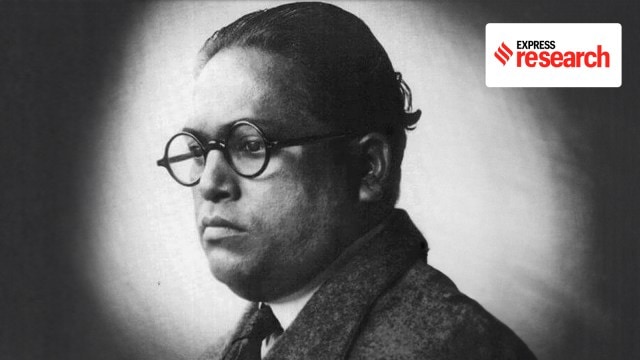 In his writings, Ambedkar recalls his stay at the inn, impersonating a Parsi, as a solitary and lonely experience. “I felt that I was in a dungeon, and I longed for the company of some human being to talk to. But there was no one,” he wrote.
There are far too many instances and ideas of note in the life of Dr B R Ambedkar, who left an indelible mark on the shaping of our independent nation – most prominent of which are his ideas on political representation for the oppressed classes, which first came to be 100 years ago, in 1919.
In India, Ambedkar grew up an ‘untouchable’ and his life was marked by harsh experiences of caste-based discrimination. While it was the totality of his experiences that led him to change the path of history forever, it was his short stint as an official in Baroda that would alter the course of his life and dedicate it to the cause of upliftment of oppressed castes.
In 1913, when Maharaja Sayajirao Gaekwad III ruled the princely state of Baroda, Ambedkar was awarded a scholarship to study at the Columbia University in New York. On June 4 of that year, he signed an agreement with the Baroda State, agreeing to devote his time to studying and to serve for 10 years the Baroda State after completion of his studies, writes Dhananjay Keer, Indian biographer, in his book ‘Dr. Ambedkar: Life and Mission’, in 1954.
The return to Baroda
Four years after the agreement, Babasaheb returned to Baroda and was appointed as a probationer in the Accountant General’s Office by the Maharaja in 1917. But his stay in the city would be very brief, as the maltreatment he faced on grounds of untouchability forced him to leave in a month’s time.
As a probationer in Baroda, he was looking for accommodation when he was suggested to stay at a Parsi inn. In his autobiographical account Waiting for A Visa, Ambedkar wrote: “Hearing that it was an inn maintained by the Parsis, my heart was gladdened. The Parsis are followers of the Zoroastrian religion. There was no fear of my being treated by them as an untouchable, because their religion does not recognise untouchability.”
However, he did not realise that the inn was only open to Parsi visitors. He was confronted with this reality while he was undressing to be at ease, and the caretaker, seeing him in his half-dressed state, noticed that he was not wearing Sadra and Kasti — two things which identify that one is a Parsi.
“Not knowing that this inn was maintained by the Parsi community for the use of Parsis only, I told him that I was a Hindu. He was shocked, and told me that I could not stay in the inn… The question returned again, where to go?” Ambedkar wrote.
Luckily, his problem was solved after he put down a Parsi name in the inn register, and was allowed to continue his stay. But even this would be short-lived.
In his writings, Ambedkar recalls his stay at the inn, impersonating a Parsi, as a solitary and lonely experience. “I felt that I was in a dungeon, and I longed for the company of some human being to talk to. But there was no one,” he wrote.
On the eleventh day of his stay, he was about to leave his room for the library, when he heard the footsteps of a considerable number of people.
“I thought they were tourists who had come to stay… Instantly I saw a dozen angry-looking, tall, sturdy Parsis, each armed with a stick, coming towards my room. I realised that they were not fellow tourists… They lined up in front of my room and fired a volley of questions. “Who are you? Why did you come here? How dare you take a Parsi name? You scoundrel! You have polluted the Parsi inn!”, recalled Ambedkar in his account.
After this encounter, Ambedkar vacated the inn, and upon exhausting all hopes of finding another accommodation at this notice, decided to catch the 9pm train to Bombay. He had five hours to spare till the train departed, and he spent those sitting on a bench in a public garden – Kamathi Baug.
Ambedkar’s return to Baroda, and his forced departure from a place he was committed to and declined several offers for, was a striking time in his life – a life he would eventually dedicate to the cause of upliftment of social classes.
“This scene of a dozen Parsis armed with sticks lined before me in a menacing mood, and myself standing before them with a terrified look imploring for mercy, is a scene which so long a period as eighteen years has not succeeded in fading away. I can even now vividly recall it… It was then for the first time that I learnt that a person who is an untouchable to a Hindu is also an untouchable to a Parsi,” he wrote.