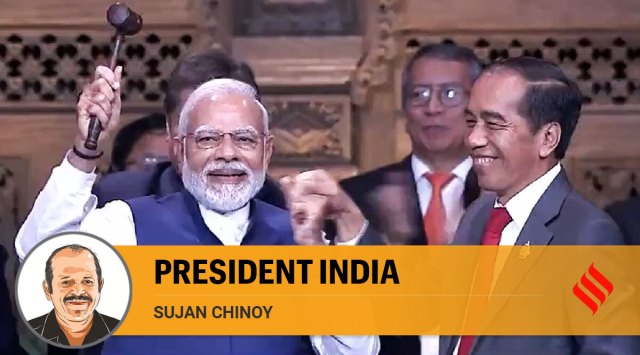
The G20 Leaders Summit in Bali is the grand finale of Indonesia’s year-long presidency. The baton passes on to India on December 1, 2022. Ever since the G20 was recast as an annual apex-level summit in the aftermath of the 2008 global financial crisis, developing countries chaired it only on four occasions — Mexico in 2012, China in 2016, Argentina in 2018 and now, Indonesia in 2022. India’s presidency marks the fifth such occasion. In a historic first for developing countries, the G20 troika after December 1 will comprise the past, the incoming and the next G20 presidencies, i.e., Indonesia, India and Brazil.
This is not only a moment for the Global South to try and set the tone for the theme of the Bali conference — “Recover Together, Recover Stronger” — but also a moment for regional groupings like Southeast Asia, South Asia and others to seek greater economic convergence on sustainable development goals.


Modi’s cautionary words touch upon the hard realities of today and the existence of several fault-lines. The world is deeply divided over the situation in Ukraine, leaving developing countries to suffer the consequences of food, energy and fertiliser shortages. The primary concerns of the developing world relate to quotidian issues, not to the geopolitics of war.
The G20 presidency could provide an opportunity to India to assume the mantle of a peace-maker on behalf of the Global South. Today, the UN lacks credibility. Major powers like the US and the Europeans have taken sides in the proxy war in Ukraine. China remains a vicarious supporter of Russia. That leaves only India, which has taken a consistent and objective view of the developments while maintaining good relations with the belligerents and their supporters. India has the credibility to work behind the scenes for an end to the war in Ukraine.
Modi’s address provides a glimpse into the issues that are likely to receive primacy during its presidency. The world is grappling with the challenge of food security. As early as in 2018, India had proposed the observing of 2023 as the International Year of Millets. This was approved by the FAO and subsequently, endorsed by the UNGA at its 75th session in March 2021. India is one of the world’s largest producers of millets, with production increasing from 14.52 million tonnes in 2015-16 to 17.96 million tonnes in 2020-21. During its presidency, India should form an alliance of major millets producers for sharing of technologies and best practices in agriculture. India’s experience in creating three centres of excellence for millets production can be replicated in other suitable parts of the world supported by appropriate global financing mechanisms.
Such an initiative by India would dovetail with the G20 Matera Declaration of 2021, which raised the related issues of poverty alleviation, food security and sustainable food systems. Prolonged scarcity of food grains, aggravated by frequent droughts and floods around the world, could also result in shortage of livestock feed in the West and impact food supplies.
The programme at the ongoing G20 summit includes a visit to the Taman Hutan Raya mangrove forests. This is hugely symbolic, given the vital role that mangroves play in preserving coastal bio-diversity, preventing coastal erosion, and, acting as “carbon sinks”. India has agreed to join the Global Mangrove Alliance and should use its presidency to give it greater thrust.
Another important theme that Modi referred to was the need to avoid supply-side disruptions in energy markets. Even though India is committed to generating one half of its electricity needs from renewables by 2030, coal will remain an important element in the energy matrix, not just for India but for many others also. India’s position on a phase-down approach in the use of coal as against an abrupt phase-out plan flows from the burgeoning energy needs of a rapidly growing economy.
Germany is reactivating some coal-fired power plants. Just 10 months ago, it appeared that the German climate enthusiasts were wedded to the idea of completely phasing out coal by 2030 and had chastised the global community for procrastination. Now, in the wake of energy shortages created by the war in Ukraine and the approaching winter, Berlin is justifying the short-term use of coal to meet the needs of its people. This is understandable.
Similarly, the global community must realise that India’s continued use of coal and sourcing of the most fungible and affordable supplies of energy, including from Russia, are actions linked to the developmental needs of 1.35 billion Indian people.
Coal is not the only polluting fossil fuel. Crude oil and natural gas are also polluting, perhaps less so. During India’s presidency, every effort should be made to garner support for the Bridgetown Initiative, which calls for an egalitarian, accessible and affordable plan for green and development financing to enable developing countries to meet their climate change and Sustainable Development Goals (SDG) targets.
Even though the developed nations are inching forward to meet their commitment to provide $100 billion annually to the developing world for climate finance, this is a mere drop in the ocean. Energy transition only by those who can afford it is inadequate action. The challenge of climate change in a time-bound manner can be met only if the world acts in unison. As Modi said, the achievement of inclusive energy transition requires affordable sources of finance and technological assistance.
It is time that the developed world moved from merely demanding energy transition in a time-bound manner to taking concrete steps to extend the necessary financial and technical support to developing nations in achieving a common goal.
The author is the Think-20 Chair for India’s G20 presidency and Director General, Manohar Parrikar Institute for Defence Studies and Analyses. Views expressed are personal


