
Opinion The hunt for Amritpal Singh in Punjab: A contest of perceptions
Amritpal has overplayed his hand, State is now dominating the narrative. How it handles the potential polarisation of politics remains to be seen
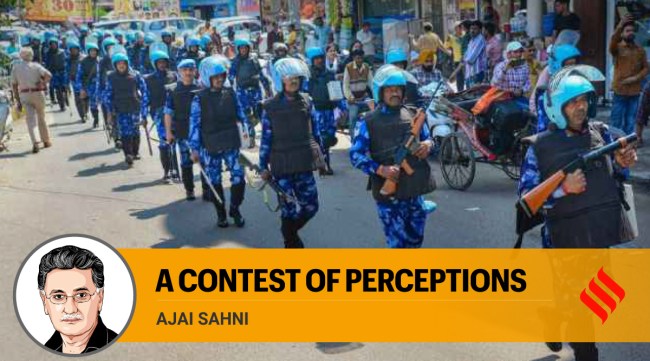 Rapid Action Force personnel flag march amid crackdown against Waris Punjab De chief Amritpal Singh and his aides in Jalandhar. (PTI)



With the advantage of hindsight, it is easy to say that Amritpal Singh should have been arrested at the earliest possible stage after his return to India in August 2022. His transgressions commenced almost immediately thereafter, even as his support base appeared to grow. Worse, both in political and administrative statements and in media projections, a larger-than-life image was being built up, far out of proportion with his actual significance. And while the state and its agencies must certainly be called to account for their failures, much of the irresponsible myth-making was the doing of the uncritical and sensation-seeking media. “Bhindranwale 2.0”, the purported return to the 1980s, the incessant coverage of his obviously attention-seeking antics, and a series of fawning interviews — these and other exaggerations and distortions in reportage enormously inflated Amritpal Singh’s actions, providing him with the very platform he would otherwise have struggled to occupy.
These processes have not ended. Hysterical and sweeping reports, tying Amritpal Singh with gun-running, narcotics smuggling, drone intrusions from Pakistan and almost every ill in Punjab continue, even as the manhunt to put him where he belongs — in jail — is ongoing. That there is, yet, little evidence to tie Amritpal Singh with these many trends and offences, all of which have a history that long precedes his arrival on the stage, appears to elude the notice of the many anchors and commentators on the subject, and consequently, the impression that this narrative is being orchestrated can hardly be avoided. These matters, moreover, are for the enforcement and intelligence agencies to deal with and should not be the subject of ignorant and frenetic media speculation.

While there are many, and clear failures on the part of both the state and central government agencies, it is important to recognise, first, that ideal solutions exist only in an ideal world. Second, and crucially, this entire issue is, above all, a contest of perceptions, not of power. Managing perceptions in a calibrated political campaign is a very different challenge.
It is important to recognise that, by intent or omission, the state has now established the upper hand in the narrative around Amritpal Singh. Before his return and usurpation of the Waris Punjab De banner – another element that the commentary largely ignores is that Deep Sidhu’s Waris Punjab De still exists and is headed by his long-time associate Sanjeev Uppal — Amritpal was an unknown entity. The very rapid rise of his profile in Punjab and the quick support that he received from conservative elements in the Sikh community, including the implicit support of the Shiromani Gurdwara Parbandhak Committee and the Shiromani Akali Dal (SAD), as well as the open support of the radical SAD-Amritsar headed by Simranjit Singh Mann, made it difficult to predict the possible consequences of any action against him. Nevertheless, delay only allowed the myth around him to grow, making state action potentially even more costly.
Nevertheless, over the past months, Amritpal has clearly overplayed his hand. Each of his prominent actions will have alienated much of the population base that he seeks to mobilise. In particular, the fracas at Gurdwara Singh Sabha in Jalandhar on December 13, 2022, and the burning of chairs and benches meant for elderly devotees, may have secured some publicity, but would certainly have alienated the devout Sikh. That this is the case is substantially borne out by the commentary on the subject in print, TV and social media. Thereafter, there was much adverse commentary on the issue of the abduction and assault on Varinder Singh, which led to the arrest of Amritpal’s associate, Lovepreet Singh aka Toofan, and subsequently to the Ajnala fiasco. Amritpal’s effort to project his personal animus against Varinder as a Sikh issue attracted significant criticism. Further, the siege on the Ajnala Police Station, and Amritpal’s visible efforts to shield himself behind the motorised Palki on which the Guru Granth Sahib was being carried, even while his associates broke through the police barricades, have not gone unnoticed by the larger Sikh community. This was, at once, an act of beadbi (sacrilege) and cowardice. And finally, after all his brave declarations challenging the police to arrest him, his abandonment of his supporters and flight in the face of actual arrest — as well as multiple social media clips demonstrating panic and desperation, both on his part and on part of his supporters — is likely to take a great deal of the sheen off his image.
The absence of any significant protests and demonstrations in the wake of the eventual action against Amritpal tends to bear out his loss of credibility, though this has occurred under a massive police and internet clampdown. The coming days will confirm or negate these arguments. What will be crucial, however, particularly for the state and the media to remember, is that what is currently playing out in Punjab is, overwhelmingly, a contest of perceptions, and it is far from over.
While the state and its agencies appear to dominate the present narrative, it remains to be seen how they will handle evolving themes. Amritpal is likely to be arrested in the near future or may reappear abroad. In the latter case, he will merely join the minor ensemble of frustrated extremists in the Sikh diaspora, to rant ineffectually against India. If, on the other hand, he is arrested, the state and the political leadership will again be tested; and not just the Aam Aadmi Party, but also the various political groupings it has marginalised in the recent assembly elections. The Shiromani Akali Dal has already sought to communalise the police action, condemning the supposed “undeclared emergency and reign of repression and terror”, and the targeting, especially, of “innocent Amritdhari youth”. While the Congress and the BJP currently support the police action, it is uncertain when the default setting of polarising politics will be restored. These, and not so much the Khalistanis, are the critical threats to peace and security in Punjab.
The writer is Executive Director, Institute for Conflict Management & South Asia Terrorism Portal
 Share
Share


