


Tags:


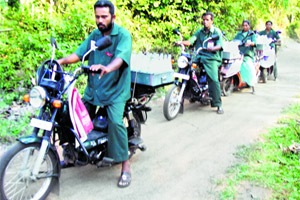
Nearly 400 households in Palakkad municipal area in Kerala enjoy a special relationship with their morning cup of tea. A code printed on the milk bottles delivered to their doorstep identifies not just the farmer but even the cow providing their daily supply of milk.
In a departure from the modus operandi of mammoth milk co-operatives which source milk from rural areas and supply in far-flung cities after processing,Kannadi village panchayat in Palakkad district has embarked on a white revolution of its own. The Kannadi nature fresh milk KNFM initiative is a refined,larger version of the next-door milk vendor.


Veterinary surgeon G S Madhu,who conceived the project,says the scheme for fresh milk supply is most suitable for urban regions surrounded by rural neighbourhoods,where milch cattle are reared. In the existing dairy co-operative system,milk collected from villages is rushed to distant plants for processing. The milk would then be brought back to the markets,in some cases to cities very close to the very villages where the milk was first procured. The conception of a smaller model where the milk is directly provided to adjoining urban areas not only cuts the unnecessary intervention of large scale cooperatives but also provides milk directly off the farm without undergoing pasteurisation to extend its shelflife.
On the other hand,as per the KNFM model,fresh milk collected from rural areas is marketed in nearby towns. The expenses on pasteurisation and transportation of milk to faraway plants could be avoided thus. The money saved on these front could be given back to the farmers, says Madhu.
The KNFM is priced 4 rupees above the price of the milk from other producers,including the MILMA,the largest co-operative venture in the states dairy sector. As the milk is fresh,consumers are ready to pay premium price.
P Dinesh,veterinary surgeon at Kannadi,said the KNFM ensures that a family consumes the milk of a single,healthy animal as there is no pooling of the liquid as is done by larger ventures. We know that we are consuming the milk collected from a disease-free animal. We are not rearing the animal,but somebody in the vicinity would be doing it for us. Consumers are free to visit the animals in the village, he said.
While milk co-operatives intervention in the dairy sector is generally limited to procurement,processing and distribution,the Kannadi initiative helps the farmers source healthy animals,erect scientific and clean cattle sheds and pursue clean milking practices.
Of the 55 members,50 are engaged in production,while five others take up marketing. A farmer would be given two animals,which can be reared in their courtyard. Of the total project cost of Rs 35.5 lakh,the district panchayat had allotted Rs 16 lakh from the Backward Region Growth Fund while the rest of the investment has been arranged as bank loan.
Cattle sheds have been constructed in an area of 130 square feet. It has been designed in such a manner that the udder of a cow does not get smeared with dung. To ensure round-the-clock water for the animals,a cost-effective supply line has been fixed.
The next important step is the procurement of the animals for the scheme. Cows are subjected to a thorough quality check before the farmers buy them. An expert committee ensures that the milk of every cow bought for the project would have 3.5 per cent fat,8.5 per cent SNF Solid Not Fat and a minimum lactometer reading of 28.
The steel utensils used for milking have a narrow mouth to ensure that no fly or insect falls into the pot. Scientific milking is another feature. After cleaning the cattle shed,the udder of the animal would be washed with potassium permanganate liquid. The first batch of milk,collected in a paddle,is tested for mastitis using the California Mastitis Test reagent.
The collected milk is poured into 650-ml bottles and food grade corks and a paper seal are fixed on it. The cork would have the codes of the cow and the dairy farmer printed on it to help the customer identify the source of his daily milk. After milking in early hours,the milk would reach consumers before 7 am. A dairy farmer rearing two animals would earn a monthly income of Rs 8,000 and the marketing persons Rs 6,000 for their morning hours work.
The Kannadi experiment has provided inspiration to other local bodies . Another village panchayat in Thrissur had launched a similar venture last month. Besides,nearly 200 panchayats have evinced interest in the scheme, said panchayat president S Radhakrishnan.


