Journalism of Courage
 3 min read


Prime Minister Manmohan Singh addressed the concerns swirling around his telecom ministrys actions over the licensing of mobile phone operators on Sunday. He said that,if anyone was guilty of doing anything wrong,then action would be taken. This is not very far from what he has said in the past,in particular when he was asked a direct question about 2G at his last press conference,to mark the first year of UPA-II in May. While there is little doubt that the CBI must be allowed to finish investigating,and that A. Raja should be formally charged if the agency uncovers enough direct evidence of wrongdoing,that is simply not enough.
Crises contain opportunities,as the Manmohan Singh of 1991 saw very well; and this is a crisis for his government,as well as an urgent opportunity to initiate a lasting,reformist series of actions. The political and public pressure has built up on the prime minister and his party,and it has depleted them of some political capital. But this kind of pressure also helps ensure that any action taken to curb rent-seeking behaviour of the sort on display during the 2G auctions will receive wide support or will,at least,be difficult for anyone to oppose. The specific policy steps should be hammered out soon; but the broad directions are clear. The discretion available to some ministers and bureaucrats to subvert processes needs to be limited. The point needs to be stressed that this is not simply about individuals,about an A. Raja or a T.R. Baalu. It is about a way of thinking that accepts that some ministries are a ready source of cash and patronage,that they can be handed out as rewards or inducements to those you want to win over.
This initiative can be Dr Singhs alone. He can turn this fraught moment to his advantage,by announcing that UPA-II will focus on the reform of infrastructure governance,and of the interface between the state and the private sector. The political dividends will be enormous,and so will the economic benefits. The prime minister has already spoken of upgrading infrastructure as among his governments biggest challenges. Focusing on regulation and reform in these sectors will solve two problems and complete the task he began in 1991.

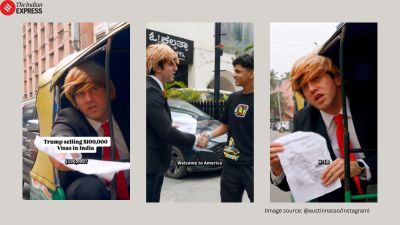
A satirical video by a US-based comedian has been making the rounds online after it showed a spoof version of US President Donald Trump apparently “selling H1-B visas” on the streets of India for a hefty price. The clip, posted by Instagram creator Austin Nasso—who has close to a million followers—features him fully leaning into a Trump impersonation.