As the number of Covid-19 deaths in Tamil Nadu jumped from 160 on May 30 to 1,025 as on June 27, and the figure of confirmed cases from 21,184 on May 30 to 78,335, senior bureaucrats working on containing the pandemic and scientists and doctors monitoring the pattern of outbreak say the state did a few things wrong at a crucial stage, which led to the present crisis.
Many of these experts also said that the current situation is unlikely to overwhelm the state’s health system in coming weeks if the ongoing efforts to contain the outbreak in Chennai — with an intense lockdown — succeed.

Chennai has 68 per cent of the state’s total case load.
A senior bureaucrat monitoring the situation said the state would have been in a better position had it escalated testing in May, especially in Chennai. “For a combination of reasons — political, wrong calculations, and lack of coordination between the Health Ministry and the Municipal Administration Ministry (which controls Chennai city corporation) — we delayed; waited until the second week of June to increase the testing rate,” this officer said
Covid lockdown| List of states that have extended restrictions beyond June 30
While 2,526 cases and 28 deaths as on May 1 went up to 13,191 cases and 87 deaths by May 30, daily testing saw only a minimal increase: from 9,615 samples tested each day on May 1 to 12,000 by month-end. It took another 10 days for the daily testing to touch to touch 17,000. There has since been a steady increase in testing — 33,000 samples, for instance, were tested on June 20.
When the state finally decided to increase testing, there was an expected increase in the number of cases as well, but the question was how did the death figure also rise: from 160 Covid deaths as on May 30, to 326 on June 10, and 704 on June 20.
Story continues below this ad
Multiple sources in the Public Health Department said data was being “managed” — or fudged — since the beginning, as it was “a matter of pride for the political leadership”. The reason for the steady increase in death count after June 10 was due to a “reconciliation process,” in which the state authorities started adding “missing deaths” to daily bulletins, a senior doctor attached to the Health Department said.
This was following a controversy that nearly 200 deaths reported to Chennai corporation’s health department were not reported to the state Health Department since late April.
And, like in many other states, a complex bureaucratic system compounded matters.
According to a senior ICMR scientist who has seen the fightback in Chennai, Mumbai, Ahmedabad and Delhi, there were two common challenges everywhere: “A huge population living in slums, and lack of administrative control of the state Health Departments on the city health department, which comes under these municipal corporations.”
Story continues below this ad
The Covid testing wrap| What are the tests and testing procedures being carried out in India, some key states?
The civic body’s health department is detached from state health system in all these cities, including Chennai, which played a big role in delaying the increased testing strategy in Chennai, the ICMR scientist said.
State Health Secretary J Radhakrishnan said the rise in deaths was proportionate to confirmed cases. “Every patient who comes to hospital is getting tested now; several deaths, including that of cancer patients and other critical illnesses, get added into the Covid count irrespective of complex medical reasons. If you look at figures from April to May and June, you can see Covid cases have gone up and the increase in deaths were proportionate to cases. Compared to other cities with a huge population and cases, our death rate is still not alarming— at 1.2 now,” he said.
Dr Prabhdeep Kaur, deputy director of ICMR-National Institute of Epidemiology, Chennai, said the biggest lesson here is the necessity for good public health systems in cities. “However, I believe Chennai should not face a situation where our health systems are getting overwhelmed by cases, like elsewhere,” she said. “The ongoing strategy of aggressive testing in Chennai and other hotspots should be giving results in two weeks.”
Story continues below this ad
Dr Jayaprakash Muliyil, former principal of Christian Medical College, Vellore, said cities with large population and a high number of slums are bound to witness the outbreak. “The question is whether you are capable of handling cases with enough doctors and hospital beds and other health infrastructure,” he said.


 5 min read


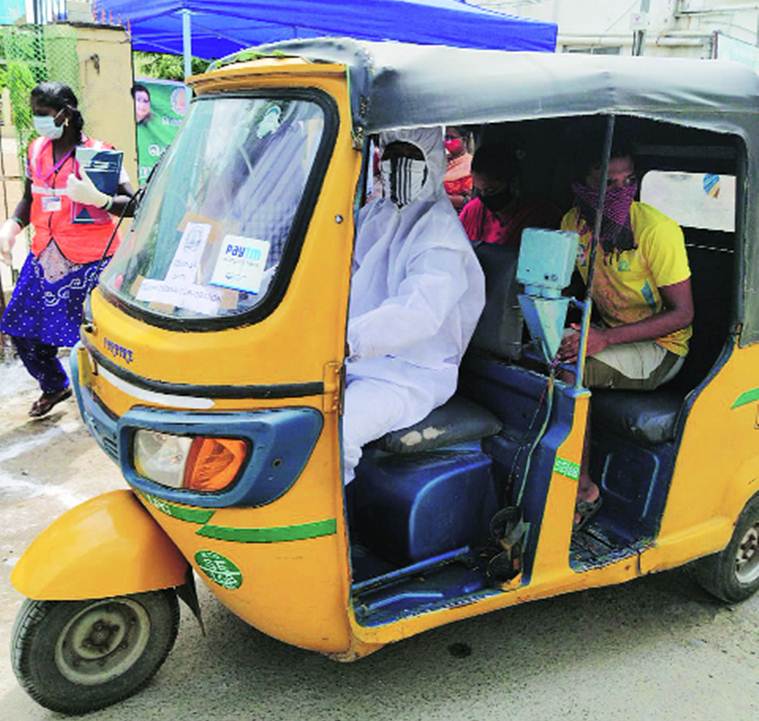 Chennai city corporation arranged auto-rickshaw services to take symptomatic people from crowded neighbourhoods to nearby medical camps and testing labs during the intense lockdown. Express