Premium
This is an archive article published on September 5, 2020

Explained: Why is an Amazon tribe talking to Indians about Blood Gold?

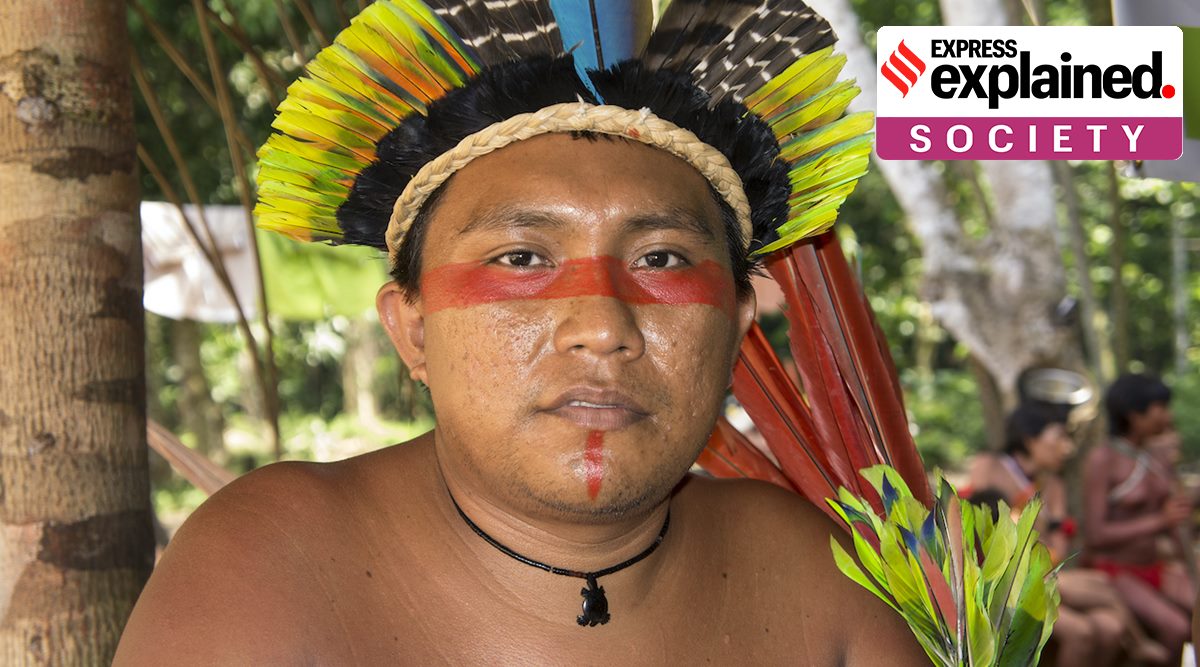
The Yanomami people, who live in a settlement deep inside the rainforest, have been threatened for several decades by illegal gold miners who invade their land and bring diseases.

Blood Gold, What is Blood Gold, Yanomami people, Yanomami appeal to India on Blood Gold, Yanomami Blood Gold, Indian ExpressDario Kopenawa Yanomami, one of the leaders of the Yanomami people, and a major international spokesperson for them. (Credit: Fiona Watson/Survival)

From the remote rainforests of Brazil, a little-known tribe has made an emotional appeal to Indians: “The gold which has come from our Yanomami territory is Blood Gold, gold at the cost of indigenous blood. I’d like to send a message to the people of India, to the Indian government and the companies which import it: You must stop buying Blood Gold. Buying Blood Gold is not good. It’s important that the government thinks again, that the Indian people think again and do not buy Yanomami Blood Gold.”

The appeal, by Dario Kopenawa of Brazil’s indigenous Yanomami people, was posted in a video online with English subtitles by Survival International, an international human rights advocacy based in London, which campaigns for the rights of indigenous and tribal peoples around the world.

The Yanomami people

The Yanomami live in the rainforests and mountains of northern Brazil and southern Venezuela, and are, according to Survival International, the largest relatively isolated tribe in South America.

The Yanomami are believed to have crossed the Bering Strait from Asia into North America perhaps 15,000 years ago, and travelled southward to their home in the Amazon. Survival International says the tribe numbers around 38,000 today, and its members live in contiguous forested territory of around 9.6 million hectares in Brazil and 8.2 million hectares in Venezuela.

The Yanomami practise an ancient communal way of life. They live in large, circular houses called yanos or shabonos, some of which can hold up to 400 people.

Rituals, feasts and games are held in the main, central area. Each family has its own hearth where food is prepared and cooked during the day. At night, hammocks are slung near the fire which is stoked all night to keep people warm.

Story continues below this ad

It is a Yanomami custom that a hunter does not eat the meat he has killed. “He shares it out among friends and family. In return, he will be given meat by another hunter,” says the website of Survival International.

The Yanomami consider all people to be equal, and do not have a chief. Instead, all decisions are based on consensus after long discussions and debates.

📣 Express Explained is now on Telegram. Click here to join our channel (@ieexplained) and stay updated with the latest

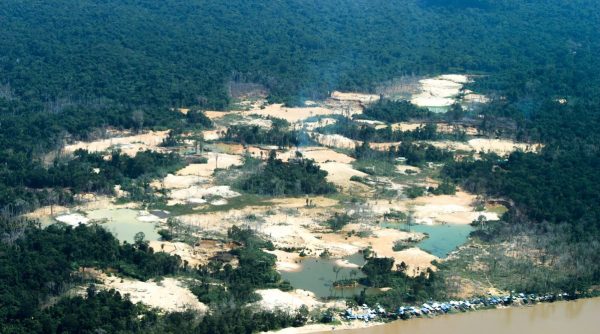
Blood Gold, What is Blood Gold, Yanomami people, Yanomami appeal to India on Blood Gold, Yanomami Blood Gold, Indian Express One of the many illegal gold mining sites in the Yanomami territory. (Credit: FUNAI)

Gold rush in Yanomami country

Story continues below this ad

Since the 1980s, the Yanomami have been facing an onslaught from illegal gold miners. According to Survival International, Yanomami land was invaded by up to 40,000 miners who killed the indigenous people, destroyed their villages, and brought them deadly diseases. A fifth of the Yanomami population perished in just seven years.

Following a sustained campaign led by Survival International, the Brazilian government notified a ‘Yanomami Park’ in 1992, and the miners were expelled. However, they kept returning, and in 1993, they murdered 16 Yanomami including a baby in Haximú village. A Brazilian court subsequently found five miners guilty of the massacre. However, the illegal entry of gold miners in Yanomami country continued.

Fiona Watson, Research and Advocacy Director at Survival International, told The Indian Express, “The situation is getting more desperate as the number of illegal gold miners has increased dramatically in the last few years and the authorities have done little to tackle the problem. The Yanomami are facing a social and environmental catastrophe in terms of their health and the forest and rivers they rely on.

“Two scientific studies by Fiocruz (one of Brazil’s leading research institutes) have shown that some Yanomami communities near the illegal mining zones are facing dangerously high levels of mercury contamination (significantly over the WHO safety limit).”

Story continues below this ad

Also in Explained | How auction of Mahatma Gandhi’s personal effects have created controversy in recent years

Why the appeal to Indians?

Watson says gold mined illegally in Yanomami land has most likely been coming to India since at least 2018 – “but it could be earlier than this as it has been traded on the black market for years”.

In June 2019, BBC Brasil reported that the state of Roraima, in which many Yanomami live, had exported 194 kg of gold to India since September 2018, quoting figures from Comex Stat, the Brazilian Ministry of Economy portal on foreign trade. Roraima, the report said, has no legal gold mines, but is the state where most of the illegal gold is mined.

A report on the Yanomami published in The New Yorker magazine in November 2019 (‘Blood gold in the Brazilian rainforest’) said a third of the gold produced in Brazil is sold as jewellery in India and China, and that it was difficult for buyers to distinguish between legal and illegal gold. The BBC Brasil report said India was “the fourth largest importer of Brazilian gold in the world”.

Story continues below this ad

What now for Yanomami

The tribe has launched an initiative called MinersOutCovidOut to enlist the support of Brazilian society and the international community to lobby the Brazilian government to take urgent action to remove the miners and to prevent the spread of the coronavirus.

“One of the transmission routes of the virus in the territory is through the miners who enter and leave the Yanomami territory with impunity. The NGO ISA wrote a report warning that Covid-19 is likely to be transmitted by the miners and in the worst case scenario 40 per cent of Yanomami living in the mining zones could be infected and hundreds could die from the virus,” Watson said.

Dipanita Nath is a Senior Assistant Editor at The Indian Express, based in Pune. She is a versatile journalist with a deep interest in the intersection of culture, sustainability, and urban life. Professional Background Experience: Before joining The Indian Express, she worked with other major news organizations including Hindustan Times, The Times of India, and Mint. Core Specializations: She is widely recognized for her coverage of the climate crisis, theatre and performing arts, heritage conservation, and the startup ecosystem (often through her "Pune Inc" series). Storytelling Focus: Her work often unearths "hidden stories" of Pune—focusing on historical institutes, local traditions, and the personal journeys of social innovators. Recent Notable Articles (December 2025) Her recent reporting highlights Pune’s cultural pulse and the environmental challenges facing the city during the winter season: 1. Climate & Environment "Pune shivers on coldest morning of the season; minimum temperature plunges to 6.9°C" (Dec 20, 2025): Reporting on the record-breaking cold wave in Pune and the IMD's forecast for the week. "How a heritage tree-mapping event at Ganeshkhind Garden highlights rising interest in Pune’s green legacy" (Dec 20, 2025): Covering a citizen-led initiative where Gen Z and millennials gathered to document and protect ancient trees at a Biodiversity Heritage Site. "Right to breathe: Landmark NGT order directs PMC to frame norms for pollution from construction sites" (Dec 8, 2025): Reporting on a significant legal victory for residents fighting dust and air pollution in urban neighborhoods like Baner. 2. "Hidden Stories" & Heritage "Inside Pune library that’s nourished minds of entrepreneurs for 17 years" (Dec 21, 2025): A feature on the Venture Center Library, detailing how a collection of 3,500 specialized books helps tech startups navigate the product life cycle. "Before he died, Ram Sutar gave Pune a lasting gift" (Dec 18, 2025): A tribute to the legendary sculptor Ram Sutar (creator of the Statue of Unity), focusing on his local works like the Chhatrapati Shivaji statue at Pune airport. "The Pune institute where MA Jinnah was once chief guest" (Dec 6, 2025): An archival exploration of the College of Agriculture, established in 1907, and its historical role in India's freedom struggle. 3. Arts, Theatre & "Pune Inc" "Satyajit Ray, Ritwik Ghatak were not rivals but close friends, says veteran filmmaker" (Dec 17, 2025): A deep-dive interview ahead of the Pune International Film Festival (PIFF) exploring the camaraderie between legends of Indian cinema. "Meet the Pune entrepreneur helping women build and scale businesses" (Dec 16, 2025): Part of her "Pune Inc" series, profiling Nikita Vora’s efforts to empower female-led startups. "How women drone pilots in rural Maharashtra are cultivating a green habit" (Dec 12, 2025): Exploring how technology is being used by women in agriculture to reduce chemical use and labor. Signature Style Dipanita Nath is known for intellectual curiosity and a narrative-driven approach. Whether she is writing about a 110-year-old eatery or the intricacies of the climate crisis, she focuses on the human element and the historical context. Her columns are often a blend of reportage and cultural commentary, making them a staple for readers interested in the "soul" of Pune. X (Twitter): @dipanitanath ... Read More


Latest Comment
Post Comment
Read Comments
Advertisement
Advertisement
Advertisement
Advertisement