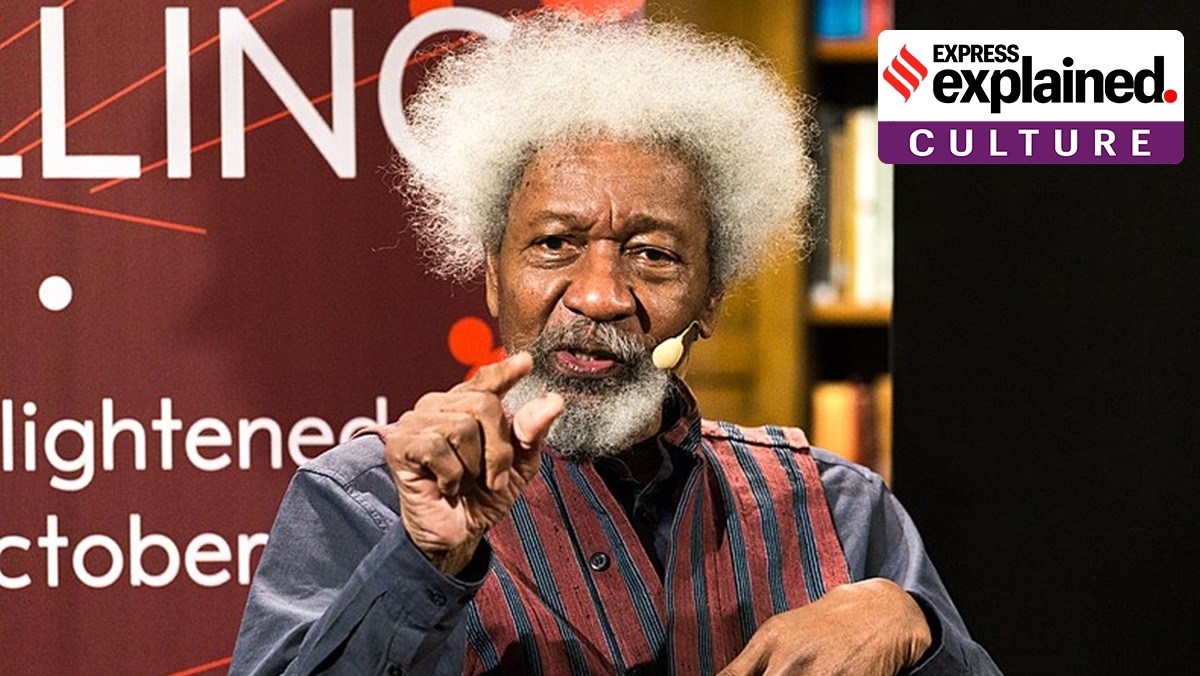
Born on July 13, 1934, in Nigeria’s Abeokuta, to a father who was a priest in the Anglican Church and a mother involved in the women’s liberation movement in the country, Wole Soyinka is the first person from Africa to have won the Nobel Prize for Literature, in 1986.
In its citation, the Nobel committee commended him for his “wide cultural perspective” and for his “poetic overtones” that helped him craft “the drama of existence”.

Besides his two novels, The Interpreters (1965) and Season of Anomy (1973), Soyinka, 86, is best known for his work as a dramatist, which draws richly from his Nigerian roots — particularly from the traditions of the Yoruba people, the ethnicity that he belongs to. He is also an acclaimed poet and essayist.
Road to literature
The second of seven children, Soyinka grew up in a religious household that was syncretic in its outlook. Soyinka’s father, Samuel, who was also the principal in a local school, laid a great deal of emphasis on education. After showing early talent, Soyinka was accepted at the prestigious Government College in Ibadan, one of contemporary Nigeria’s coveted schools. He later attended the University College of Ibadan.
During his time there, Soyinka and a group of friends launched the Pyrates Confraternity, an anti-corruption and justice-seeking student organisation, the first of its kind in the country. Soyinka’s keen interest in Nigeria’s turbulent politics would manifest itself in his work.
In 1954, Soyinka moved to the UK for higher studies at the University of Leeds, where he was mentored by the legendary Wilson Knight. He began his writing career there, publishing essays and articles in a satirical magazine called The Eagle.
Later, he worked as a dramaturgist at the Royal Court Theatre in London between 1958 and 1959. He wrote his first plays there — The Swamp Dwellers (1958) and The Lion and the Jewel (1959). His plays were produced and performed in both England and Nigeria.
Story continues below this ad
Upon his return to Nigeria, he taught drama and literature at various universities in the country, and later launched two theatre groups — The 1960 Masks in 1960, and The Orisun Theatre Company in 1964.
Literary work
At the heart of Soyinka’s prodigious literary output was Nigeria and the cross-currents of its cultural and social politics as it struggled to attain freedom from British rule and then tide over a bloody civil war (Biafran War, 1967-70).
His prolific body of work draws from both Yoruba and European culture as it apprehends the frailties of the human condition. Soyinka’s plays often include dance, music, and a retelling of Yoruba mythologies, through which he holds up a mirror to contemporary Nigerian life.
After the success of The Swamp Dwellers, Soyinka, who acknowledged the influence of Irish writer J M Synge in his work, would go on to have quick successes with his satires, The Trial of Brother Jero (1963) and its sequel, Jero’s Metamorphosis (1973).
Story continues below this ad
As Nigeria celebrated its independence from British rule on October 1, 1960, it was with a performance of Soyinka’s prescient A Dance of the Forest, in its capital city, Lagos. A critique of the corruption among the country’s political leaders, the play warned of the difficulty in always looking to the past for answers. Despite the criticism it was met with, the play remains one of Soyinka’s most well-known works. His later philosophical plays include The Strong Breed (1963), The Road (1965), and Death and the King’s Horseman (1975).
A large part of Soyinka’s body of work presents a vision of an Africa that is free from the burden of its colonial past, and has learned to reconcile its various racial and ethnic tensions. Soyinka has also produced several acclaimed works of poetry, including Telephone Conversation (1963), Poems from Prison (1969), Mandela’s Earth and Other Poems (1988), and Samarkand and Other Markets I Have Known (2002). 📣 Express Explained is now on Telegram
Soyinka’s politics
Soyinka’s interest in politics grew early, having watched his mother Grace’s activism in the local community. As early as his time in college, with the formation of the Pyrates Confraternity, he spoke up against corruption and tyranny.
This would be the beginning of a life-long commitment to upholding human rights and freedom both in Nigeria and across the world, speaking up against apartheid, racism, political despotism and corruption wherever necessary. His Nobel Prize acceptance speech was dedicated to the South African leader Nelson Mandela.
Story continues below this ad
Soyinka’s plays often posed uncomfortable questions for political leaders, and he carried forward his crusade for truth in his essays too, collected in volumes such as Myth, Literature and the African World (1975), among others.
Less than a decade after its independence, Nigeria slid into political instability and a prolonged civil war. In 1967, after he appealed for a ceasefire, Soyinka, who was already a celebrated writer, was imprisoned by the military from August 1967 to September 1969.
Denied paper in prison, Soyinka reportedly wrote on toilet paper and smuggled out poetry and critiques of the government. One of his most powerful works of the time was The Man Died: Prison Notes (1972), an autobiographical account of his time in prison. Upon his release, Soyinka left Nigeria, returning only in 1975 to serve as a university professor. His run-ins with successive governments ensured that Soyinka led a peripatetic life. He is currently based in Nigeria.
The new novel
According to The Guardian, Soyinka’s new novel will be set in present-day Nigeria, and will be published in the country by the end of the year by his Nigerian publisher Bookcraft. There are also plans for an international release early next year.


 6 min read