Premium
This is an archive article published on December 3, 2019

Explained: What is GDP and why does it matter?

GDP measures the monetary value of all goods and services produced within the domestic boundaries of a country within a timeframe (generally, a year). It is slightly different from the other commonly used statistic for national income — the GNP.

GDP, what is GDP, India GDP data, 2019 gdp data, nishikant dubey gdp remark, GNP, What is GNP, Indian Express explained GDP measures the monetary value of all goods and services produced within the domestic boundaries of a country.
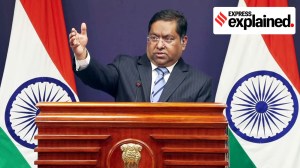
With the upsetting news of a secular decline in India’s Gross Domestic Product growth rate, the ruling party and the government have offered several arguments to either say the picture is not as bleak as it is being made out to be — Finance Minister Nirmala Sitharaman saying “it is not a recession yet” — to outrightly denying the existence of a slowdown — Union Minister Suresh Angadi saying “Airports are full, trains are full, people are getting married. Some people are doing this for nothing else but to malign the image of Narendra Modi”.

On December 2, Nishikanth Dubey, one of the members of Parliament belonging to the BJP, took the debate in a different direction altogether when he questioned the merit of the basic variable used to map economic growth — that is, the GDP.

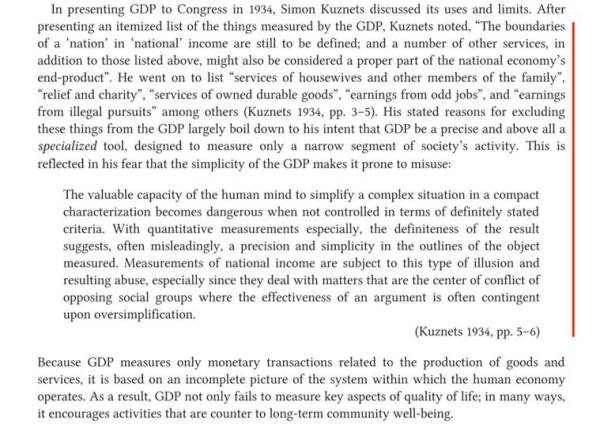
Dubey said “GDP came into this world in 1934. Before that, there was no GDP anywhere in the world”. As such it should not be treated as a gospel “like Bible or Ramayana”. Further, he quoted, albeit inaccurately, Nobel winning economist Simon Kuznets, who is also credited with being the person who first came up with GDP as it is being used in the current form (see attached picture).

GDP, what is GDP, India GDP data, 2019 gdp data, nishikant dubey gdp remark, GNP, What is GNP, Indian Express explained (Credit: Routledge Handbook of Sustainability Indicators; Google Books).

What is GDP?

GDP measures the monetary value of all goods and services produced within the domestic boundaries of a country within a timeframe (generally, a year). It is slightly different from the other commonly used statistic for national income — the GNP.

The Gross National Product (GNP) measures the monetary value of all goods and services by the people and companies of a country regardless of where this value was created.

For example, if Apple manufactures its mobile phone worth $1 million within India, then this $1 million will be counted in India’s GDP and US’ GNP. On the other hand, if the US office of Infosys created software worth $1 million, then it will be counted in US’ GDP and India’s GNP. It is the domestic boundary that distinguishes the GDP.

When were these notions of GDP and GNP created?

The modern-day definitions of GDP and GNP can indeed be traced back to Simon Kuznets, who was entrusted with the task of creating National Accounts in 1933 by then US President Franklin D Roosevelt. According to Financial Times journalist David Pilling (The Growth Delusion, Bloomsbury), “Kuznets’ team travelled the length and breadth of the USA asking farmers and factory managers what and how much they had produced and what they had purchased in order to make their final product”. The final report, National Income, 1929-32, was presented to the US Congress in January 1934.

Story continues below this ad

However, the origins of GDP as a concept date far back. Indeed, the man credited with inventing the concept is William Petty (1623-1687), an Englishman who was a professor of anatomy at Brasenose College. Petty’s quest started when he received an estate in Ireland. To figure out how much did it value, Petty attempted to account for the benefits from the estate and find an appropriate “present value” of the estate. Later on, he applied his approach to the whole of England and Wales to provide the first set of national accounts for the two countries. The idea here was to figure out a reasonable level of taxation on the landowners.

To be sure, since GDP forms the basis of all tax inquires, it would incorrect to assume that past kingdoms — even those dating back millenniums — did not track the performance of the broader economy. Kautilya Arthshastra speaks in detail about the principles governing the taxation of different sorts and all of these first require some sort of assessment of the level and type of produce.

Was Kuznets completely satisfied with GDP as a measure?

Dubey is correct in pointing out that Kuznets was not entirely happy with the final product. Pilling writes that “Kuznets was striving for a measure that would reflect welfare rather than what he considered a crude summation of all activities”.

But, again, one has to understand that no measure can accurately summarise the welfare or wellbeing of an entire population. All measures suffer from some weaknesses. For instance, annual GDP of India is $2.8 trillion but that does not mean that an average Indian is better off than say the average New Zealander. That’s because even though NZ’s total annual GDP is just $0.18 trillion — that is, India produces more goods and services (in value terms) in a month than NZ produces in a year — its GDP per capita is $38,000 while India’s is just over $2,000. In other words, an average Kiwi is 19-times richer than an average Indian even though India’s annual GDP is 15-times than of NZ’s.

Story continues below this ad

For a complete picture of any society or economy, one has to look at a variety of variables.

So, what is the point of GDP?

Yet, GDP is a variable of great merit. That’s because as a measure, it most sums up more information about an economy than any other variable. For instance, countries with higher GDPs have citizens with higher incomes and better standards of living. Of course, one can point out variations and suggest that a country ranked 1 in GDP is ranked 9 in GDP per capita but these divergences would be relatively small when data is seen at a global level.

Similarly, countries with higher GDP can be expected to have much better health and education metrics. The so-called richer countries would have better institutions devoted to higher education, research and development etc primarily because they have the money to spare.

As such, while it helps not to depend overly on just the GDP of a country to make up one’s mind, it is also not a good idea to disregard it as a measure.

Story continues below this ad

Don’t miss from Explained: Why, if growth is to revive, credit flows to industry must pick up fast

Udit Misra is Senior Associate Editor at The Indian Express. Misra has reported on the Indian economy and policy landscape for the past two decades. He holds a Master’s degree in Economics from the Delhi School of Economics and is a Chevening South Asia Journalism Fellow from the University of Westminster. Misra is known for explanatory journalism and is a trusted voice among readers not just for simplifying complex economic concepts but also making sense of economic news both in India and abroad. Professional Focus He writes three regular columns for the publication. ExplainSpeaking: A weekly explanatory column that answers the most important questions surrounding the economic and policy developments. GDP (Graphs, Data, Perspectives): Another weekly column that uses interesting charts and data to provide perspective on an issue dominating the news during the week. Book, Line & Thinker: A fortnightly column that for reviewing books, both new and old. Recent Notable Articles (Late 2025) His recent work focuses heavily on the weakening Indian Rupee, the global impact of U.S. economic policy under Donald Trump, and long-term domestic growth projections: Currency and Macroeconomics: "GDP: Anatomy of rupee weakness against the dollar" (Dec 19, 2025) — Investigating why the Rupee remains weak despite India's status as a fast-growing economy. "GDP: Amid the rupee's fall, how investors are shunning the Indian economy" (Dec 5, 2025). "Nobel Prize in Economic Sciences 2025: How the winners explained economic growth" (Oct 13, 2025). Global Geopolitics and Trade: "Has the US already lost to China? Trump's policies and the shifting global order" (Dec 8, 2025). "The Great Sanctions Hack: Why economic sanctions don't work the way we expect" (Nov 23, 2025) — Based on former RBI Governor Urjit Patel's new book. "ExplainSpeaking: How Trump's tariffs have run into an affordability crisis" (Nov 20, 2025). Domestic Policy and Data: "GDP: New labour codes and opportunity for India's weakest states" (Nov 28, 2025). "ExplainSpeaking | Piyush Goyal says India will be a $30 trillion economy in 25 years: Decoding the projections" (Oct 30, 2025) — A critical look at the feasibility of high-growth targets. "GDP: Examining latest GST collections, and where different states stand" (Nov 7, 2025). International Economic Comparisons: "GDP: What ails Germany, world's third-largest economy, and how it could grow" (Nov 14, 2025). "On the loss of Europe's competitive edge" (Oct 17, 2025). Signature Style Udit Misra is known his calm, data-driven, explanation-first economics journalism. He avoids ideological posturing, and writes with the aim of raising the standard of public discourse by providing readers with clarity and understanding of the ground realities. You can follow him on X (formerly Twitter) at @ieuditmisra           ... Read More


Latest Comment
Post Comment
Read Comments
Advertisement
Advertisement
Advertisement
Advertisement