Premium
This is an archive article published on November 30, 2018

Why Sharada Peeth is back in focus with the opening of Kartarpur corridor

A temple of huge importance for Kashmiri Pandits, but which stands across the LoC, and is out of bounds. But it is back in focus with the opening of Kartarpur Corridor.

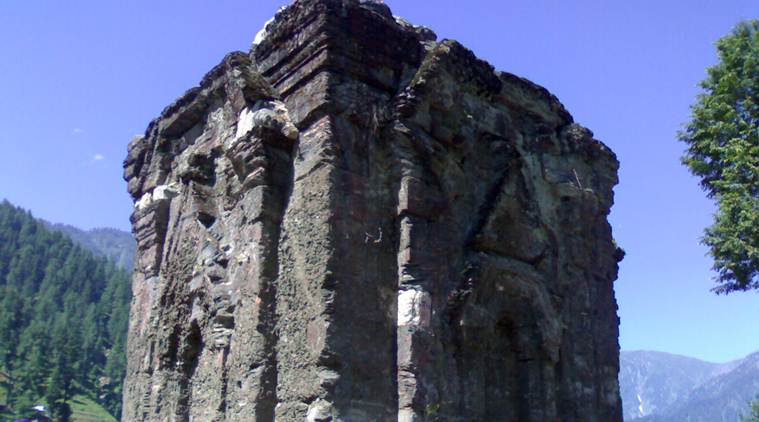
Why Sharada Peeth is back in focus with the opening of Kartarpur corridor A picture of the ruins of Sharada Peeth in PoK, taken by Prof Ayaz Rasool Nazki, who in 2007 became the first from the Indian side to visit.

In the run-up to the inauguration of the Kartarpur corridor, Kashmiri Pandit groups were demanding a similar arrangement for pilgrims to Sharada Peeth, an important temple across the Line of Control. In fact, mainstream political parties like People’s Democratic Party (PDP) too have been voicing this demand. Now, Pakistan Prime Minister Imran Khan has been quoted as saying that his government “can consider other proposals including opening up travel for the Sharada Peeth in Kashmir…”

The ancient temple of Sharada (also spelt Sharda or Sarada) and the adjacent ruins of Sharada University lie in Neelam Valley, 160 km from Muzaffarabad, and right across the Line of Control in a small village, Shardi or Sardi, where the river Neelam (Kishanganga) converges with the Madhumati and Sargun streams. The Save Sharada Committee, which has been spearheading the campaign to allow Kashmiri Pandit pilgrims access to the Sharada temple, says it has members on both sides, and has petitioned the central government, and also written to the Pakistan Prime Minister.

“And now as I hear, he (Imran) has talked about it, it has given us a lot of hope,’’ said Ravinder Pandita, who heads the Committee. “We have a cross-LoC permit in force since 2007… but this is only for J&K residents to meet their relatives. We want an amendment; we want religious pilgrimage added so that we can visit Sharada.”

Pandita described Sharada as “our kuldevi, the principal deity for Kashmiri Pandits”. He said that while there are three or four traditional routes, “we are only asking that we should be allowed to use the present permit system. We will go via Muzaffarabad.”

Besides the temple, there are also “ruins of one of India’s oldest universities there”, he said. “(At) a time when Hinduism was on the decline and Buddhism was on the ascendant… the revival of Hinduism started after Adi Shankaracharya’s visit to the university,’’ Pandita said.

Pandita claimed it was because of the efforts of his Committee that the Supreme Court in Muzaffarabad ordered the preservation of this heritage site in January this year.

“I have never been there. We aren’t allowed. But I am hopeful,’’ he said. “After the Kartarpur Corridor was opened, we hope we are also allowed to go for pilgrimage to our holiest site.”

Story continues below this ad

Although Sharada has been out of bounds for Kashmiri Pandits since Partition, the demand for allowing a pilgrimage gained momentum in 2007 after a visit by Prof Ayaz Rasool Nazki, a Kashmiri scholar and former regional director of the Jammu & Kashmir chapter of the Indian Council for Cultural Relations. He says he found the temple floor covered with soil. “I was the first person from the Indian side to visit Sharada. I took pictures and a video which I subsequently exhibited,’’ Nazki said. “Although Kashmiri Pandits had always been aspiring to visit this holy place of great importance, Sharada is important for every Kashmiri because of our common roots and ancestry. After my return, there was a revived interest in the demand for opening up of LoC for pilgrims to Sharada.”

Nazki said Sharada is the most revered religious place for Kashmiri Pandits. “The legend is that when there was a war between evil and good, goddess Sharada saved the pot of knowledge and carried it on her head to these mountains where she dug the earth and hid it. Then she turned herself into stone to cover this pot carrying knowledge. Thus there used to be only a rectangular stone covering the floor of the Sharada temple.”

Nazki had written earlier: “Sharda in Kashmir has been described as the Shakti embodying the three separate manifestations i.e. Sharda (the goddess of learning) Narda (the goddess of knowledge) and Vagdevi (the goddess of articulation). This is the beauty of Kashmir’s philosophy and its thought system… Sharda thus encompasses knowledge, learning and articulation and confers upon Kashmir and Kashmiris the distinct scholarship and wisdom associated with them.”

In the chapter ‘In search of roots’ in the anthology Cultural Heritage of Kashmiri Pandits edited by S S Toshkhani and K Warikoo, Nazki wrote: “During the reign of Kanishka I, Sharada was the largest academic institution in entire Central Asia. Side by side with imparting education in Buddhist religion, history, geography, structural science, logic and philosophy was taught. This University had evolved its own script, known as Sharada… At one point, there were five thousand resident scholars and it had the word’s biggest library also.” This, he said, “is the second aspect why Sharada is important”.

Story continues below this ad

Nazki said local villagers still referred to Sharada as a university. “The structure is a thousand years old.. There isn’t much visible, other than large bricks. The temple site hasn’t been encroached upon or vandalised in the last 70 years. The stone structure is intact. But it needs care.”

Muzamil Jaleel is a Deputy Editor at The Indian Express and is widely recognized as one of India’s most authoritative voices on Jammu & Kashmir, national security, and internal affairs. With a career spanning over 30 years, he has provided definitive on-the-ground reportage from the heart of the Kashmir conflict, bearing witness to historic political transitions and constitutional shifts. Expertise and Investigative Depth Muzamil’s work is characterized by a rare combination of ground-level immersion and high-level constitutional analysis. His expertise includes: Conflict & Geopolitics: Decades of reporting on the evolution of the Kashmir conflict, the Indo-Pak peace process, and the socio-political dynamics of the Himalayan region. Constitutional Law: Deep-dive analysis of Article 370 and Article 35A, providing clarity on the legal and demographic implications of their abrogation in 2019. Human Rights & Accountability: A relentless investigator of state and non-state actors, uncovering systemic abuses including fake encounters and the custodial death of political workers. International War Reporting: Beyond South Asia, he provided on-the-spot coverage of the final, decisive phase of the Sri Lankan Civil War in 2009. Landmark Exposés & Impact Muzamil’s reporting has repeatedly forced institutional accountability and shaped national discourse: The Kashmir Sex Scandal (2006): His investigative series exposed a high-profile exploitation nexus involving top politicians, bureaucrats, and police officers, leading to the sacking and arrest of several senior officials. Fake Encounters: His reports blew the lid off cases where innocent civilians were passed off as "foreign terrorists" by security forces for gallantry awards. SIMI Investigations: He conducted a massive deep-dive into the arrests of SIMI members, using public records to show how innocuous religious gatherings were often labeled as incriminating activities by investigative agencies. The Amarnath Land Row: Provided critical context to the 2008 agitation that polarized the region and altered its political trajectory. Over the years, Muzamil has also covered 2002 Gujarat riots, Bhuj earthquake, assembly elections in Bihar for Indian Express. He has also reported the peace process in Northern Ireland, war in Sri Lanka and national elections in Pakistan for the paper. Awards and Fellowships His "Journalism of Courage" has been honored with the industry's most prestigious accolades: Four Ramnath Goenka Awards: Recognized for J&K Reportage (2007), On-the-Spot Reporting (2009), and Reporting on Politics and Government (2012, 2017). Kurt Schork Award: From Columbia University for international journalism. Sanskriti Award: For excellence in Indian journalism and literature. IFJ Tolerance Prize: For his empathetic and nuanced reporting in South Asia. International Fellowships: Served as a visiting scholar at UC Berkeley and worked with The Guardian, The Observer, and The Times in London. He has also received Chevening fellowship and a fellowship at the Institute of Social Studies, Hague, Netherlands. Professional Presence Current Location: New Delhi (formerly Bureau Chief, Srinagar). Education: Master’s in Journalism from Kashmir University. Social Media: Follow him for field insights and rigorous analysis on X (Twitter) @MuzamilJALEEL. ... Read More


 

Latest Comment
Post Comment
Read Comments
Advertisement
Advertisement
Advertisement
Advertisement