This is an archive article published on December 3, 2021
Explained: Govt answers questions on Omicron
Covid-19 variant Omicron FAQ: Here's what the government has said on a third wave of coronavirus in India, whether vaccines will work, precautions to be taken, and diagnostic methods to detect the new strain.
New Delhi | Updated: December 3, 2021 09:20 PM IST
4 min read
Whatsapp
twitter
Facebook
Reddit
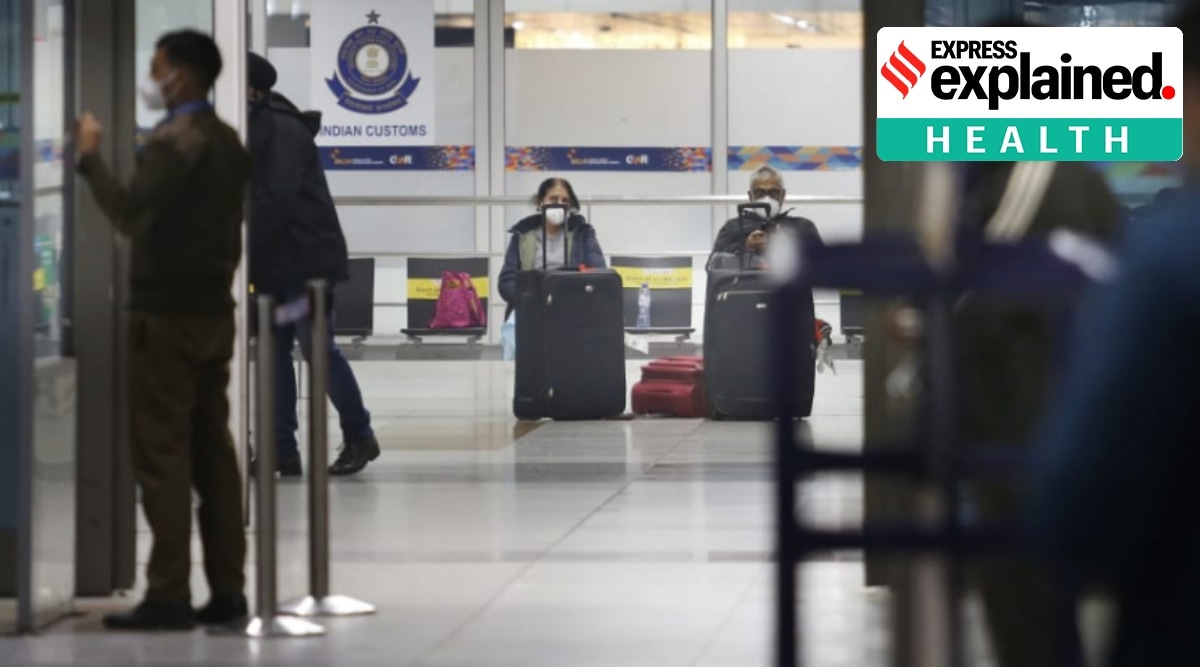
People wait for their relatives outside the international arrival at IGI Airport at T-3, in New Delhi. (Express Photo: Praveen Khanna)
The Union Health Ministry Friday issued answers to Frequently Asked Questions (FAQs) on Omicron – the new variant of Covid-19 – highlighting that given the fast pace of vaccination in India and high exposure to the Delta variant as evidenced by high seropositivity, the severity of the disease is “anticipated” to be low.
Is there a possibility of a third wave in India due to the emergence of Omicron?
The Health Ministry has said Omicron cases are increasingly being reported from countries outside of South Africa and given its characteristics, it is likely to spread to more countries including India. “However, the scale and magnitude of the rise in cases and most importantly the severity of disease that will be caused is still not clear,” the ministry.
It further said that given the fast pace of vaccination in India and high exposure to Delta variant as evidenced by high seropositivity – “the severity of the disease is anticipated to be low. However, scientific evidence is still evolving”.
Will the existing vaccines work against Omicron?
The health ministry has said that while there is no evidence to suggest that existing vaccines do not work on Omicron, “some of the mutations reported on Spike gene may decrease the efficacy of existing vaccines”. “However, vaccine protection is also by antibodies as well as by cellular immunity, which is expected to be relatively better preserved. Hence vaccines are expected to still offer protection against severe disease, and vaccination with the available vaccines is crucial. If eligible, but not vaccinated, one should get vaccinated,” it has said.
The health ministry has said that it is important to highlight that Omicron has been declared VoC based on the “observed mutations, their predicted features of increased transmission and immune evasion, and preliminary evidence of detrimental change in COVID-19 epidemiology, such as increased reinfections”. “The definitive evidence for increased transmission and immune evasion is awaited,” it has said.
What precautions have been recommended by the health ministry?
The health ministry has said that it is essential to mask yourself properly, take both doses of vaccines if not yet vaccinated, maintain social distancing and maintain good ventilation to the maximum possible.
Can the currently used diagnostics methods detect Omicron?
The health ministry has said that RT-PCR tests detect specific genes in the virus, such as Spike (S), Enveloped (E), and Nucleocapsid (N) to confirm the presence of the virus. “However, in the case of Omicron, as the S gene is heavily mutated, some of the primers may lead to results indicating the absence of the S gene (called as S gene drop out),” it has said.
Story continues below this ad
The health ministry has said this particular S gene drop out along with the detection of other viral genes “could be used as a diagnostic feature of Omicron”. “However, for final confirmation of the omicron variant genomic sequencing is required,” it has said.
As City Editor ( Delhi) at the Indian Express, Kaunain Sheriff leads city reporting with a sharp focus on accountability journalism, data-driven stories, and ground-level impact. As the National Health Editor he leads the newsroom’s in-depth coverage of pressing health issues.
He is the author of Johnson & Johnson Files: The Indian Secrets of a Global Giant, a definitive investigation into the accountability of one of the world’s most powerful pharmaceutical corporations.
Areas of Expertise
Investigative Reporting: Has deep expertise in investigative reporting spanning public health, regulatory affairs, drug safety, and the criminal justice system. His work sits at the intersection of governance, law, and accountability, with a particular focus on how regulatory failures, institutional lapses, and policy decisions affect citizens’ rights and safety.
Data Journalism: Has extensively on big data–driven investigations, including analyses of flagship government schemes and large datasets on criminal trials, uncovering systemic gaps.
Global Collaborations
Kaunain is a key contributor to major international journalistic projects:
The Implant Files: Collaborated with the International Consortium of Investigative Journalists (ICIJ) to expose global malpractices in the medical device industry.
Chinese Big-Data Investigation: Uncovered how a foreign data firm monitored thousands of prominent Indian institutions and individuals in real-time.
Awards & Recognition
His commitment to "Journalism of Courage" has been recognized with the industry's highest honors:
Ramnath Goenka Award for Excellence in Journalism
SOPA Award (Society of Publishers in Asia)
Red Ink Award (Mumbai Press Club)
Indian Express Excellence Awards (Triple recipient for investigations into the NSA abuse in UP, Vyapam scam, and the anti-Sikh riots).
Education: Studied Mechanical Engineering at Visvesvaraya Technological University (VTU), Bangalore, before moving to Delhi to pursue his passion for journalism. His engineering training informs his analytical approach, enabling him to decode technical, legal, and data-heavy systems with precision.
Social media
LinkedIn: linkedin.com/in/kaunain-sheriff-3a00ab99
X ( fromerly Twitter): @kaunain_s ... Read More


 4 min read