As the agitation against the three farm laws enacted a year ago shows no signs of flagging, the action has shifted from its birthplace Punjab to Haryana, where leaders of the ruling BJP-JJP coalition are facing a blanket boycott.
From a small pocket in Kurukshetra in 2020, the protests have now spread across the state with stirrings in the Ahirwal belt of Rewari as well.

While state Chief Minister M L Khattar and Home Minister Anil Vij claim the protests are the handiwork of neighbouring Punjab, which is ruled by the Congress, former Union minister Chaudhry Birender Singh — who switched to the BJP from Congress in 2014 — likens the agitation to the Sampoorna Kranti movement led by Jayaprakash Narayan in the 1970s.
Regardless of these divergent opinions about this agitation, the moot question is: Why has Haryana become the epicentre of farm agitation? At least six reasons are apparent.
First, there is the politics.
With panchayat polls in Haryana around the corner, it’s a pressure tactic by the farmers to break the NDA government’s indifference to the agitation.
The farmers have been camping at the borders of Delhi for almost 10 months now, but the Centre has remained unmoved after the breakdown of the talks on January 22. The feeling among the farmer union leaders is that if the Haryana farmers don’t mobilise now, the BJP will continue to not do anything.
The Congress government of Punjab, where the movement originated in June 2020 when the farm Bills were tabled in Parliament, has been largely supportive.
Story continues below this ad
The BJP government in Haryana, on the other hand, has been proactively confronting the protesting farmers, and has been routinely booking them on charges as grave as attempt to murder, and even sedition. So far, the state police have lodged over 150 FIRs against thousands of farmers in 18 out of the 22 districts in the state.
“This confrontation suits the Khattar government, which came to power riding on non-Jat votes. The government may have perhaps calculated that this standoff would lead to a further polarisation of Jats and non-Jat voters,’’ political observer Dr Pramod Kumar said.
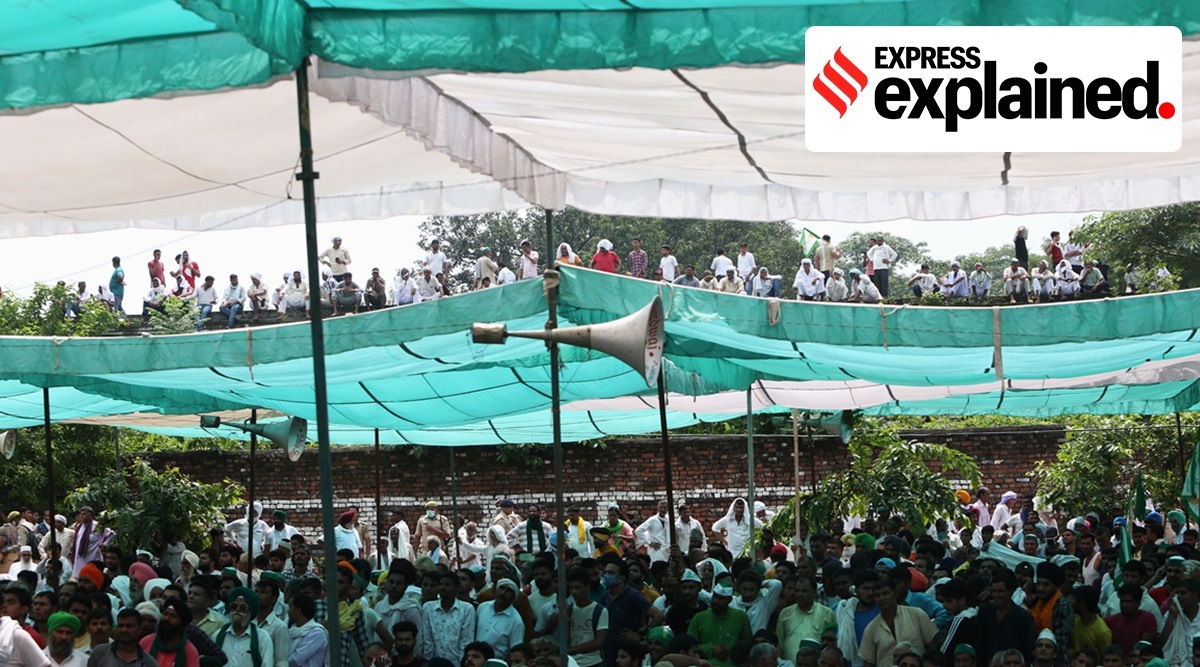
As for the farmers, the police action is only galvanising them more. The massive turnout at the mahapanchayat a day after the lathicharge at the Bastara toll plaza in Karnal is a case in point. The police action is perceived as suppression — and as a cursory look at the history of the state shows, Haryana has a culture of standing up to it.
A retired police officer said, “The Haryana farmer does not respond well to threats or police action when it’s a question of his land. He is not scared of going to jail either.”
Story continues below this ad
Also, the farmer leaders helming the Samyukt Kisan Morcha understand that politically, the Centre and BJP cannot communalise or stigmatise the agitation in Haryana. As Dr Ashutosh Kumar of the Department of Political Science at Panjab University says, “How can you paint people who greet each other with ‘Ram, Ram’ as Khalistanis?”
Police lathi-charge protesters to break-up the stir at Bastara toll plaza, Karnal. (Express Photo)
Second is the power of the khaps.
The agitation against the farm laws is backed by the all-powerful khaps (groups of villages united by a clan) that encapsulate the caste identity in Haryana.
“It was the khap leaders who first said that the farmer is in danger. They pressed the trigger points when they said this government will give your land to corporates, and no one will marry your children,” Dr Kumar said.
This message found resonance in the state, which has already seen the rapid takeover of agricultural land around the national capital region. Today, ask any farmer sitting in protest at a toll plaza in the state about the three laws, and you will likely hear this rationale.
Story continues below this ad
Then there is the proximity to Punjab…
In the beginning, Haryana was largely unmoved by the agitation against the farm laws, and the agitation was limited to Kurukshetra and a few other areas. But the Punjab union leaders’ decision to shift their movement to Delhi in November 2020 changed this situation.
When the cavalcades of Punjab farmers first moved to Delhi through Haryana on November 26 last year, braving water cannons and navigating past gigantic roadblocks erected by the state police, villagers in Haryana rose in their support.
For the first time, many in Haryana played host to complete strangers who took shelter in their villages while trying to escape the police crackdown. As the Punjab farmers dug in for the long haul at Delhi’s borders, the neighbouring villages in Haryana began to provide them with logistic support.
…And the formidable power of social media.
The message of unity of farmers from the two states, who have been historically divided by the dispute over the sharing of river waters through the SYL canal, was spread and amplified on social media.
Story continues below this ad
“At present, every village is organised into committees, and a single message in one of the WhatsApp groups can mobilise people and resources,” said Prof Vinod K Choudhary of the Department of Sociology at Panjab University.
“Every rally, every move is reported on social media. The plight of a farmer in distress is presented so vividly with such evocative jingles that it is difficult to remain unmoved,” Choudhary, who hails from a village near Hisar, said.
Hours after the lathicharge at Karnal on August 28, pictures of a bespectacled Mahender Singh, a farmer who was sporting a medallion of Bhagat Singh, and who suffered blows to his head, went viral. The administration suspended the Internet on the eve of the May 7 Karnal rally, but the social media warriors still managed to find a way to post pictures and videos.
Mahindra Singh of Barauta village who was injured in the violence.
It has become a platform to give vent to a range of grievances.
Historian Prof Raghuvendra Tanwar of Kurukshetra University said the agitation has become a rallying point for farmers in distress due to wider issues of fragmentation of landholdings, diminishing returns from agriculture, rising debt, and the culture of rampant consumerism.
Story continues below this ad
“I fully support the three farm laws, but 90 per cent of the protesters don’t understand their merits. There is a lot of pent-up anger and frustration which is finding a vent in this agitation,” said Prof Tanwar, who is himself a prosperous farmer with a large landholding.
Schemes such as online registration for procurement and crop insurance, although progressive in spirit, are also adding to the collective angst, as most farmers are unable to process them.
Again, the mobilisation due to the agitation allows farmers to seek justice for hyper-local issues. A few months ago, farmers gheraoed a police station at Tohana because the police had refused to register a complaint about a stolen car. Be it for tubewell connections, complaints about electricity or procurement, farmers are uniting to form a pressure group.
Mandeep Nathwan, convener of the Kisan Sanghrash Samiti, Haryana, says many local unions have also joined hands with the protesters, beefing up their strength.
Story continues below this ad
Finally, there is the leadership at the grassroots.
Unlike the past when farmer leaders such as Sir Chhotu Ram and Chaudhary Devi Lal were from wealthy families, the present farmer leadership in the state is from the grassroots, with smaller landholdings in general.
They visit the villages regularly, and give direction to the movement. The boycott of the BJP-JJP leaders is a case in point.
Besides Gurnam Singh Chaduni, the most prominent Bharatiya Kisan Union (BKU) leader who has been working for farmers since 1992, there are many local leaders such as Subhash Gurjar from Yamunanagar, Rakesh Bains from Kurukshetra, and young women like Reeman Nain, 25, who is mobilising women from 58 villages of Hisar.
These leaders command trust and loyalty that is very unlike the popular distrust of politicians. This keeps the movement strong.
Story continues below this ad
Newsletter | Click to get the day’s best explainers in your inbox


 9 min read



 Police lathi-charge protesters to break-up the stir at Bastara toll plaza, Karnal. (Express Photo)