Premium
This is an archive article published on August 15, 2019

Explained: Why PM Narendra Modi batted for India’s wealth creators

The latest thrust of PM Narendra Modi’s Independence speech suggests that he wants India’s businesses to lead the way and he has promised to back them in terms of clarity and stability in policymaking.

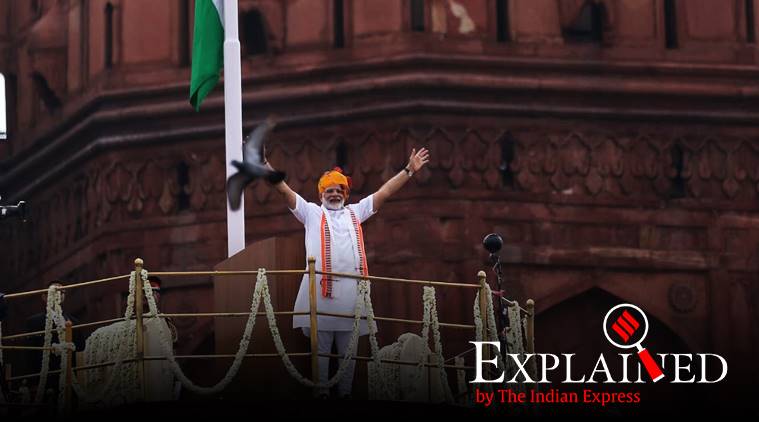
modi, independence day Prime Minister Narendra Modi said, “If no wealth is created, no wealth can be distributed.”

Prime Minister Narendra Modi used his latest Independence Day speech — the sixth in succession — to create awareness about how India can become more prosperous and achieve the lofty goals — such as doubling of farmers’ income, every household having a proper house, breaking down the digital divide etc.— that it has set for itself . In doing so, the PM stressed on the need to rectify how Indians viewed the “wealth creators” in the country.

“Those who create wealth for the country, those who contribute in the country’s wealth creation — they all are serving the nation as well,” he said. “We should not look at wealth creators with apprehension and doubt their intentions; we should not look down upon them.” The PM said there is a need in the country today to give such wealth creators due respect and credit. He then explained why he wanted the countrymen to bring about a change in their outlook towards those who “create wealth”. “If no wealth is created, no wealth can be distributed,” he said.

The PM’s message stands out for at least two reasons.

One, it is a clear departure from his defensive approach to the issue of backing the “wealth creators” during his first term. While he started his first term with a keen desire to bring about long-pending structural reforms in the use of land and labour — for example, he repeatedly brought ordinances to make the acquisition of land easier and cheaper for businesses — yet when his moves were resisted especially because of a lack of majority in the Rajya Sabha, he backed down. In particular, a jibe by Congress leader Rahul Gandhi — that Modi’s government was a “suit-boot ki sarkar” (a government that only looks after the rich) — appeared to have done considerable damage to PM Modi’s desire to push ahead with economic reforms.

PM Modi I-Day top quotes | ‘We neither nurse problems nor keep them pending’

For the PM to bat for the “wealth creators” and urge the country to alter the way it views its businessmen — both big and small — possibly shows his commitment to back private enterprise in the country.

Secondly, the PM’s message also comes at a time when the Indian economy is fast losing its growth momentum. There are fears that India may barely clock a growth of 6 per cent — a far cry from expectations of a 7.5 per cent growth just six months ago. What is worse, from a government perspective, is that the government finances are already stretched. Thanks to a slowing economy, its revenue collections are way behind the Budget targets and this limits its ability to ramp up expenditure and push growth.

Story continues below this ad

Independence Day photos: Prime Minister Narendra Modi addresses nation from Red Fort

The other key driver of growth — exports to the world — is also sputtering because global growth itself is floundering with trade tensions and geopolitical uncertainties.

Under the circumstances, the latest thrust of PM Modi’s speech suggests that he wants India’s businesses to lead the way and he has promised to back them in terms of clarity and stability in policymaking. But he also wants the country to understand why he is backing the businesses so that he does not come under political pressure like he did the last time around.

Udit Misra is Senior Associate Editor at The Indian Express. Misra has reported on the Indian economy and policy landscape for the past two decades. He holds a Master’s degree in Economics from the Delhi School of Economics and is a Chevening South Asia Journalism Fellow from the University of Westminster. Misra is known for explanatory journalism and is a trusted voice among readers not just for simplifying complex economic concepts but also making sense of economic news both in India and abroad. Professional Focus He writes three regular columns for the publication. ExplainSpeaking: A weekly explanatory column that answers the most important questions surrounding the economic and policy developments. GDP (Graphs, Data, Perspectives): Another weekly column that uses interesting charts and data to provide perspective on an issue dominating the news during the week. Book, Line & Thinker: A fortnightly column that for reviewing books, both new and old. Recent Notable Articles (Late 2025) His recent work focuses heavily on the weakening Indian Rupee, the global impact of U.S. economic policy under Donald Trump, and long-term domestic growth projections: Currency and Macroeconomics: "GDP: Anatomy of rupee weakness against the dollar" (Dec 19, 2025) — Investigating why the Rupee remains weak despite India's status as a fast-growing economy. "GDP: Amid the rupee's fall, how investors are shunning the Indian economy" (Dec 5, 2025). "Nobel Prize in Economic Sciences 2025: How the winners explained economic growth" (Oct 13, 2025). Global Geopolitics and Trade: "Has the US already lost to China? Trump's policies and the shifting global order" (Dec 8, 2025). "The Great Sanctions Hack: Why economic sanctions don't work the way we expect" (Nov 23, 2025) — Based on former RBI Governor Urjit Patel's new book. "ExplainSpeaking: How Trump's tariffs have run into an affordability crisis" (Nov 20, 2025). Domestic Policy and Data: "GDP: New labour codes and opportunity for India's weakest states" (Nov 28, 2025). "ExplainSpeaking | Piyush Goyal says India will be a $30 trillion economy in 25 years: Decoding the projections" (Oct 30, 2025) — A critical look at the feasibility of high-growth targets. "GDP: Examining latest GST collections, and where different states stand" (Nov 7, 2025). International Economic Comparisons: "GDP: What ails Germany, world's third-largest economy, and how it could grow" (Nov 14, 2025). "On the loss of Europe's competitive edge" (Oct 17, 2025). Signature Style Udit Misra is known his calm, data-driven, explanation-first economics journalism. He avoids ideological posturing, and writes with the aim of raising the standard of public discourse by providing readers with clarity and understanding of the ground realities. You can follow him on X (formerly Twitter) at @ieuditmisra           ... Read More


Latest Comment
Post Comment
Read Comments
Advertisement
Loading Taboola...
Advertisement
Advertisement
Advertisement