6 min read
© The Indian Express Pvt Ltd



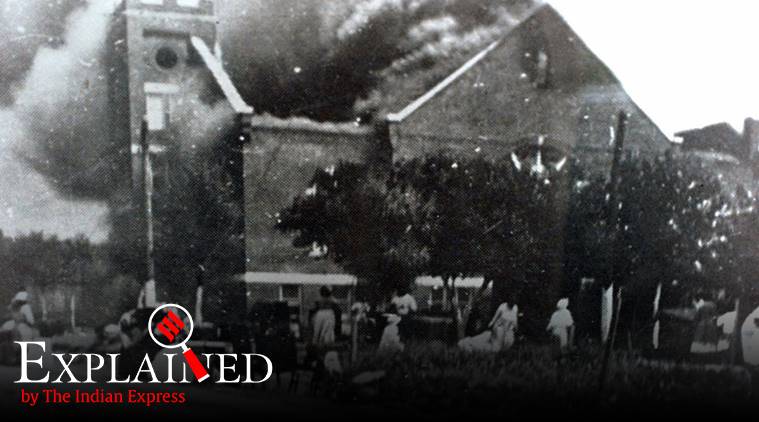 In this 1921 file image provided by the Greenwood Cultural Center via Tulsa World, Mt. Zion Baptist Church burns after being torched by white mobs during the 1921 Tulsa massacre (AP)
On Friday, US President Donald Trump gave in to pressure and announced the postponement of his upcoming election rally in Tulsa, Oklahoma by a day so that it does not clash with Juneteenth, the day that celebrates the end of slavery in the US. Trump was criticised for his decision to hold his rally on June 19 in Tulsa, the city that saw some of the worst massacres of black people in US history witnessed in 1921.
On Friday, Trump tweeted “We had previously scheduled our #MAGA Rally in Tulsa, Oklahoma, for June 19th – a big deal. Unfortunately, however, this would fall on the Juneteenth Holiday. Many of my African American friends and supporters have reached out to suggest that we consider changing the date out…”.
He added, “..of respect for this Holiday, and in observance of this important occasion and all that it represents. I have therefore decided to move our rally to Saturday, June 20th, in order to honor their requests…”.
Amid the ongoing nation-wide anti-racism protests sparked after the custodial killing of African American George Floyd on May 25, Trump’s decision to hold the rally on the same day as Juneteenth was widely criticised as disrespecting the African American community.
Further, on Tuesday, Twitter and Square declared Juneteenth,as a company holiday. On June 9, Twitter CEO Jack Dorsey tweeted, “Both Twitter and Square are making #Juneteenth (June 19th) a company holiday in the US, forevermore. A day for celebration, education, and connection.”
Now, Google, Nike, The New York Times and the National Fooball League (NFL) are the latest among the growing list of private sector organisations in the US that are choosing to commemorate Juneteenth by giving their workers off.
Juneteenth is the portmanteau of June and nineteenth and while it is not a federal holiday, it is recognised as a state holiday in over 45 US states. The day is the oldest nationally celebrated commemoration of the ending of slavery in the US and is observed on June 19. It is also known as Emancipation Day or Juneteenth Independence Day.
On January 1, 1863, then-president Abraham Lincoln issued the Emancipation Proclamation, which declared that “all persons held as slaves” within the states in rebellion “are, and henceforward shall be free.” Even so, over 2.5 years after Lincoln’s proclamation, many slave owners continued to hold their slaves captive by hiding this information from them and holding them slaves for one more harvest season, as per the Congressional Research Service (CRS).
On June 19, 1865, Major General Gordon Granger arrived in Galveston, Texas and announced the end of both the Civil War and slavery. Since then, Juneteenth has become a largely symbolic date representing freedom for African Americans.
As per CRS, Granger’s announcement read the following, “The people of Texas are informed that, in accordance with a proclamation from the Executive of the United States, all slaves are free. This involves an absolute equality of personal rights and rights of property, between former masters and slaves and the connection heretofore existing between them, becomes that between employer and hired labor. The Freedmen are advised to remain at their present homes and work for wages. They are informed that they will not be allowed to collect at military posts; and they will not be supported in idleness either there or elsewhere.”

For Texans, the first Juneteenth celebration started from 1866, with community-centric events such as parades, cookouts, prayer gatherings, historical and cultural readings and musical performances. The day has evolved over the years with people and communities developing their own traditions and customs. For instance, some communities purchased land for celebrating the day, such as Emancipation Park in Houston, Texas. Juneteenth was recognised as an official holiday in Texas on January 1, 1980.
As per the National Juneteenth Observance Foundation (NJOF), the era of the “Modern Juneteenth Movement” began in 1994 when a group of Juneteenth leaders from across the country gathered in New Orleans, Louisiana to work towards the greater recognition of Juneteenth.
According to the Tulsa Historical Society and Museum, after World War I, Tulsa was recognised for its affluent African American community, which was known as the Greenwood District or the “Black Wall Street”. In June, 1921 a series of events that took place there, “nearly destroyed” the entire Greenwood area.
On May 30, 1921, a black man named Dick Rowland was imprisoned for allegedly assaulting a white woman. After his arrest, an “inflammatory report” published in the May 31 edition of the Tulsa Tribune spurred a confrontation between black and white armed mobs, as per the museum’s website. Some of the members of the mobs armed themselves to protect Rowland, while others wanted to lynch him.
By the morning of June 1, 1921 the Greenwood area was looted and burned down by white rioters. The incident referred to as the Tulsa race massacre or the Tulsa race riot, resulted in the deaths of over 300 people and is noted as one of the worst episodes of racial violence in US history.