4 min read





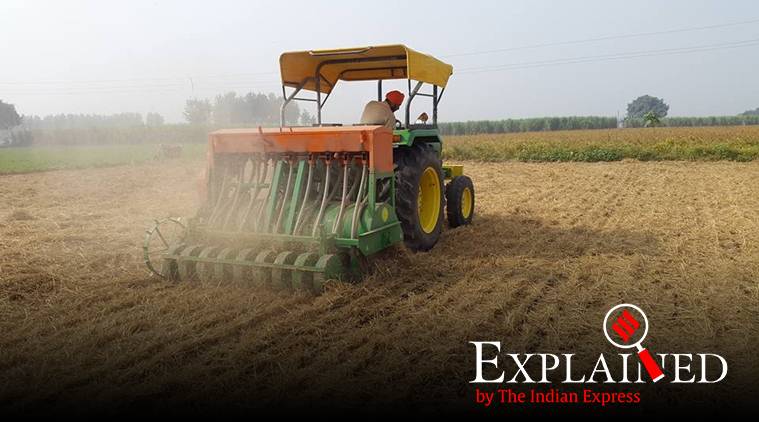 The Happy Seeder wasn’t well received in Punjab by farmers till 2016, when just around 620 machines were operating in the state covering just 64,000 hectares.
Chief Minister Capt Amarinder Singh faced opposition from farmers during Kisan Mela at Punjab Agricultural University (PAU) in Ludhiana recently, when he said that ‘using Happy Seeders for direct wheat sowing leads to increased productivity’, and hence farmers must ‘stop burning paddy stubble’ to clear the fields. The Sunday Express explains if Happy Seeder machines really ‘increase’ wheat productivity.
Farmers and experts say that to get a higher yield when wheat is sown with Happy Seeder, the trick lies in following proper technique. Also, in initial years, productivity won’t overwhelmingly increase or decrease.
Happy Seeder (HS) or Turbo Happy Seeder (THS) is a tractor-operated machine developed by the PAU in collaboration with Australian Centre for International Agricultural Research (ACIAR), for in-situ management of paddy stubble (straw).
While it was developed in 2002, the PAU officially recommended it to farmers in 2005-06 and it made to the markets in 2006. Currently, it costs around Rs 1.50 to 1.60 lakh and is manufactured by different companies. The agriculture department gives 80 per cent subsidy to farmer groups and 50 per cent subsidy to individual farmers.
After harvesting the paddy field using a combined harvester fitted with Super-SMS (Straw Management System) equipment, which chops and evenly spreads the stubble in the field, farmers can directly sow wheat seeds using Happy Seeder with the stubble’s organic value adding to the soil, says PAU.
The average wheat yield a farmer gets using traditional sowing method (after burning stubble) is 19-22 quintal/acre (q/acre).
Bir Dalwinder Singh, a farmer from Patiala, who has been using Happy Seeder for four years now, says that in the first year, the yield was 17 q/acre but now it’s 19-22 q/acre. “It is wrong to say that yield magically increases or decreases using Happy Seeder. It mostly remains at par, with normal average yield. Initially, farmers will face problems because after sowing with HS, fields require proper management,” he says.
However, a farmer from Moga, who was among those who protested against CM’s words, said, “Despite using the super-SMS, I have to burn the stubble because Happy Seeder doesn’t work on thick bunches of straw left behind. My yield has also decreased and it is a lie that the government is giving machines to all.”
According to the experts, wheat yield will start increasing after the initial 2-3 years, as the stubble will add to the organic quality of the soil. Manjeet Singh, head, department of farm machinery and power engineering, PAU, says, “After 2-3 years, the wheat yield will increase by 8-10 per cent, our experiments have shown”.
Meanwhile, Sutantar Kumar Airi, director (agriculture) Punjab, said that currently there are almost 12,000 HS machines operational in Punjab and that wheat yield has even touched 24 q/acre in some cases after using them. “Farmers who have used it are giving positive feedback. From timely sowing to irrigation, manure and even fertilizers — wheat sown with HS needs proper management. We have recorded an increase of 1.5-2 q/acre in farmers’ fields,” he says. He claimed that in 2018-19 wheat season, almost 5 lakh hectares (12.35 lakh acres) was sown in Punjab using HS.
The Happy Seeder wasn’t well-received in Punjab by farmers till 2016 when just around 620 machines were operating in the state covering just 64,000 hectares back then. Wheat is sown over 35 lakh hectares (86 lakh acres approx) across Punjab.