Explained: What are IPCC assessment reports, and why are they significant in understanding climate change?
So far, five assessment reports have been produced, the first one being released in 1990. The fifth assessment report had come out in 2014 in the run up to the climate change conference in Paris.
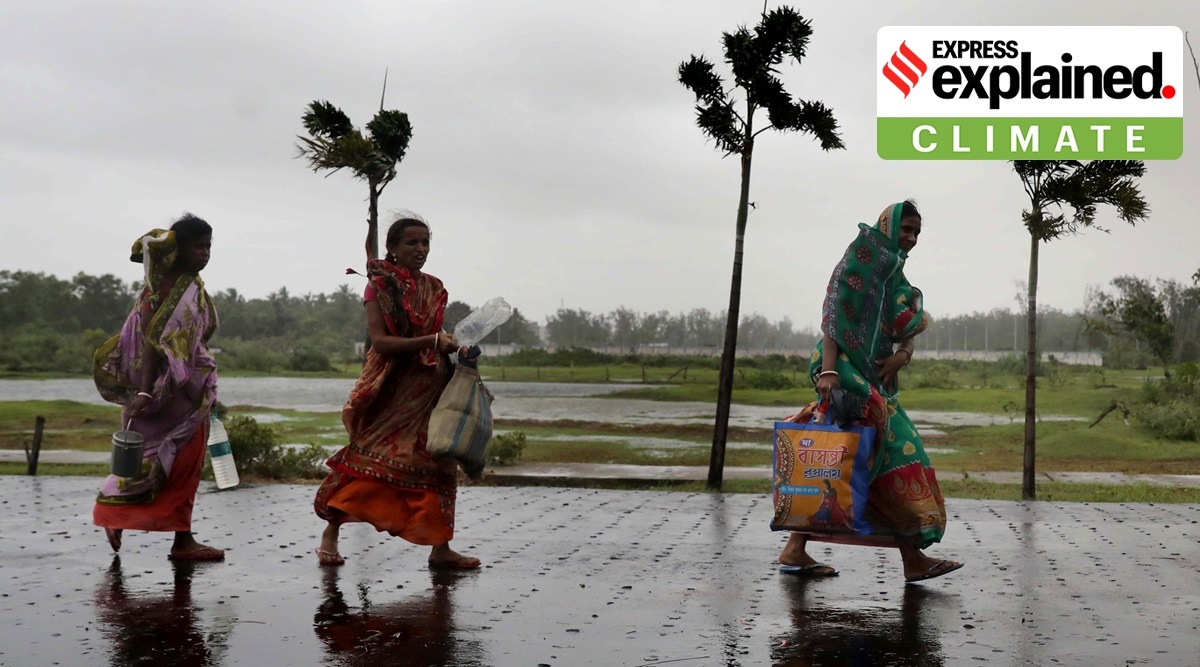
The third IPCC assessment report said that the frequency, intensity and duration of extreme weather events will increase. (Express file photo by Partha Paul)
Every few years, the Inter-governmental Panel on Climate Change (IPCC) produces assessment reports that are the most comprehensive scientific evaluations of the state of earth’s climate.
Set up in 1988 by the World Meteorological Organisation (WMO) and the UN Environment Programme (UNEP), the IPCC does not itself engage in scientific research. Instead, it asks scientists from around the world to go through all the relevant scientific literature related to climate change and draw up the logical conclusions.
You’ve Read Your Free Stories For Now
Sign up and keep reading more stories that matter to you.
So far, five assessment reports have been produced, the first one being released in 1990. The fifth assessment report had come out in 2014 in the run up to the climate change conference in Paris. On Monday, the IPCC released the first part of its sixth assessment report (AR6). The two remaining parts would be released next year.
The IPCC reports are created by three working groups of scientists. Working Group-I, whose report has been released on Monday, deals with the scientific basis for climate change. Working Group-II looks at the likely impacts, vulnerabilities and adaptation issues, while Working Group-III deals with actions that can be taken to combat climate change.
Over 750 scientists have contributed to the Working Group-I report that was released on Monday. They reviewed over 14,000 scientific publications.
The assessment reports are the most widely-accepted scientific opinion about climate change. They form the basis for government policies to tackle climate change, and also provide the scientific foundation for the international climate change negotiations.
Here is what the previous assessments reports had said:
First Assessment Report (1990)
Story continues below this ad
Emissions resulting from human activities are substantially increasing the atmospheric concentrations of the greenhouse gases.
Global temperatures have risen by 0.3 to 0.6 degree Celsius in last 100 years. In business-as-usual scenario, temperatures likely to increase by 2 degree Celsius compared to pre-industrial levels by 2025, and 4 degree Celsius by 2100
Sea-level likely to rise by 65 cm by 2100
This report formed the basis for negotiation of the UN Framework Convention on Climate Change in 1992.
Second Assessment Report (1995)
Revises projected rise in global temperatures to 3 degree Celsius above pre-industrial levels by 2100, sea-level rise to 50 cm, in light of more evidence.
Global rise in temperature by 0.3 to 0.6 degree Celsius since late 19th century, “unlikely to be entirely natural in origin”.
This report was the scientific underpinning for Kyoto Protocol in 1997.
Revises projected rise in global temperatures to 1.4 to 5.8 degree Celsius by 2100 compared to 1990. Projected rate of warming unprecedented in last 10,000 years.
Rainfall will increase on an average. The report also predicts that by 2100, the sea level is likely to rise by as much as 80 cm from 1990 levels. Glaciers to retreat during the 21st century.
Frequency, intensity and duration of extreme weather events to increase.
Presents new and stronger evidence to suggest that global warming is mostly attributable to human activities.
Fourth Assessment Report (2007)
Story continues below this ad
Greenhouse gas emissions increased by 70 per cent between 1970 and 2004.
Atmospheric concentrations of CO2 in 2005 (379 ppm) the maximum in 650,000 years.
In worst case scenario, global temperatures could rise 4.5 degree Celsius by 2100 from pre-industrial levels. Sea-levels could be 60 cm higher than 1990 levels.
The report won the 2007 Nobel Peace Prize for IPCC and was the scientific input for the 2009 Copenhagen climate meeting.