Premium

Why so many Indian students — especially from Kashmir — go to Iran for higher education

As Indian citizens are evacuated from Iran, one question is in the spotlight again: why do so many Indians go abroad to study medicine? And for Kashmiri students, what is Iran's appeal? We explain

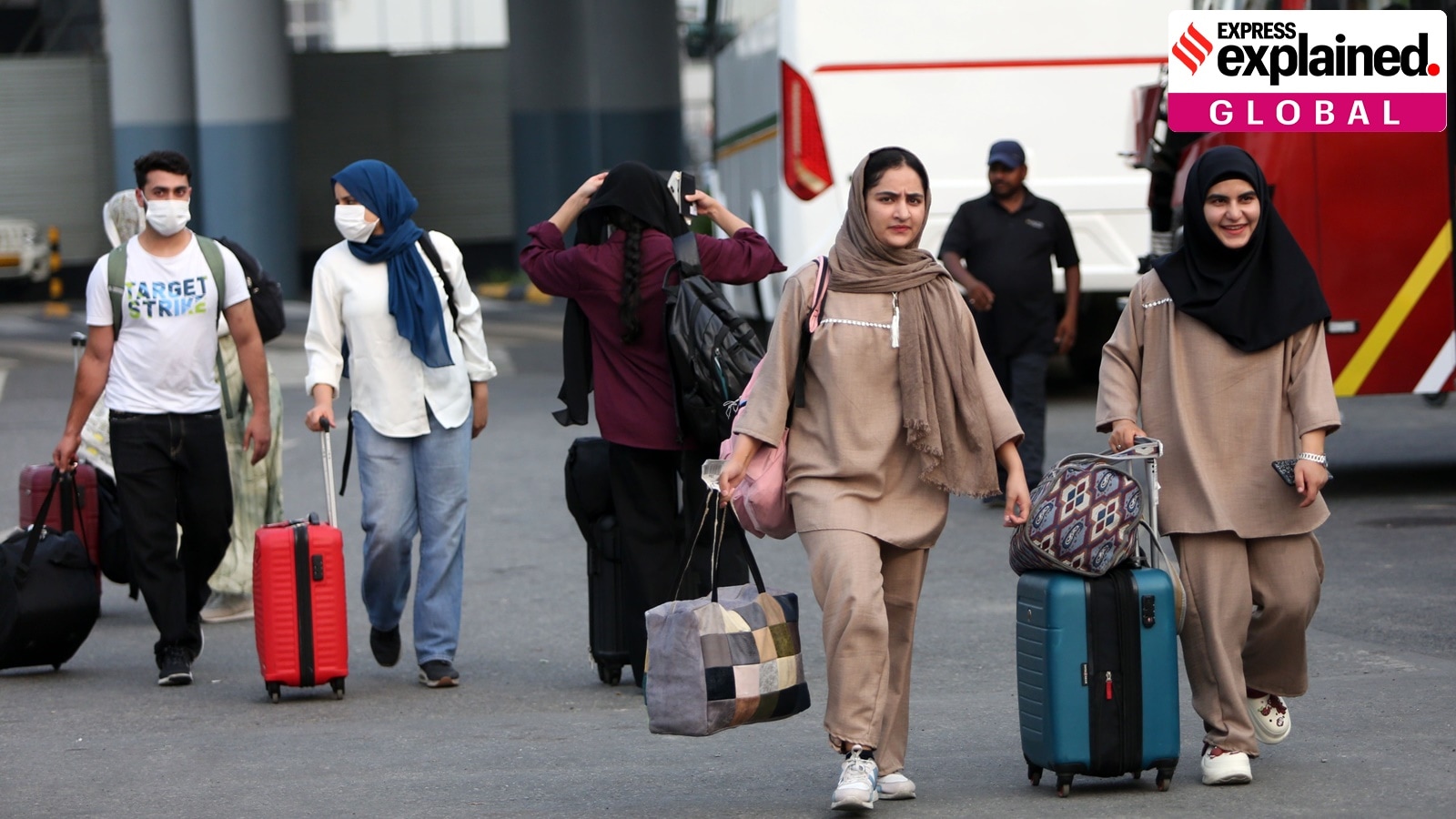
indian students from IranWith Operation Sindhu, India brought Indian students stuck in Iran. The flight landed at Delhi airport on Sunday. (Express Photo: Gajendra Yadav)

The ongoing Iran–Israel conflict, and the Indian government’s efforts to evacuate its citizens — especially medical students — from the region, has once again thrown the spotlight on a recurring question: Why do so many Indian students go abroad to study medicine?

According to the MEA’s estimated data of Indian students studying abroad, in 2022, about 2,050 students were enrolled in Iran, mostly for medical studies, at institutions like the Tehran University of Medical Sciences, Shahid Beheshti University and Islamic Azad University. A significant number of the students are from Kashmir.

This is not the first time a geopolitical crisis has exposed the scale of India’s outbound medical education. In 2022, during the Russia – Ukraine war, the Indian government had to evacuate thousands of medical students under ‘Operation Ganga’.

A growing trend

Despite a significant rise in the number of medical seats in India—from around 51,000 MBBS seats in 2014 to 1.18 lakh in 2024 —tens of thousands of students continue to pursue medical education abroad. The trend is visible in the rising number of candidates appearing for the Foreign Medical Graduate Examination (FMGE), which is mandatory for practising medicine in India after studying abroad. About 79,000 students appeared for the FMGE in 2024, up from 61,616 in 2023 and just over 52,000 in 2022.

This outward movement is driven by two main factors: competitiveness and cost.

“While the number of MBBS seats have increased in the country, the field continues to remain competitive. Students have to get a very good rank to get into government colleges,” said Dr Pawanindra Lal, former executive director of the National Board of Examinations in Medical Sciences, which conducts the FMGE.

More than 22.7 lakh candidates appeared for NEET-UG in 2024 for just over 1 lakh MBBS seats. Only around half of these seats are in government colleges. The rest are in private institutions, where costs can soar.

Story continues below this ad

“A candidate ranked 50,000 can get admission in a good private college but the fees can run into crores. How many people in the country can afford that? It is just simple economics that pushes students towards pursuing medical education in other countries. They can get the degree at one-tenth the cost in some of the countries,” said Dr Lal.

Why do so many Kashmiri students go to Iran?

While affordability draws many Indian students abroad, Iran holds a unique appeal for those from the Kashmir Valley. For them, the choice is shaped not just by economics, but by cultural and historical ties.

“Kashmir for a very long time has been called Iran-e-Sagheer or Iran Minor,” said Professor Syed Akhtar Hussain, a Persian scholar at Jawaharlal Nehru University. “The topography of Kashmir and the culture of Kashmir are similar to that of Iran. In the old times, they always thought Kashmir was a part of Iran in a way. In the 13th century, Meer Sayyed Ahmed Ali Hamadani came to Kashmir from Iran. He brought about 200 Syeds along with him, and those people brought crafts and industry from Iran to Kashmir. They brought carpet, papier-mâché, dry fruits and saffron too. Historically, this is the link”

Religious affinity is another driver. “Because there is a Shia element in Kashmir, and Shia presence in Iran, there is that affinity. Iran also feels happy that it has that special space in the heart of Kashmir,” he said.

Story continues below this ad

Most Kashmiri students pursue medical education in Tehran, while others study Islamic theology in the holy cities of Qom and Mashhad. According to Prof. Hussain, Iran has even created admission pathways tailored for Kashmiri students. “Iran gives some concessions to Kashmiri students to study there. By virtue of being Shia, they get admission very quickly and easily… for Kashmiris in Iran, it’s less expensive.”

This is often referred to as the “pargees quota”.

What are the risks?

Though admission is relatively easier and cheaper abroad, experts warn of important caveats in medical studies abroad.

“There are not a lot of eligibility requirements. If the student can pay, they usually get admission. Some universities run two batches for each year to accommodate more students,” said Dr Lal. However, he warned that some foreign universities operate two tiers of medical education: one designed to produce local doctors, and another primarily to award degrees to foreigners. “In fact, after completing some of the courses meant for foreigners, the students may not be eligible to practice in the host country,” he said.

Story continues below this ad

To address this, India’s National Medical Commission (NMC) has introduced a rule stating that students will be eligible to practise in India only if they are also eligible to practise in the country where they studied. The NMC also mandates that the medical course be 54 months long, completed at a single university, followed by a one-year internship at the same institution.

Dr Lal also flagged the lack of transparent information: “There are no foreign colleges or universities listed by the country’s medical education regulator that people can trust… The regulator should either provide a list of approved colleges or select, say, the top 100 colleges from a given country.”

What happens when such students return?

Even after securing their degree, foreign-trained doctors face several hurdles in India. Students from the Philippines, for instance, faced recognition issues because their courses were only 48 months long, short of the required 54.

Another bottleneck is the FMGE, which all foreign-trained doctors must clear. The pass rate has historically been low: 25.8% in 2024, 16.65% in 2023, and 23.35% in 2022.

Story continues below this ad

“Even afterwards, they face challenges in getting employed. This is because their training is not as robust. Sometimes there is a lack of patients and practical training. The FMGE questions are simple, meant to test the students’ practical knowledge. And, yet, many are unable to pass the examination even after several attempts,” said Dr Lal.

Anonna Dutt is a Principal Correspondent who writes primarily on health at the Indian Express. She reports on myriad topics ranging from the growing burden of non-communicable diseases such as diabetes and hypertension to the problems with pervasive infectious conditions. She reported on the government’s management of the Covid-19 pandemic and closely followed the vaccination programme. Her stories have resulted in the city government investing in high-end tests for the poor and acknowledging errors in their official reports. Dutt also takes a keen interest in the country’s space programme and has written on key missions like Chandrayaan 2 and 3, Aditya L1, and Gaganyaan. She was among the first batch of eleven media fellows with RBM Partnership to End Malaria. She was also selected to participate in the short-term programme on early childhood reporting at Columbia University’s Dart Centre. Dutt has a Bachelor’s Degree from the Symbiosis Institute of Media and Communication, Pune and a PG Diploma from the Asian College of Journalism, Chennai. She started her reporting career with the Hindustan Times. When not at work, she tries to appease the Duolingo owl with her French skills and sometimes takes to the dance floor. ... Read More

Vidheesha Kuntamalla is a Senior Correspondent at The Indian Express, based in New Delhi. She is known for her investigative reporting on higher education policy, international student immigration, and academic freedom on university campuses. Her work consistently connects policy decisions with lived realities, foregrounding how administrative actions, political pressure, and global shifts affect students, faculty, and institutions. Professional Profile Core Beat Vidheesha covers education in Delhi and nationally, reporting on major public institutions including the University of Delhi (DU), Jawaharlal Nehru University (JNU), Jamia Millia Islamia, the IITs, and the IIMs. She also reports extensively on private and government schools in the National Capital Region. Prior to joining The Indian Express, she worked as a freelance journalist in Telangana and Andhra Pradesh for over a year, covering politics, rural issues, women-centric issues, and social justice. Specialisation She has developed a strong niche in reporting on the Indian student diaspora, particularly the challenges faced by Indian students and H-1B holders in the United States. Her work examines how geopolitical shifts, immigration policy changes, and campus politics impact global education mobility. She has also reported widely on: * Mental health crises and student suicides at IITs * Policy responses to campus mental health * Academic freedom and institutional clampdowns at JNU, South Asian University (SAU), and Delhi University * Curriculum and syllabus changes under the National Education Policy Her recent reporting has included deeply reported human stories on policy changes during the Trump administration and their consequences for Indian students and researchers in the US. Reporting Style Vidheesha is recognised for a human-centric approach to policy reporting, combining investigative depth with intimate storytelling. Her work often highlights the anxieties of students and faculty navigating bureaucratic uncertainty, legal precarity, and institutional pressure. She regularly works with court records, internal documents, official data, and disciplinary frameworks to expose structural challenges to academic freedom. Recent Notable Articles (Late 2024 & 2025) 1. Express Investigation Series JNU’s fault lines move from campus to court: University fights students and faculty (November 2025) An Indian Express investigation found that since 2011, JNU has appeared in over 600 cases before the Delhi High Court, filed by the administration, faculty, staff, students, and contractual workers across the tenures of three Vice-Chancellors. JNU’s legal wars with students and faculty pile up under 3 V-Cs | Rs 30-lakh fines chill campus dissent (November 2025) The report traced how steep monetary penalties — now codified in the Chief Proctor’s Office Manual — are reshaping dissent and disciplinary action on campus. 2. International Education & Immigration ‘Free for a day. Then came ICE’: Acquitted after 43 years, Indian-origin man faces deportation — to a country he has never known (October 2025) H-1B $100,000 entry fee explained: Who pays, who’s exempt, and what’s still unclear? (September 2025) Khammam to Dallas, Jhansi to Seattle — audacious journeys in pursuit of the American dream after H-1B visa fee hike (September 2025) What a proposed 15% cap on foreign admissions in the US could mean for Indian students (October 2025) Anxiety on campus after Trump says visas of pro-Palestinian protesters will be cancelled (January 2025) ‘I couldn’t believe it’: F-1 status of some Indian students restored after US reverses abrupt visa terminations (April 2025) 3. Academic Freedom & Policy Exclusive: South Asian University fires professor for ‘inciting students’ during stipend protests (September 2025) Exclusive: Ministry seeks explanation from JNU V-C for skipping Centre’s meet, views absence ‘seriously’ (July 2025) SAU rows after Noam Chomsky mentions PM Modi, Lankan scholar resigns, PhD student exits SAU A series of five stories examining shrinking academic freedom at South Asian University after global scholar Noam Chomsky referenced Prime Minister Narendra Modi during an academic interaction, triggering administrative unease and renewed debate over political speech, surveillance, and institutional autonomy on Indian campuses. 4. Mental Health on Campuses In post-pandemic years, counselling rooms at IITs are busier than ever; IIT-wise data shows why (August 2025) Campus suicides: IIT-Delhi panel flags toxic competition, caste bias, burnout (April 2025) 5. Delhi Schools These Delhi government school grads are now success stories. Here’s what worked — and what didn’t (February 2025) ‘Ma’am… may I share something?’ Growing up online and alone, why Delhi’s teens are reaching out (December 2025) ... Read More

 

Latest Comment
Post Comment
Read Comments
Advertisement
Advertisement
Advertisement
Advertisement