7 min read
© The Indian Express Pvt Ltd



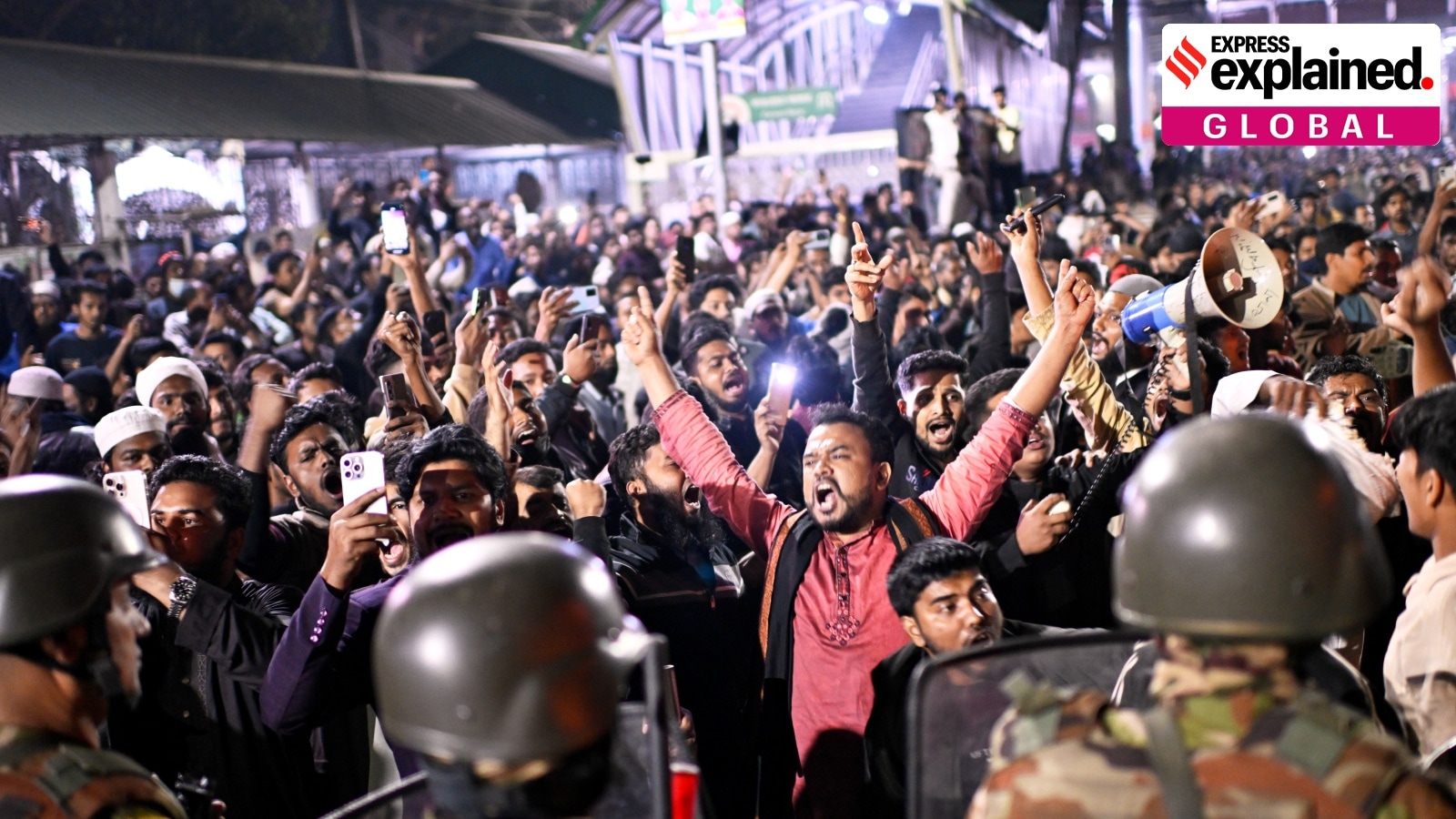 Bangladesh Violence and Protests Explained Protesters shout slogans in front of the premises of the Prothom Alo newspaper after news reached the country from Singapore of the death of Sharif Osman Hadi, in Dhaka, Bangladesh, on December 19. (Photo: AP)
Bangladesh Violence News Explained: A wave of political violence has gripped Bangladesh since the killing of Inquilab Moncho leader Sharif Osman Hadi, who was closely affiliated to the student leaders of the National Citizen Party (NCP), on December 11.
The upheaval has resulted in massive anti-India demonstrations (student leaders blame India for sheltering Hadi’s killers), arson against two prominent Bangladesh newspapers for allegedly being pro-India, mob lynchings against minorities (including the gruesome murder of Dipu Chandra Das, a factory worker), and acts of vandalism against Bengali cultural institutions. On Monday, another student leader, Motaleb Shikder, was shot at.
Amid this tumult, it will be useful to freeze the frame on December 10, the day before Hadi’s killing, for a bird’s eye analysis of the context in which the fresh violence is occurring.
Unprecedented polls
While Bangladesh is slated to go to polls on February 12, 2026, it has also remained on a razor’s edge for months, with the constant risk of post-revolutionary violence upending political stability. Such stability is crucial for Bangladesh’s elections to be free, fair, and secure, and thus legitimate.
These are the first elections since Sheikh Hasina’s exit and 15 years of Awami rule; amid the formal ban on the Awami League, the period until the elections have been a test of how Bangladesh’s political actors (old and new) are able to preserve this stability.
The election’s already high stakes have been doubled by the inclusion of a referendum on the July Charter — a set of constitutional changes drafted by the Interim Government. The effort is to not only bring in a new government in February but also a new system, one that upends the older Awami League era ‘establishment’. For this too, stability is imperative. A referendum tainted by violence will be vulnerable to being discredited and changed by future governments.
Lastly, the nature of Bangladesh’s electorate itself has shifted. After consecutive elections that have been marred by electoral malpractice, strong uncertainty prevails over how Bangladesh’s people view their current options. A limited voter survey by the BRAC Institute in August 2025 showed that about 50% of Bangladesh’s electorate was undecided about their political choice, a 10%-point jump from October 2024.
The Election Commission’s announcement that the 15 million-odd Bangladeshi diaspora will also be able to participate in the 2026 polls — they will make up about 10% of the enlarged electorate — further increases the novelty of the February polls.
New political rivalries
Cognizant of the February polls’ novelty, all prominent actors in Bangladesh’s polity have been suspicious of the process leading up to it.
First, parties like the NCP and Jamaat-e-Islami (JeI) have long been averse to elections being held in early 2026: both have consistently pushed the Interim Government to set a later date for polls. In particular, the NCP, formed by student leaders who led the July 2024 movement to oust Hasina in February, is less than a year old. As Bangladesh’s newest political party, elections in February mean insufficient gestation time, and prevent it from credibly gaining a foothold among the electorate.
Second, the Bangladesh Nationalist Party, the country’s only remaining legacy party, has consistently sought elections as soon as possible. The BNP, unlike the NCP, is eager to leverage the vacuum left by Hasina with its large cadre, experience, and superior organising capacity compared to the likes of NCP. The BNP has been the other source of pressure on the Muhammad Yunus’s Interim Government, and has sought to prevent it from catering to the NCP’s needs, especially since Yunus was invited to form the Interim Government by student leaders.
On the question of the referendum too, all parties remain opposed on key clauses. As the party that suffered much in the older Hasina-dominated system, the BNP arguably wants greater agency in shaping the new system, which it can only do while in power (and thus after polls).
Third, the Interim Government itself has a lot at stake. Apart from prosecuting Hasina and her allies in the Awami League, this administration was formed with two specific aims — to implement an ambitious multi-pillared domestic reform agenda as well as oversee the conduct of free, fair, and secure polls. On the former, the Yunus’s progress has been sluggish, with all actors, including the BNP, Awami League, NCP and Jamaat, accusing it of bias. This makes it even more important for the Interim Government to succeed in overseeing a peaceful election, which functionally requires political and social stability.
Now, Hadi’s death
Within this context, Hadi’s death on December 11 acted as a hair-trigger. Yunus, while declaring a day of mourning, categorically said that the killing was perpetrated by forces that do not want Bangladesh to hold a peaceful election. Regardless of who was responsible for Hadi’s killing — the NCP has blamed the Awami League’s student wing — this is true. The arson, vandalism, and murder, all represent a broken windows effect with the dam of post-revolutionary chaos bursting.
For any political actor, whipping up a mob then becomes easy. Here, for NCP leaders, most of whom are in their late 20s, anti-India rhetoric in particular is a low-hanging fruit to garner populist credentials. Leaders such as Hasnat Abdullah have long been rhetorically trigger happy, with the NCP itself having to (ostensibly) discipline Abdullah in the past. Apart from anti-India rhetoric, they have also sought to de-legitimise any institution deemed to be part of the older establishment. This naturally includes old, liberal, papers such as Prothom Alo and The Daily Star. Note that in December last year, Hasnat Abdullah stormed Somoy TV’s office and strong-armed them into sacking specific employees.
The BNP, however, occupies an interesting position. Both Hadi’s and Shikder’s killings, and Bangladesh’s descent into fresh instability, come on the eve of BNP de facto chief Tarique Rehman’s return to the country after an 18-year exile. Like the Interim Government, the BNP also has a strong interest in ensuring that stability prevails, which has led to the party condemning the violence and characterising it as terrorism. Moreover, the BNP, despite being ostracised by Hasina for years, is also seen as part of the older establishment and is cast as such by Bangladesh’s newer political actors. While this has meant that there is fresh ground for unprecedented functional cooperation between the BNP and the Awami League cadre, the first aim of the party is to take power through early elections. For what it’s worth, among all parties in pre-poll surveys, the BNP usually stays ahead.
Bangladesh today has enough elements of contention among powerful actors who have little to lose and much to gain through carelessly inflammatory rhetoric. It is now up to the Interim Government and the Bangladesh Army, on whom Yunus has relied for security since August 2024, to ensure that the violence does not spill over.
However, post-revolutionary chaos has been a centuries-old global trend, with few exceptions. Since Bangladeshi leaders have effectively formalised the term ‘revolution’ for the July 2024 uprising, Dhaka evidently too has not been able to escape the subsequent chaos. Predicting its course is difficult. As many have argued, India’s best option is to be tolerant, patient, and observant.