7 min read
© The Indian Express Pvt Ltd



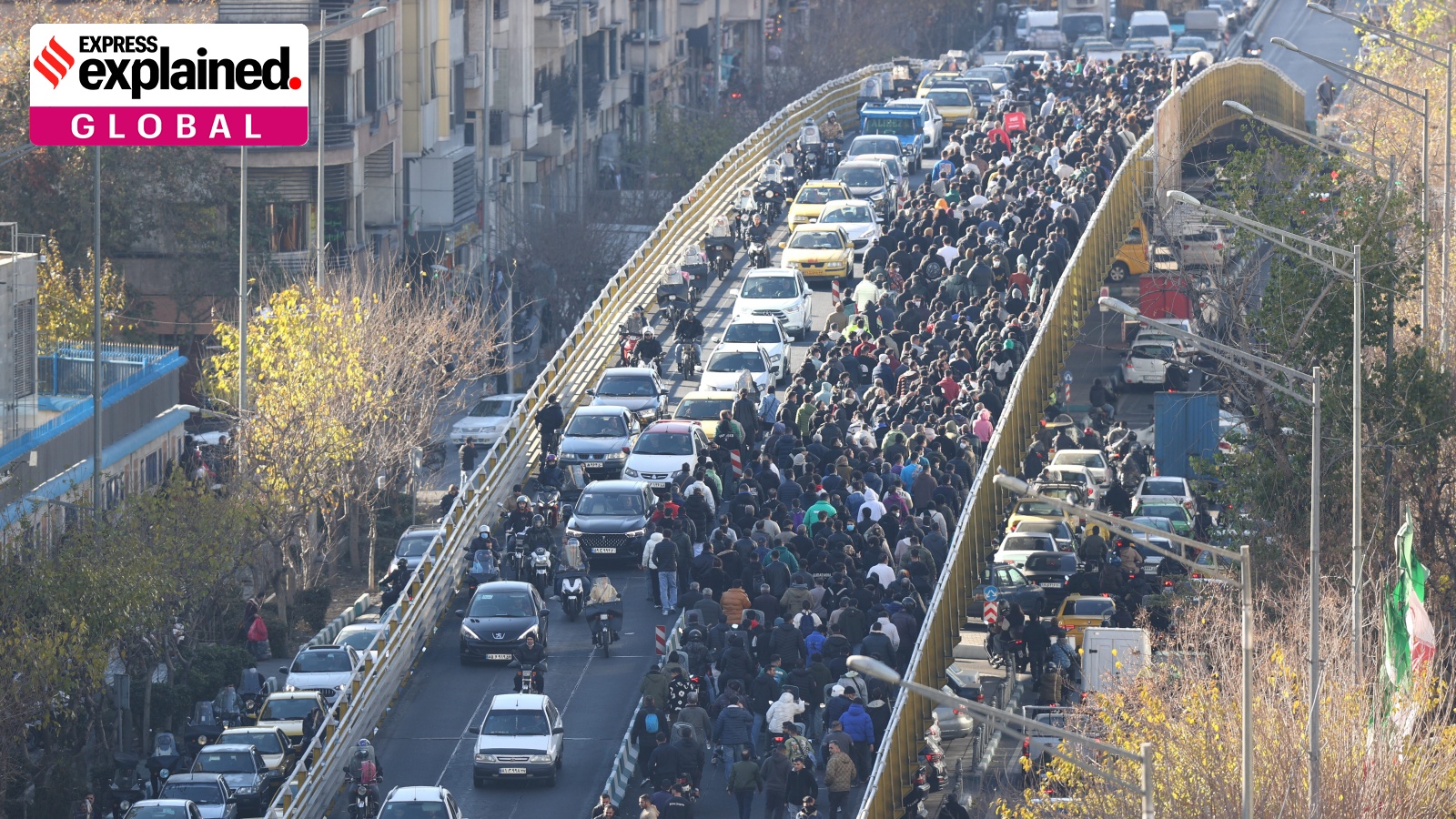 Protesters march on a bridge in Tehran, Iran, on December 29, 2025. AP Photo
Since December 28, Iran has witnessed a wave of protests that has spread to at least 22 of its 31 districts. The unrest, which began in the form of demonstrations by merchants in Tehran’s Grand Bazaar, was fueled by serious economic concerns.
Iran’s inflation grew across 2025 by at least 30% to over 52%, with average monthly food inflation touching 7%. The Iranian rial lost more than half its value over last year, dropping to a record low of 1.46 million against the US dollar this week.
On January 5, the Iranian government announced key economic reforms such as ending subsidies on essential imports in an attempt to stabilise the foreign exchange rate. It also began direct cash and voucher transfers to a majority of the population, amounting to approximately $7 a month.
However, the protests have taken on a larger anti-regime colour and clashes with security forces have killed at least 36 people so far. On January 3, President Donald Trump asserted that the US was “locked and loaded” to come to the rescue of the protestors. Tehran has taken this, along with statements from other US leaders, as evidence of foreign interference.
But to what extent have protests worked in Iran in its modern history? What is different about these demonstrations from the earlier round in 2022-23? And what does this mean for the Iranian government?
Different triggers, consistent expression
In the Islamic Republic’s 21st-century history, economic hardship has always existed as a cause for discontent. In the last two decades, this has been accompanied by an undercurrent of anti-regime sentiments owing to Tehran’s increasingly authoritarian governance.
So, each time a strong economic, social or political trigger has presented itself, mass demonstrations have led to calls for an end to the regime — led for 36 years now by the octogenarian Supreme Leader, Ali Khamenei, and kept secure through a deeply entrenched internal security apparatus comprising the Islamic Revolutionary Guard Corps (IRGC).
The last time when Iran saw such nationwide protests was 2022-23. Then, the trigger was social — the regime’s killing of activist Mahsa Amini for non-compliance with draconian hijab laws. And, in 2009, it was political — the regime’s blatant rejection of reformist Presidential candidate Mir Hossein Mousavi’s election victory. Other protests in interceding years have had similar triggers.
In the last five years, however, the economic trigger has become significantly potent. Domestic challenges, such as recurring foreign exchange crises, high inflation and paltry domestic purchasing power for a large section of the population, have been exacerbated by US and UN sanctions over the nuclear programme.
While the fresh imposition of the UN’s “snapback” sanctions and the resumption of President Trump’s ‘Maximum Pressure’ campaign has worsened external economic pressures, Tehran had been struggling to mitigate its worsening conditions long before Trump took office for a second time.
For instance, Iran’s former President Ebrahim Raisi oversaw significant turmoil within his cabinet between 2022 and 2024 over pensions, rising inflation and a wages crisis in the education sector.
These occurred even as the Joe Biden administration partially eased existing sanctions on Iran. Now, the leading role played by Iran’s merchant class (the bazaaris) in the current protests, has only added to the pressures.
Tehran’s current approach
Iran has undergone a long learning curve in terms of responding to popular anti-government demonstrations. Itself a product of a revolution in 1979, the Islamic Republic has always limited concessions to protestor’s demands. In the clerical establishment’s institutional memory, the Shah’s gradual concessions are what weakened the monarchy’s grip and allowed the opposition to consolidate (among other factors).
It has typically unleashed violent crackdowns, sometimes spearheaded by the Basij (the IRGC’s voluntary paramilitary militia which usually provides shock troops to suppress protests), that have invariably resulted in a large number of deaths and injuries among protestors.
It was arguably this lesson that also helped the Islamic Republic isolate itself from the Arab Spring of 2010-11. For Tehran, the approach has to always stop the saplings of a potential ‘Persian Spring’ from getting any sunshine or nourishment.
So, Iran’s swift acknowledgement of protestors’ “legitimate demands” this time is a surprising break, even while maintaining the use of force. Essentially, the government now distinguishes between protests against economic ailments and those against the state and system. The former can be acknowledged, but the latter must be put down.
But Pezeshkian was also forced to deal with the Islamic Republic’s biggest external challenge of the century — direct, sustained, US and Israeli bombardment. Even then, Tehran kept up a conciliatory position (notwithstanding hostile rhetoric). Now, as Pezeshkian faces his first major internal challenge, the conciliatory tone is old for his Presidency, but new for the Islamic Republic.
The ‘regime-change’ question
Given how quickly and widely Iran’s protests garner an anti-regime character, the question of whether they can cause significant shifts in the Iranian political system has always been relevant. However, apart from the largely unorganised nature of the protests, there are two crucial elements which make the question premature.
The first is that for any systemic change, a large enough section of the IRGC must be willing to aid a significant transition. The IRGC ranks benefit from the corrupt systems and enjoy more economic access than ordinary Iranians. They remain allied with the current establishment. Far from enabling another revolution, they are unlikely to step aside during an uprising, something the Shah’s military did in 1979.
Second, as Esfandyar Batmanghelidj, Adjunct Professor at Johns Hopkins School of Advanced International Studies, has noted, there is little evidence to show that Iranians are willing to upend the state’s bureaucratic institutions responsible for daily public administration. The foundational social welfare system these institutions run has largely continued for decades. The upheaval of a revolution will arguably worsen Iranians’ current economic plight.
Iran has other areas of vulnerability. Geopolitically, it is arguably at its weakest since 1979 with the loss of a state ally in Syria (the Bashar Al Assad regime), the decapitation of its principal non-state ally in Lebanon (Hezbollah) and an increasingly dominant Israel backed by the Trump administration. All these have weakened Tehran’s internal image as a strong power.
Structurally, too, Iran is at the cusp of change. Tehran’s military and political elites are preparing ground for Ayatollah Khamenei’s succession. This will likely be a sensitive and potentially unstable process since the new, dissatisfied Iranian generation has never witnessed a transition in the Supreme Leader’s office.
Collectively, these factors demand internal stability for regime preservation.
While Iran’s protests remain unwieldy in organisation, their snowballing nature could lead to uncertain outcomes, less neat than a clean change of the governing system. The effects of any future military crisis (like more Israeli/US strikes) are likely to be equally uncertain. They can energise anti-regime demonstrations or trigger greater national unity, as was seen in June 2025 due to Israeli strikes causing Iranian deaths.