5 min read
© The Indian Express Pvt Ltd



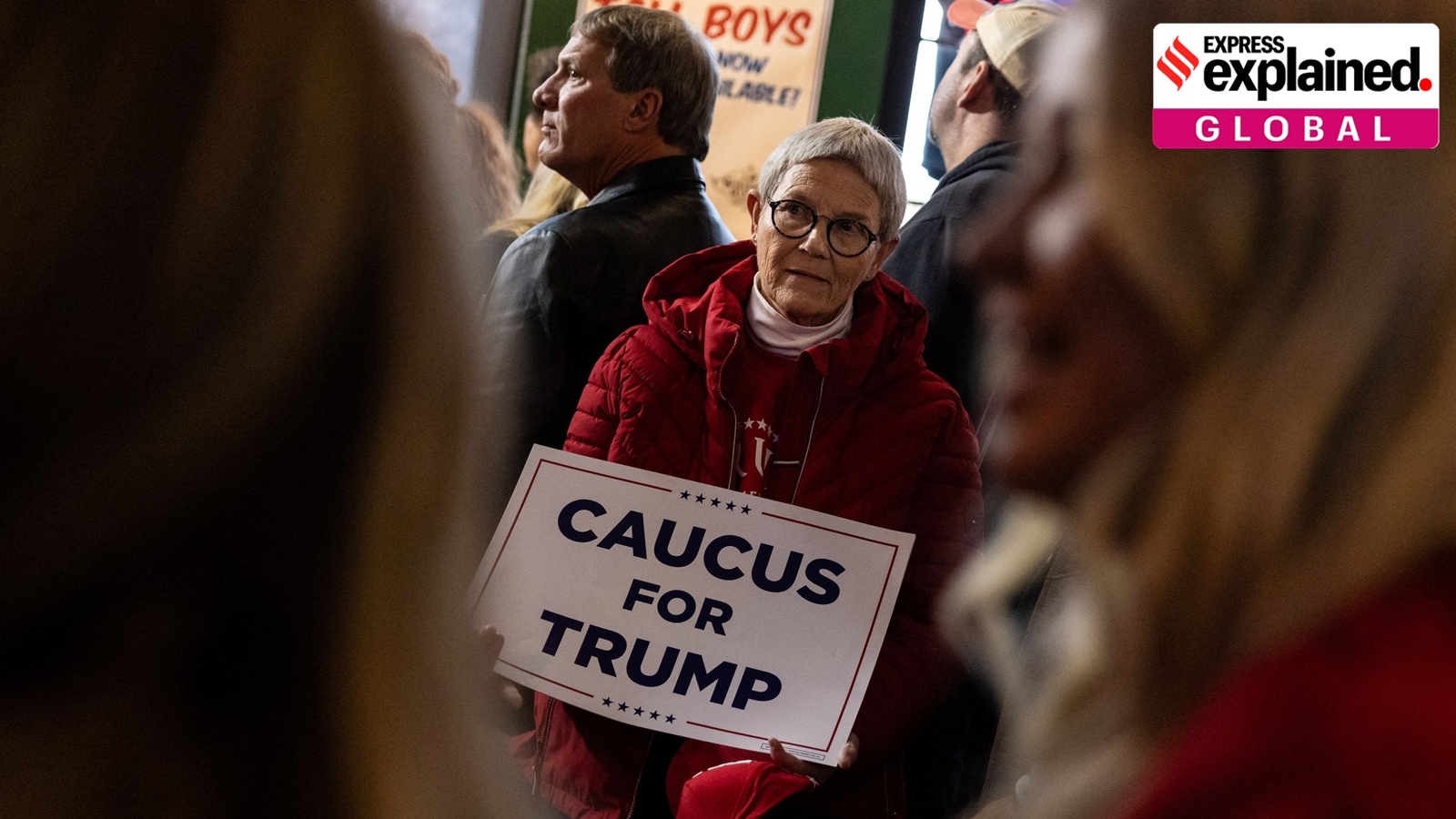 Supporters of former US President and Republican presidential candidate Donald Trump attend a "commit to caucus" event at a Whiskey bar in Ankeny, Iowa, US December 2, 2023. REUTERS/Carlos Barria
Every four years, Iowa — a rural state in America’s heartland — comes under the spotlight for kicking off the election year race for the White House. Since the 1970s, the state has held caucuses, which mark the beginning of the long process by which the Republicans and Democrats choose their nominees for the presidential election.
This year, however, the Iowa caucuses are different. For instance, only Republicans will vote on Monday (January 15) as Democrats have changed their primary calendar, moving their first votes to different states.
Here is everything you need to know about Iowa caucuses and why they are significant.
Caucuses and primaries are the processes available to the 50 American states (plus Washington DC and outlying territories) to choose the two major parties’ nominees for President. The contests — referred to as the primary race — are being held this year between January 15 and June 8.
Since the Democrats all but have their nominee already — President Joe Biden — the 2024 primary race holds meaning only for the Republican party. Republican presidential candidate Donald Trump is far ahead of other Republican candidates, though. Political website FiveThirtyEight, which compiles an average of public opinion polls, pegged Trump’s support in Iowa at 52%, which was more than 30 percentage points above former United Nations Ambassador Nikki Haley and Florida Governor Ron DeSantis, according to a report by Reuters.
Some American states hold primaries, some hold caucuses, and a third group holds a combination of the two systems. Primary elections are conducted by governments; caucuses are private events held by the parties.
In primaries, voters go to polling stations and check the box against the name of their favoured candidate. Caucuses are lengthier processes in which voters attend meetings at public places such as school gymnasiums, churches, and community centres, debate candidate preferences and, when it comes to voting, openly raise their hands for their choice.
The caucus system favours candidates with strong, active bases over those with broader support — and is often criticised for being vulnerable to intimidation, and inconvenient for employees who work in shifts and parents who might find it difficult to attend an in-person meeting of unpredictable length.
As mentioned before, the Republican caucuses will be held on Monday. The Democratic caucuses, however, will be conducted through mail. The process will begin on January 12, when the first ballots will be mailed out to voters, and will conclude on March 5.
Iowa Democrats on Monday can attend in-person gatherings to conduct other party business but they will not choose a presidential candidate then.
The first two states to vote for a Democratic presidential nominee will be South Carolina and Nevada (both of them hold primaries instead of caucuses), which will vote on February 3 and February 6 respectively. Notably, New Hampshire would have voted on the same day as Nevada but it refused to cede its first-in-the-nation primary status, which is enshrined in state law, according to a report by The New York Times. It has scheduled an unsanctioned primary for January 23.
The change in the Democratic primary calendar has been brought to states with a more racially diverse make-up than Iowa and New Hampshire, which are overwhelmingly white.
Last year, in a letter, President Biden pushed for the change, saying the party “must ensure that voters of colour have a voice in choosing our nominee much earlier in the process and throughout the entire early window”.
Why does Iowa go first (for Republicans)?
Iowa has always had caucuses, but they moved into the national spotlight in the 1970s. As the Democratic Party tried to become more inclusive, the process of holding precinct meetings became more elaborate. This required an earlier start, and in 1972, when George McGovern became the Democratic nominee Iowa ended up becoming the first state to hold caucuses. It has since ensured that it remains the first in the nation, even when other states have brought forward their dates.
The caucuses are viewed as the first snapshot of voters’ support for presidential candidates. Typically, those candidates will have spent months campaigning across the state, testing their messages and their appeal. Those who don’t fare well sometimes opt to drop out of the race.
In the case of Republicans, however, the state has not been a reliable barometer of national support. None of the winners of the last three Iowa caucuses – in 2016, 2012 and 2008 – went on to capture the party’s nomination. That’s largely due to Iowa’s evangelical Christian community, which plays an outsized role in the process and tends to back the most socially conservative candidate in the field.
In addition, given its relatively small population, Iowa sends far fewer delegates to the national convention than a state such as Florida or Texas, meaning that it plays a highly disproportionate role in the nominating process.
(With inputs from Reuters)