3 min read
© The Indian Express Pvt Ltd



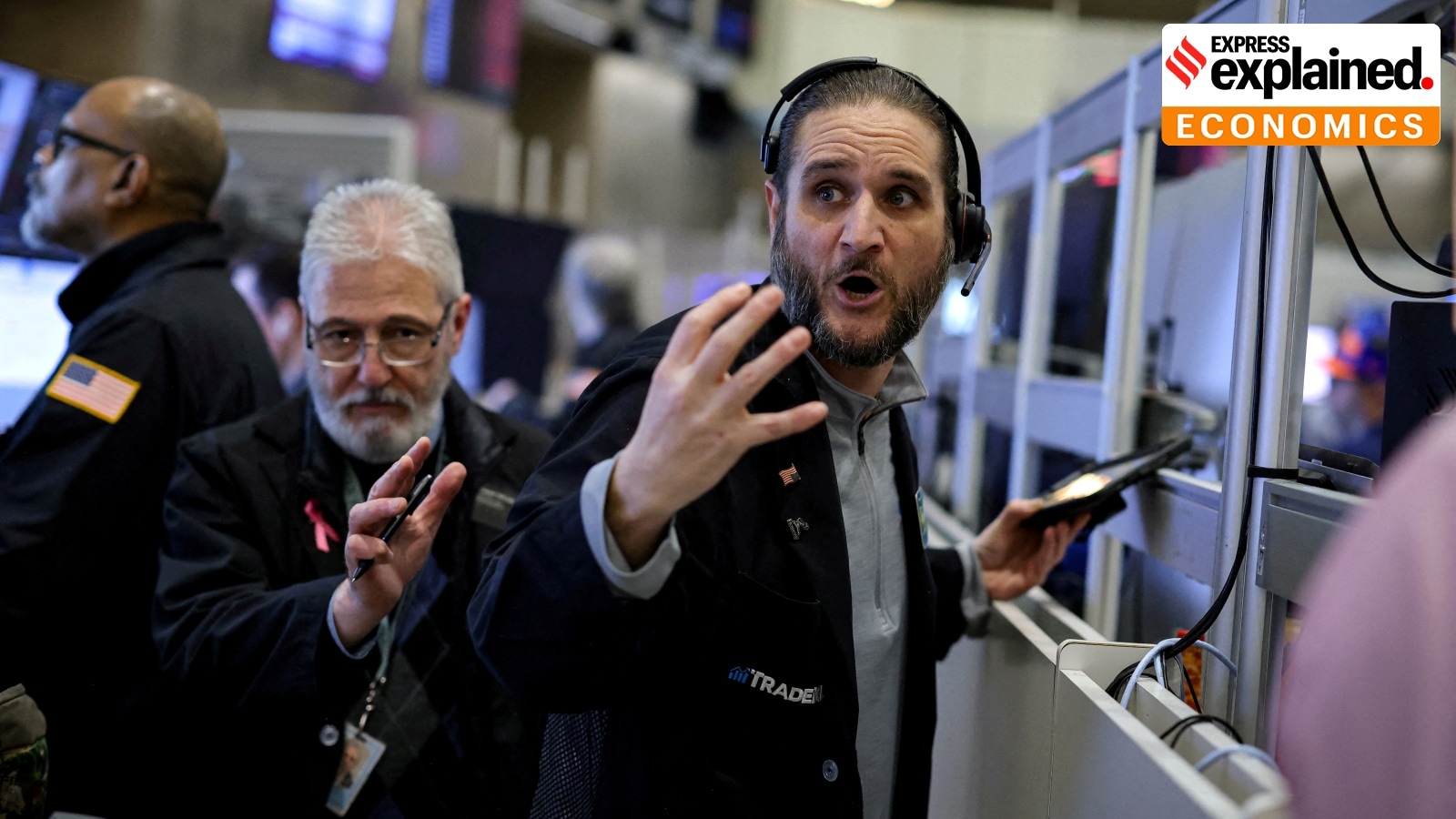 Futures-options traders work on the floor at the American Stock Exchange (AMEX) at the New York Stock Exchange (NYSE) in New York City, US, on Monday. (Photo: Reuters)
 Global stock markets continued to plunge on Monday (April 7) as United States President Donald Trump showed no signs of backing away from the sweeping tariffs that he had announced last week.
Notably, the S&P 500 —- a stock market index that tracks the performance of 500 of the largest publicly traded companies in the US — on Monday briefly entered bear market territory for the first time since 2022.
Here is a look at what a bear market means, its history, and its implications.
A bear market is when a stock index sinks at least 20% from its last peak state. There is nothing official about the determination. The term is just a shorthand way of communicating that the stock index has tumbled.
A bear market is the opposite of a bull market, which refers to when a stock index has increased at least 20% from its recent low.
Note that a bear market is different from a market correction which occurs when there is a decline of at least 10% or more.
A bear market (or for that matter, all types of market decline) takes place when investors are more motivated to sell than to buy stocks. There could be a host of different reasons for this. These include a weak or slowing economy, the anticipation of an economic slowdown, or investor sentiment that the market is too hot and prices too high. Events that are not purely economic — such as wars, oil supply shocks, etc — can also spook investors, leading to a dip in the market.
A bear market often precedes a recession — a slowdown in economic output and is usually defined as at least two consecutive quarters of decline in gross domestic product (GDP). However, this is not always the case. In the US, a quarter of bear markets have not ended in a recession, according to a report by NBC New York.
Bear markets are not incredibly common, but they also are not uncommon. For instance, “over the past 150 years, US stocks have entered bear-market territory about every 6 years, on average,” according to a report by Fidelity Investments, a US-based multinational financial services corporation.
In the US, bear markets have lasted 18.9 months on average, according to Howard Silverblatt, senior index analyst for S&P Dow Jones Indices.
The Indian stock market has also experienced bear markets over the years. One of the worst bear markets occurred during the 2008 global financial crisis. Between September 8, 2008, and November 6, 2008, the Nifty 50 index had dropped over 35%.


Luxury watchmaker Jacob & Co has unveiled a one-of-a-kind timepiece, the Opera Vantara Green Camo, as a tribute to Vantara, the wildlife rescue and conservation initiative based in Gujarat and led by Anant Ambani, the younger son of Mukesh and Nita Ambani. The watch was introduced on January 21, 2026.