GDP: New labour codes and opportunity for India’s weakest states
India has always had surplus labour and, not surprisingly as a result, fairly low wage rates. But instead of these being a strength, Indian states that had surplus labour and low wage rates, have historically been the laggards in the growth story
The idea is that these codes will provide a new, more predictable framework in which India’s labour can be engaged. (Express photo by Harmeet Sodhi)
Five years after they were passed by the Parliament, the Indian government notified the implementation of the four new labour codes last week. The new codes replace 29 existing laws and are aimed towards reforming India’s labour market, a key element in helping the Indian economy achieve its potential. That’s because, as the government claims, these labour codes will modernise labour market regulations, ease compliance burden, widen the security net for workers, including for gig and platform workers, and encourage formalisation. The idea is that these codes will provide a new, more predictable framework in which India’s labour can be engaged.
The proof of this pudding, as they say, will lie in how far these labour codes succeed in creating more jobs for India’s youth in the coming years. India has always had surplus labour and, not surprisingly as a result, fairly low wage rates. But instead of these being a strength, Indian states that had surplus labour and low wage rates, have historically been the laggards in the growth story — think of Uttar Pradesh (UP) and Bihar. On the other hand, countries with similar characteristics, say China, Vietnam and Bangladesh, have, over time, been successful in leveraging these very factors to overtake India, especially in the manufacturing sector — the one sector that has the most ability to absorb surplus labour by means of creating new jobs.
A new report by HSBC Global Investment Research shares an interesting data insight regarding this.
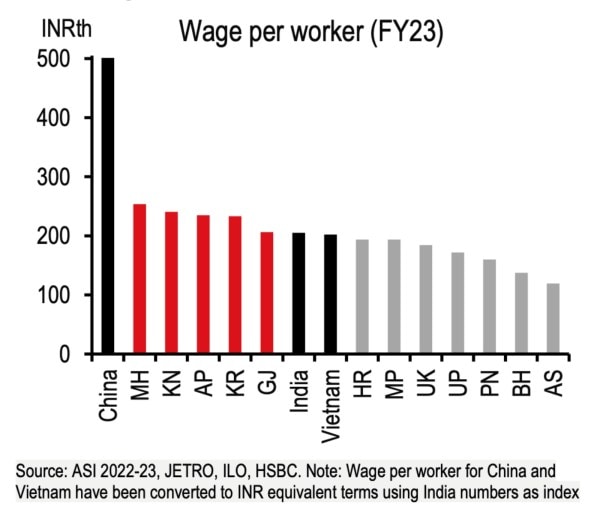
“We find that there are signs of global supply chains being rejigged in labour-intensive mid-tech sectors such as textiles, footwear, furniture, and toys. Countries such as Vietnam have already grown quickly by seizing this opportunity over the last several years, and now the world may be looking for new manufacturers. India’s emerging states have a wage advantage (see attached chart), and if they double it up with better infrastructure, more deregulation, and easier labour laws, they can succeed in attracting some of this mid-tech FDI, and finally become a part of global supply chains,’ states the report.
Several key things stand out from this chart. For one, it again underscores the point that China’s manufacturing dominance is no longer about low wage rates. China’s wages are far higher.
The second noteworthy aspect is that Vietnam’s average wage per worker is lower than India’s average. Several Indian states that are already some of the bigger states either in total economic output or else in output per capita — such as Maharashtra, Karnataka, Andhra Pradesh and Kerala — have wage rates much higher than Vietnam.
However — and this is the most important insight from this chart — in most states that have lagged behind in economic growth in the past (e.g. UP, Bihar and Madhya Pradesh, etc.) the wage rates are still lower than in Vietnam. As HSBC points out, with the right incentive structure in the form of easier labour laws and better infrastructure, etc., these states can script a growth story of their own.
Udit Misra is Senior Associate Editor at The Indian Express. Misra has reported on the Indian economy and policy landscape for the past two decades. He holds a Master’s degree in Economics from the Delhi School of Economics and is a Chevening South Asia Journalism Fellow from the University of Westminster.
Misra is known for explanatory journalism and is a trusted voice among readers not just for simplifying complex economic concepts but also making sense of economic news both in India and abroad.
Professional Focus
He writes three regular columns for the publication.
ExplainSpeaking: A weekly explanatory column that answers the most important questions surrounding the economic and policy developments.
GDP (Graphs, Data, Perspectives): Another weekly column that uses interesting charts and data to provide perspective on an issue dominating the news during the week.
Book, Line & Thinker: A fortnightly column that for reviewing books, both new and old.
Recent Notable Articles (Late 2025)
His recent work focuses heavily on the weakening Indian Rupee, the global impact of U.S. economic policy under Donald Trump, and long-term domestic growth projections:
Currency and Macroeconomics:
"GDP: Anatomy of rupee weakness against the dollar" (Dec 19, 2025) — Investigating why the Rupee remains weak despite India's status as a fast-growing economy.
"GDP: Amid the rupee's fall, how investors are shunning the Indian economy" (Dec 5, 2025).
"Nobel Prize in Economic Sciences 2025: How the winners explained economic growth" (Oct 13, 2025).
Global Geopolitics and Trade:
"Has the US already lost to China? Trump's policies and the shifting global order" (Dec 8, 2025).
"The Great Sanctions Hack: Why economic sanctions don't work the way we expect" (Nov 23, 2025) — Based on former RBI Governor Urjit Patel's new book.
"ExplainSpeaking: How Trump's tariffs have run into an affordability crisis" (Nov 20, 2025).
Domestic Policy and Data:
"GDP: New labour codes and opportunity for India's weakest states" (Nov 28, 2025).
"ExplainSpeaking | Piyush Goyal says India will be a $30 trillion economy in 25 years: Decoding the projections" (Oct 30, 2025) — A critical look at the feasibility of high-growth targets.
"GDP: Examining latest GST collections, and where different states stand" (Nov 7, 2025).
International Economic Comparisons:
"GDP: What ails Germany, world's third-largest economy, and how it could grow" (Nov 14, 2025).
"On the loss of Europe's competitive edge" (Oct 17, 2025).
Signature Style
Udit Misra is known his calm, data-driven, explanation-first economics journalism. He avoids ideological posturing, and writes with the aim of raising the standard of public discourse by providing readers with clarity and understanding of the ground realities.
You can follow him on X (formerly Twitter) at @ieuditmisra
... Read More


 3 min read



 Chart
Chart