The Cabinet’s approval is part of Indian Railways’ long-term initiative to decongest all the seven High Density Network or Corridors. They together form almost 16 per cent of the entire network, but handle 41 per cent of the total rail traffic. This makes the HDN the backbone of Indian Railways. With the increasing passenger and freight traffic demands, better management of the high density network is imperative.

The routes
High Density Network or HDN is formed by passenger-freight corridors where trains are running beyond capacity in most sections. This causes congestion, delays in passenger and freight operations, and affects the efficiency of the network. Out of the total 69,181 route-km network of Indian Railways, the High Density Network accounts for 11,051 route-km or 15.97 percent of the total. These saturated corridors have been further divided into 237 sections with different kilometre ranges.
While there is not a single universal benchmark for the “right capacity utilisation”, it is considered that a rail network should operate at 70-80 percent of its total capacity to keep the flow of trains seamless.
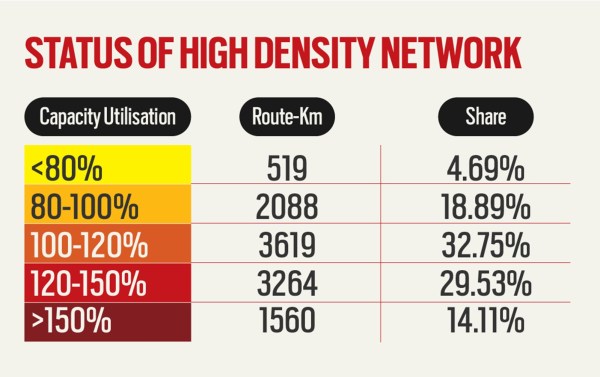
According to the latest report of the Planning Directorate, Railway Board, only 4.60 percent of the entire route of HDN is operating below 80 per cent capacity. The line-capacity utilisation of 18.89 per cent of the HDN is 80-100 per cent, 32.75 per cent of the network’s utilisation is 100-120 per cent, 29.53 per cent of the route has 120-150 per cent utilisation, and 14.11 per cent of the network is seeing more than 150 per cent operation.
The report further shows that out of the total 237 sections on the corridor, only 24 sections or 10 per cent of the total have less than 80 per cent line capacity utilisation, 41 sections have 80-100 per cent, 81 sections have 100-120 per cent, 58 sections have 120-150 per cent, and 33 sections are seeing more than 150 per cent capacity utilisation.
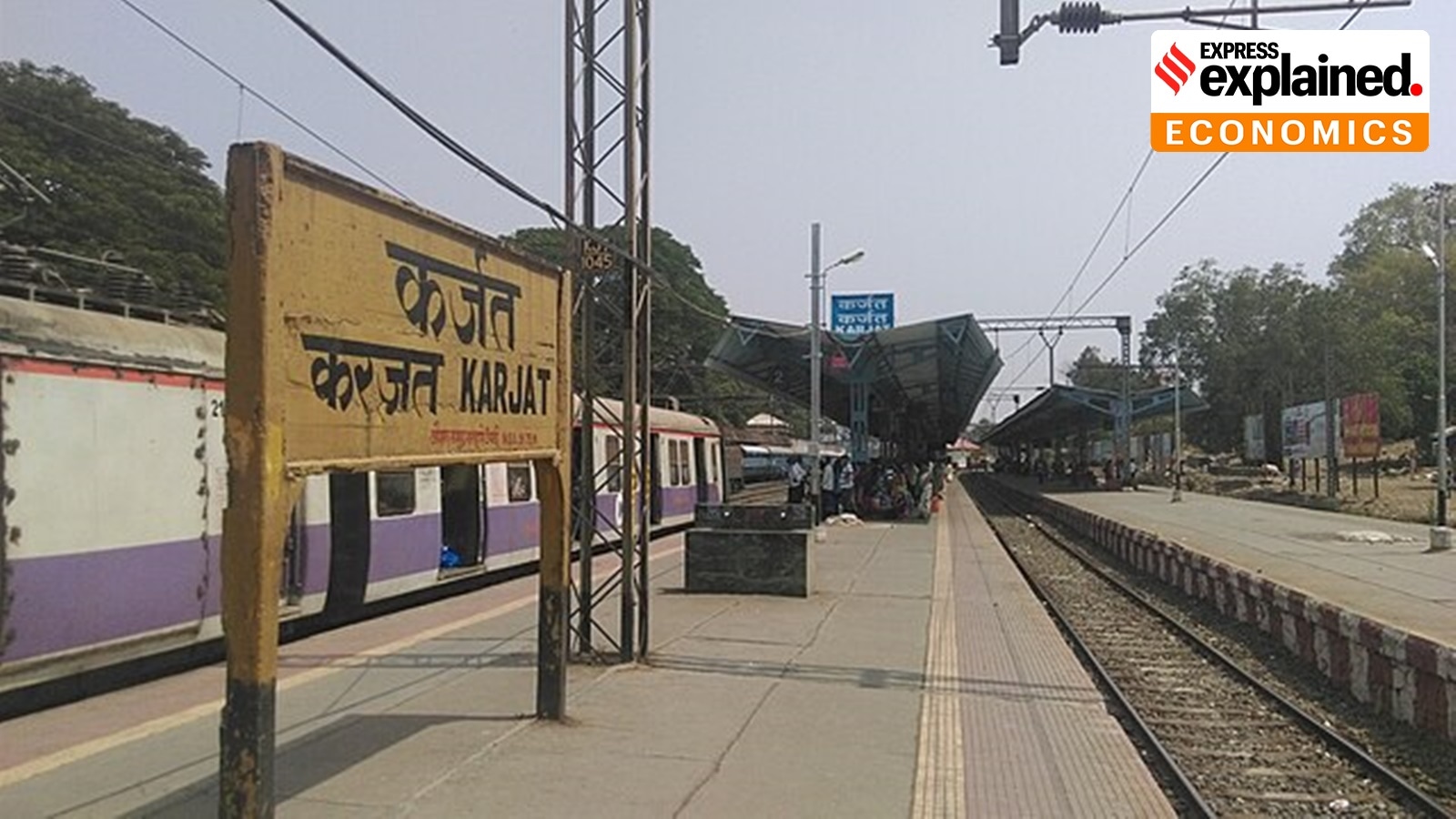
For example, in the 28-km Karjat-Lonavala section of Mumbai-Chennai HDN, which is the section after the Badlapur-Karjat line, on an average 67 trains run each way per day against the maximum capacity of 40 trains, resulting in the capacity utilisation to 167 per cent.
Story continues below this ad
These figures of HDN are much higher when compared with the overall capacity utilisation of Indian Railways. According to the National Rail Plan — the vision document outlining the Railways’ planning up to 2051 — the number of trains operating on 45 per cent of the entire network is below 70 per cent capacity, 29 per cent is operating between 70-100 per cent, 25 per cent of the network is operating between 100-150 per cent, and one per cent of the network is operating trains at 1.5 times higher than its capacity, or more than 150 per cent.
The HDN Coverage
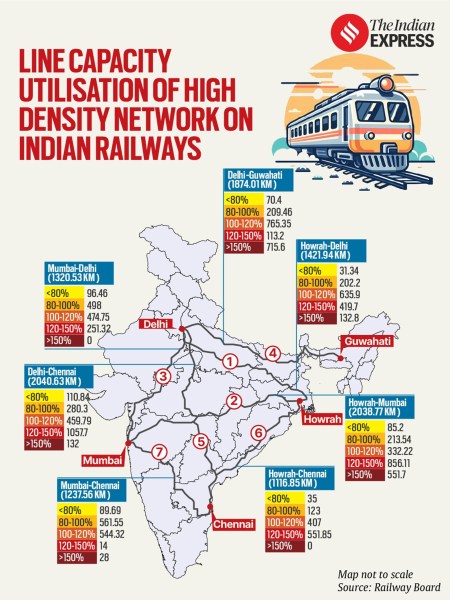
The HDN covers all four sides of the country. The seven HDN are: 1,422-km Howrah-Delhi via Dankuni, Asansol, Dhanbad, Prayagraj and Kanpur Central; 2,039-km Howrah-Mumbai via Kharagpur, Tatanagar, Jharsuguda, Bilaspur, Nagpur, Bhusaval and Igatpuri; 1322-km Mumbai-Delhi via Surat, Godhra, Ratlam, Nagda, Sawai Madhopur and Mathura; 1,876-km Delhi -Guwahati via Moradabad, Roza, Gonda, Gorakhpur, Katihar, New Jalpaiguri and Rangiya; 2,037-km Delhi-Chennai via Mathura, Jhansi, Bina, Bhopal, Nagpur, Balharshah and Vijayawada; 1,117-km Howrah-Chennai via Bhadrak, Visakhapatnam and Vijayawada; and Mumbai-Chennai Corridor.
The report shows that in the Howrah-Delhi corridor or HDN 1 , the line capacity utilisation for only 31.34 km or two sections is less than 80 per cent. Similarly, in HDN 2 or Howrah (Kolkata)-Mumbai corridor, which is part of Golden Diagonal, 85.2-km route is seeing less than 80 per cent of total train capacity.
HDN 3 or Delhi-Mumbai corridor, a part of the Golden Quadrilateral, is one of the only two HDN which does not have line capacity utilisation more than 150 per cent for any stretch. A total of its 1224-km stretch is over saturated with the capacity utilisation of over 80 percent. The Western Dedicated Freight Corridor (WDFC) from Jawaharlal Nehru Port (JNPT) near Mumbai to Dadri in Uttar Pradesh runs along HDN 3 to handle freight trains.
Story continues below this ad
HDN 4 or Delhi-Guwahati corridor connects the national capital with North-Eastern states via three metropolitan cities. Along with passengers, the line sees high demand for freight as well. Almost 96 per cent route-km in the corridor has over 80 per cent line capacity utilisation.
Similarly, nearly 52 per cent of the HDN 5 or Delhi-Chennai corridor and 50 percent of HDN 6 or Howrah-Chennai is over saturated with 120-150 percent of the line capacity utilisation. In HDN 7 or Mumbai-Chennai, almost 90 per cent of the corridor sees trains running 80-120 per cent of its total capacity.
Decongestion efforts
The National Rail Plan has estimated that with the current infrastructure, congestion in HDN will increase so much that none of the sections will be operating with capacity utilisation of less than 100 percent and 92 per cent of the network shall be operating on capacity utilization higher than 150 per cent by 2051.
For the near future, by 2031, the document shows that 50 percent of the total High Density Network will be operating with over 150 per cent congestion, 39 per cent with 100-150 per cent capacity, and 9 per cent will be operating at 70-100 per cent of its capacity.
Story continues below this ad
While there are different operations that ensure the seamless movement of a train, expansion of the line, i.e doubling, tripling, quadrupling and penta/hexa lining, is the most important project in decongesting a corridor.
The Ministry of Railways has been taking up line-expansion projects under its doubling schemes. The data shows that a total of 1,983 km of such projects were completed in 2021-22, 3,185.5 km in 2022-23, 2,244 km in 2023-24, and over 2,900 km in 2024-25.
Along with this, the two dedicated freight corridors (DFCs), of which Eastern DFC is fully operational and Western DFC is 96.4 per cent operational, is expected to transfer some freight traffic to its corridor to east the HDN for passenger operations.
According to the Railway Board’s data, out of the total 11,051 km of HDN, 250 km is single line, 8,113 km is double line, 2,040 km is triple line, 625 km is quadruple line, and 23 km is penta/hexa line. HDN 4 is the only one among the categories in which over 250 km of the corridor is still single line. HDN 1, HDN 3 and HDN 5 are the only ones that have penta/hexa lines. The longest quadruple line of 212 km is in HDN 2, followed by 187 km in HDN 1 and 126 km in HDN3.
Story continues below this ad
As per the National Rail Plan, HDN 1 and HDN 4 have been recommended to be upgraded to triple line for the entire length. Similarly, it has been proposed to convert HDN 2, HDN 3, HDN 6 and HDN 7 to triple or quadruple lines for the entire length to meet the passenger and freight demand in future.


 7 min read