What are MSPs? Why do they matter?
MSPs are “support prices” announced by the government (and sometimes state governments add a bonus amount to them) and the intended aim in announcing them is to provide a safety net for farmers.
As a farmer, one is worried sick each season because one does not know what one’s harvest will fetch. Given the acute lack of warehousing and cold storage in India, a farmer has little bargaining power in the market. If the market prices are below the farmer’s cost of production they and their families can be ruined.
Widespread distress of this kind tends to have broader ramifications as well. For example, if one particular crop, say cotton, led to the ruin of many farmers, then farmers will avoid growing cotton next season. This, in turn, will reduce supply and push up prices. Higher prices will then show up across the different products for consumers.
By announcing MSPs, the government makes a promise that it will buy (called procurement) from farmers at the announced prices. Since MSPs are calculated in such a manner that covers the basic costs of cultivation, the hope is that MSPs will save farmers from ruin.
Story continues below this ad
The other big purpose of MSPs is to serve as a tool in the hands of the policymakers to tweak the production pattern. If the government wants to incentivise the production of pulses, as against paddy (rice), then it can give a relatively higher hike in MSP of pulses than the MSPs for paddy.
Does the government actually buy all crops at MSPs?
No. It is important to remember that, while the government announces MSPs for a whole host of crops both in the Rabi (winter) and the Kharif (summer) season, it procures only a few of those crops and that too from only a few states.
According to a CRISIL research report, crops such as paddy, cotton and, to a limited extent, pulses get procured at MSP. Only few Kharif crops benefit from government procurement.
“However, not all crops benefit from it (MSPs), leave alone equally. While around 45% of the paddy produced is procured at MSP, it is about 25% in case of cotton and only 1-3% in case of pulses,” according to CRISIL.
Story continues below this ad
“Also, the procurement is concentrated in only a few states — in Punjab, Haryana, western Uttar Pradesh, Chhattisgarh, and Telangana for paddy, in Telangana and Maharashtra for cotton, and in Maharashtra and Karnataka for pulses,” states the CRISIL report.
What are the economic and political aspects of MSP announcements?
India’s farm economy — or for that matter that of any country — doesn’t really fully adhere to market principles. Partly that’s because national food security is a strategic concern. Moreover, if large a population is involved in farming as it is in India, then it is unlikely that farming will prove to be remunerative.
But government intervention makes everything political. Closer to elections, it is natural for governments to announce high MSPs to win over the farmer vote.
Story continues below this ad
The economic aspect of MSPs, however, is not limited to farmers alone. While a sharp rise in MSPs (or higher MSPs over a sustained period) does alleviate farm distress, it can also lead to a spike in food inflation.
The trade-off between the interests of the farmer, on the one hand, and consumers, on the other, makes deciding MSPs so difficult. The political dimension just adds to the complications.
So, what has been announced?
On June 7, the government announced that MSPs for the Kharif season will go up by an average of 7%; the actual range varies between 5% to 10.5% depending on the crop.
However, since different people speak for different stakeholders, this increase can be viewed in many different ways.
Story continues below this ad
How big is the hike in MSPs? Has it been motivated by political concerns?
“This is the highest MSP increase in the last 5 years and the second highest in the last decade,” states a Citi Research note by Samiran Chakraborty (Managing Director, Chief Economist, India).
At the same time, “the government has refrained from large MSP spikes usually seen in pre-election years (34.1%, 19.6% and 15.2% witnessed in the last 3 pre-election years),” finds the Citi note (SEE CHART 1).
 Chart 1: Modest MSP increase for a pre-election year. (Source: Citigroup Inc)
While India’s farm distress is decades long, it is important to remember that it has only deepened over the past decade.
Story continues below this ad
How does this hike compare with the rate of food inflation and the rise in cost of production?
The prices of cereals went up by almost 14% in April this year. In other words, they were 14% more than what they were in April last year. From that perspective, the MSP hike is modest.
However, the Citi Research note finds that cost of cultivation went up by 6.8% and from that perspective, a 7% hike in MSPs is enough to ensure that farm economy does not lose out to the non-farm economy.
How will this hike impact inflation and monetary policy?
It is unlikely that this hike per se would spike inflation. However, it is noteworthy that food inflation may still spike if the normal monsoon is affected by El Nino.
Story continues below this ad
Given that this hike is unlikely to spike inflation by itself, it will allay the apprehensions RBI and the members of its Monetary Policy Committee might have about possible inflation surge later on in the year.
What does it mean for the government’s finances?
Higher MSPs and more procurement as well as the storage and disbursal of subsidised foodgrains are all expenditures that weigh down government’s financial health. According to Citi Research, this “MSP increase will not materially alter the government’s food subsidy budgeting.”
What will be the likely impact on rural India?
This is possibly the crucial aspect of the MSP decision.
Latest GDP data showed that personal consumption growth — the biggest contributor to India’s GDP — was growing at around 2.5% over the past two quarters. This is starkly lower than India’s overall GDP growth rate of 7.2%.
Story continues below this ad
Worse, within this broader trend, it is the rural economy that is lagging behind urban India. “The consumption growth trends in the GDP have been weak with drivers of rural consumption remaining uneven,” states the Citi Research note.
Given this context as well as the market expectation that the Karnataka election result would have resulted in a stimulus for the rural demand, this hike is muted.
“The 7% MSP increase might just be enough to cover the increase in cost of production but does not signal a pre-election populist boost to rural consumption. There was some market perception that after the Karnataka election results, the government might be focusing more on stimulating rural demand,” states Citi notes.
However, it does provide a caveat.
“The extent of MSP increase does not support that hypothesis, though in theory, populist spending could be more back-ended, closer to the general election date.”
See you on Monday,
Udit


 8 min read



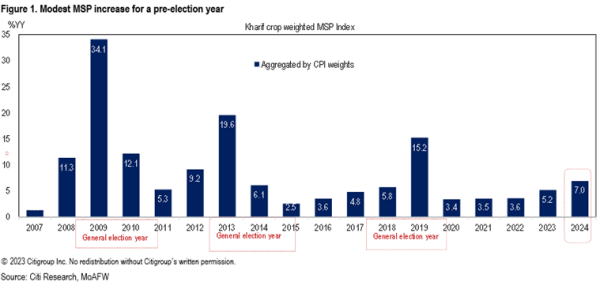 Chart 1: Modest MSP increase for a pre-election year. (Source: Citigroup Inc)