This is an archive article published on February 10, 2022
Explained: Why the Centre has termed the country’s Covid-19 situation ‘optimistic’
The government has said the overall Covid-19 pandemic situation emerging in the country is optimistic. However, it has also warned against complacency.
New Delhi | Updated: February 11, 2022 08:21 AM IST
4 min read
Whatsapp
twitter
Facebook
Reddit
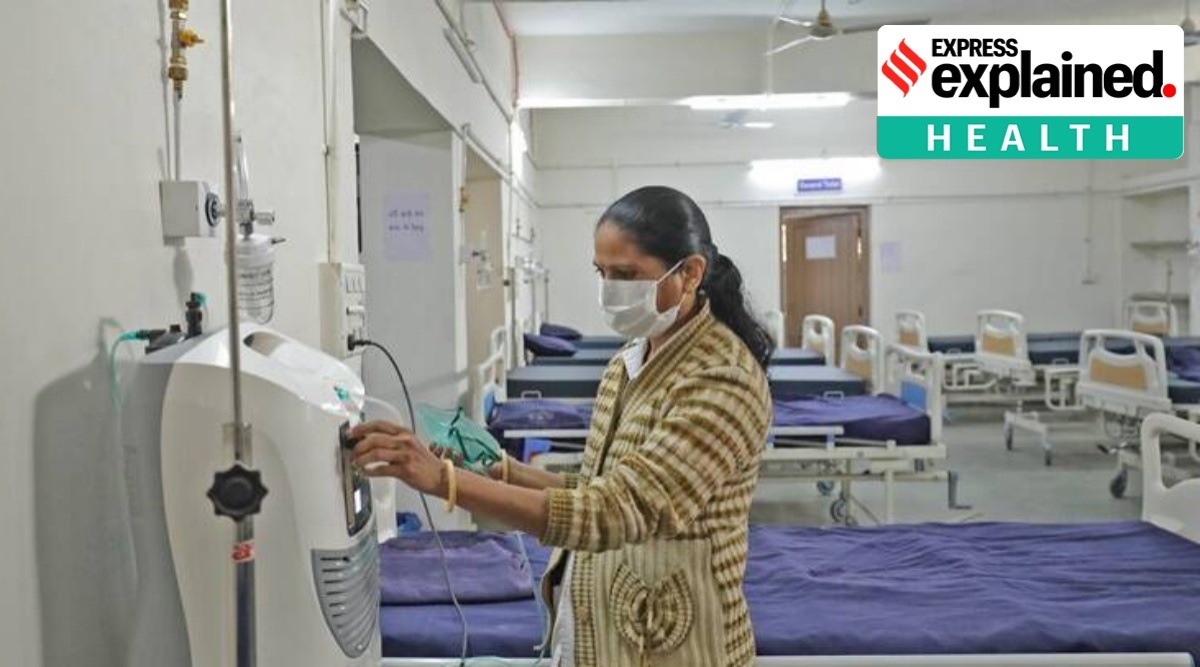
Covid care ward getting ready at Civil hospital in Sanand, Gujarat. (Express Photo by Nirmal Harindran)
India is in the middle of its third wave of the coronavirus pandemic, triggered by the highly infectious Omicron variant. The government said on Thursday that the overall pandemic situation emerging in the country was optimistic. However, it also warned against complacency given the unique challenges the virus can still pose and the situation in some states and districts.
The good news
First, there has been a consistent decline in cases reported in the country. In fact, the daily number of new cases has remained under one lakh in the past four days. Second, there has also been a decline in the positivity rate—indicating the decreased spread of infections. Most significantly, in the past three days, the positivity rate has remained under five per cent, above which infections are considered to be a cause for concern. The health ministry has time and again asked for local containment and surveillance in districts reporting positivity rates above five per cent.
In the week ending February 9, a significant 433 districts reported positivity rates below five per cent. In the previous week, only 268 districts did so. This indicates a significant decrease in the spread of infections at the district level.
More importantly, only 141 districts are now reporting positivity rates above 10 per cent. In the previous week, as many as 297 districts were reporting positivity rates of over 10 per cent.
As many as 21 states are reporting fewer than 10,000 active cases daily, and 11 states are reporting active cases between 10,000 and 50,000. This shows a majority of states have fewer active cases—an indication that the health system is not overwhelmed by hospitalisation due to severe Covid-19 disease.
There are four states in the country that report more than 50,000 active cases: Kerala, Maharashtra, Tamil Nadu and Karnataka. But even in these states, there has been a significant drop in active cases compared to the past week. There are also 200 districts with test positivity rates of 10 per cent.
Story continues below this ad
“Approximately 40 districts have shown an increase in weekly cases and positivity rates. And 200 districts have a positivity of 10 per cent. The overall picture is optimistic; there is no doubt of that. However, if we look at it closely, then there are very critical problems of concern at the state and district levels. So we are passing through a transition towards improvement. But then this is not yet the time for us to be less vigilant. We cannot lower our guard,” said Dr V K Paul, head of India’s Covid-19 task force.
The worry
The government emphasised that since the world still had a limited understanding of the novel coronavirus, people should expect the virus to be around in the country and the world. Therefore, despite the drop in positivity rates, containment, surveillance and Covid-appropriate behaviour continue to remain critical. “Going into the future, this is not the end of the virus. This is still around in the world and country. And the virus, being under pressure, will try to emerge fitter so that it could find a way to exponentially increase. Therefore the x-factor should always be borne in our minds. The world does not know everything about this virus,” Paul said.
As City Editor ( Delhi) at the Indian Express, Kaunain Sheriff leads city reporting with a sharp focus on accountability journalism, data-driven stories, and ground-level impact. As the National Health Editor he leads the newsroom’s in-depth coverage of pressing health issues.
He is the author of Johnson & Johnson Files: The Indian Secrets of a Global Giant, a definitive investigation into the accountability of one of the world’s most powerful pharmaceutical corporations.
Areas of Expertise
Investigative Reporting: Has deep expertise in investigative reporting spanning public health, regulatory affairs, drug safety, and the criminal justice system. His work sits at the intersection of governance, law, and accountability, with a particular focus on how regulatory failures, institutional lapses, and policy decisions affect citizens’ rights and safety.
Data Journalism: Has extensively on big data–driven investigations, including analyses of flagship government schemes and large datasets on criminal trials, uncovering systemic gaps.
Global Collaborations
Kaunain is a key contributor to major international journalistic projects:
The Implant Files: Collaborated with the International Consortium of Investigative Journalists (ICIJ) to expose global malpractices in the medical device industry.
Chinese Big-Data Investigation: Uncovered how a foreign data firm monitored thousands of prominent Indian institutions and individuals in real-time.
Awards & Recognition
His commitment to "Journalism of Courage" has been recognized with the industry's highest honors:
Ramnath Goenka Award for Excellence in Journalism
SOPA Award (Society of Publishers in Asia)
Red Ink Award (Mumbai Press Club)
Indian Express Excellence Awards (Triple recipient for investigations into the NSA abuse in UP, Vyapam scam, and the anti-Sikh riots).
Education: Studied Mechanical Engineering at Visvesvaraya Technological University (VTU), Bangalore, before moving to Delhi to pursue his passion for journalism. His engineering training informs his analytical approach, enabling him to decode technical, legal, and data-heavy systems with precision.
Social media
LinkedIn: linkedin.com/in/kaunain-sheriff-3a00ab99
X ( fromerly Twitter): @kaunain_s ... Read More


 4 min read