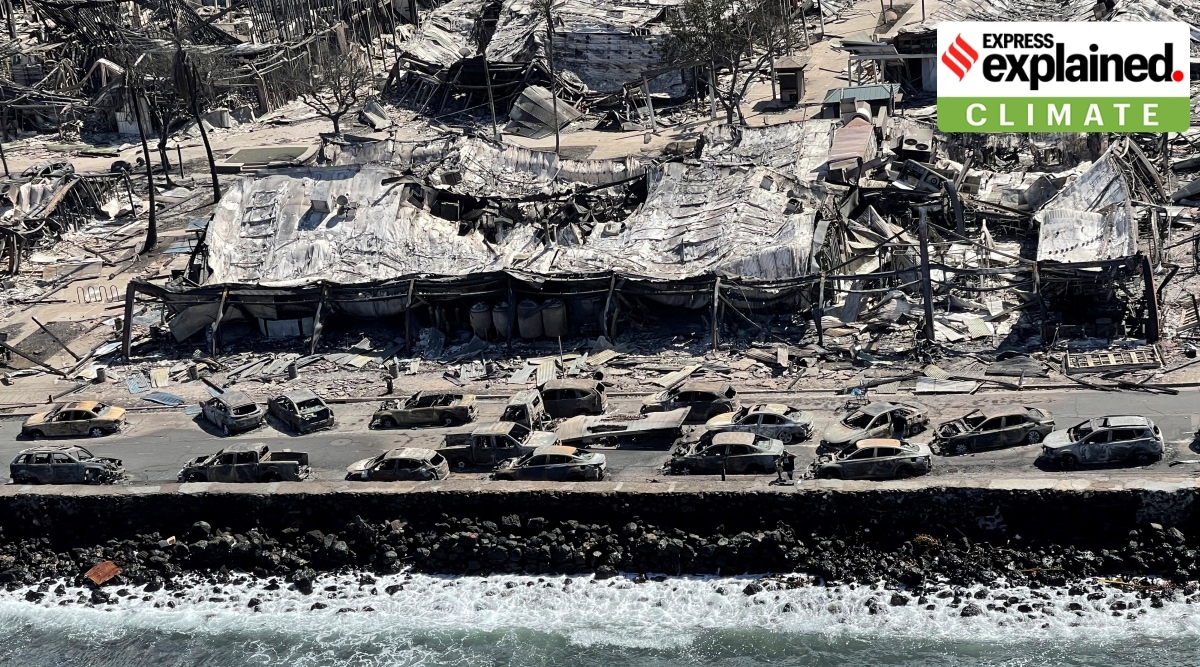
This photo provided by the Hawaii Department of Land and Natural Resources shows burnt areas in Lahaina on the Maui island, Hawaii, Friday, Aug. 11, 2023, following a wildfire. (Hawaii Department of Land and Natural Resources via AP)
Listen to this article
Global warming and strong winds: What led to the wildfires of Hawaii
x
00:00
1x1.5x1.8x
In one of the worst natural disasters to hit the US, multiple wildfires are raging through Hawaii, especially the island of Maui. It is known that at least 93 people have died as of August 13, thousands have been displaced and buildings and businesses have burnt down — the numbers will rise as rescue operations increase. More than 48 hours after it started, the fires are yet to be brought under complete control by crews.
The affected areas in Hawaii
Maui is one of the eight main islands that make up the archipelago of Hawaii. Lahaina, a coastal town of art galleries, unique spots and history in Maui, has, reportedly, been reduced to ashes.
“None of it is there. It’s all burnt to the ground,” Mayor Richard Bissen has said.
Images show smouldering stretches of neighbourhood, smoking rubble and a grey landscape. Among the other areas affected are the coastal cities of Kihei and Kula, a picturesque, rustic area on the mountain slopes at the centre of the island. Parts of another island, called Hawai’i or the Big Island, have also been burnt by the fire.
Man-made and natural causes
The exact cause of the fire is still not certain. Data from 2000-2017 from US Forest Service, among others, shows that 85 percent of wildfires in the US are caused by humans and involve campfires, garbage burning, malfunctioning equipment and burning cigarettes, among others. Natural causes of fire include volcanic activity and lightning strikes. Maui is home to one of the six active volcanoes of Hawaii. What experts are noting is that most of Maui was experiencing severe drought, so the dry land, with dry non-native grasses and vegetation, was ready fuel for fires. These fed the fires and helped them spread.
The winds of Hurricane Dora
Experts feel that the fire in Hawaii started in the wild and was carried by the wind that was blowing at almost 100 kmph. The winds have their origins in Hurricane Dora, an unusually strong storm in the Pacific Ocean. Hundreds of miles away from Hawaii, Hurricane Dora did not hit Hawaii. Instead, the islands were caught between high and low pressure zones due to the hurricane, which resulted in the winds fanning the flames and making these difficult to control.
When the fire reached Lahaina in the darkness, the residents were unprepared. The flames ate through wooden monuments and other landmarks with such speed that people ran out of their homes but found the roads ablaze and strewn with debris. Many jumped into the ocean.
Story continues below this ad
The role of fossil fuel
Hawaii, according to government data, has lost 1.5 million acres of native forest, which were natural water and climate regulators. “Without them, we are seeing disruptions in weather and temperature patterns. In other words, climate change and forest loss are working together to make Hawai‘i drier and hotter,” says an official statement. Maui, for instance, had suffered fires in 2018 and 2021, which caused massive destruction.
Climate Scientist Prof. Katharine Hayhoe tweeted on August 10, “Amid the devastating Maui fires, I see many arguing, ‘it’s weather, arson – anything but climate change’. Let’s set the record straight. Climate change doesn’t usually start the fires; but it intensifies them, increasing the area they burn + making them much more dangerous”.
One of the big reasons for climate change is the burning of fossil fuels which release large amounts of greenhouse gases into the atmosphere, causing global warming. Unprecedented climate events are increasing around the world. According to the United Nations, there will be an increase of extreme fires globally by up to 14 per cent by 2030, 30 per cent by the end of 2050 and 50 per cent by the end of the century.
Dipanita Nath is a Senior Assistant Editor at The Indian Express, based in Pune. She is a versatile journalist with a deep interest in the intersection of culture, sustainability, and urban life.
Professional Background
Experience: Before joining The Indian Express, she worked with other major news organizations including Hindustan Times, The Times of India, and Mint.
Core Specializations: She is widely recognized for her coverage of the climate crisis, theatre and performing arts, heritage conservation, and the startup ecosystem (often through her "Pune Inc" series).
Storytelling Focus: Her work often unearths "hidden stories" of Pune—focusing on historical institutes, local traditions, and the personal journeys of social innovators.
Recent Notable Articles (December 2025)
Her recent reporting highlights Pune’s cultural pulse and the environmental challenges facing the city during the winter season:
1. Climate & Environment
"Pune shivers on coldest morning of the season; minimum temperature plunges to 6.9°C" (Dec 20, 2025): Reporting on the record-breaking cold wave in Pune and the IMD's forecast for the week.
"How a heritage tree-mapping event at Ganeshkhind Garden highlights rising interest in Pune’s green legacy" (Dec 20, 2025): Covering a citizen-led initiative where Gen Z and millennials gathered to document and protect ancient trees at a Biodiversity Heritage Site.
"Right to breathe: Landmark NGT order directs PMC to frame norms for pollution from construction sites" (Dec 8, 2025): Reporting on a significant legal victory for residents fighting dust and air pollution in urban neighborhoods like Baner.
2. "Hidden Stories" & Heritage
"Inside Pune library that’s nourished minds of entrepreneurs for 17 years" (Dec 21, 2025): A feature on the Venture Center Library, detailing how a collection of 3,500 specialized books helps tech startups navigate the product life cycle.
"Before he died, Ram Sutar gave Pune a lasting gift" (Dec 18, 2025): A tribute to the legendary sculptor Ram Sutar (creator of the Statue of Unity), focusing on his local works like the Chhatrapati Shivaji statue at Pune airport.
"The Pune institute where MA Jinnah was once chief guest" (Dec 6, 2025): An archival exploration of the College of Agriculture, established in 1907, and its historical role in India's freedom struggle.
3. Arts, Theatre & "Pune Inc"
"Satyajit Ray, Ritwik Ghatak were not rivals but close friends, says veteran filmmaker" (Dec 17, 2025): A deep-dive interview ahead of the Pune International Film Festival (PIFF) exploring the camaraderie between legends of Indian cinema.
"Meet the Pune entrepreneur helping women build and scale businesses" (Dec 16, 2025): Part of her "Pune Inc" series, profiling Nikita Vora’s efforts to empower female-led startups.
"How women drone pilots in rural Maharashtra are cultivating a green habit" (Dec 12, 2025): Exploring how technology is being used by women in agriculture to reduce chemical use and labor.
Signature Style
Dipanita Nath is known for intellectual curiosity and a narrative-driven approach. Whether she is writing about a 110-year-old eatery or the intricacies of the climate crisis, she focuses on the human element and the historical context. Her columns are often a blend of reportage and cultural commentary, making them a staple for readers interested in the "soul" of Pune.
X (Twitter): @dipanitanath ... Read More


 4 min read