Premium
This is an archive article published on December 5, 2020

Explained: Can surgery be a part of Ayurveda? Why is IMA objecting to it?

The government has notified compulsory surgical procedures for PG students of Ayurveda. How does Ayurveda deal with surgery, and why is the Indian Medical Association upset with the notification?

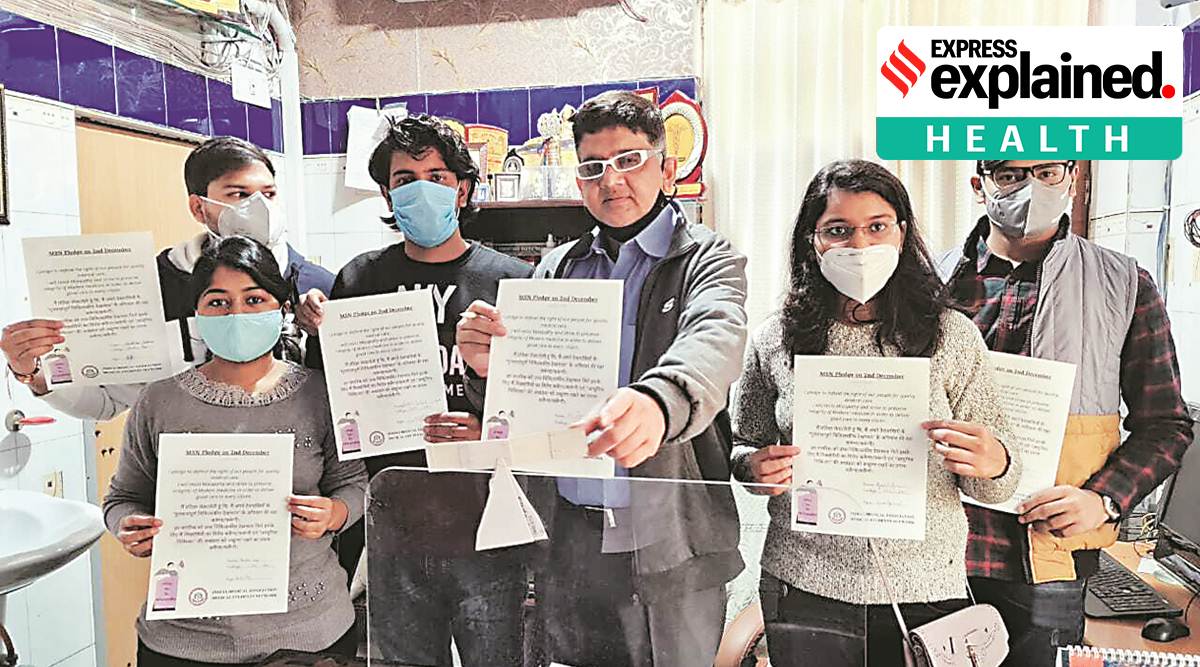
Medical students of Maharashtra Institute of Medical Education and Research's college at Talegaon display a pledge to resist ‘mixopathy’. (Source: Indian Medical Association)Medical students of Maharashtra Institute of Medical Education and Research's college at Talegaon display a pledge to resist ‘mixopathy’. (Source: Indian Medical Association)

On November 19, a government notification listed out specific surgical procedures that a postgraduate medical student of Ayurveda must be “practically trained to acquaint with, as well as to independently perform”. The notification has invited sharp criticism from the Indian Medical Association, which questioned the competence of Ayurveda practitioners to carry out these procedures, and called the notification an attempt at “mixopathy”.

The IMA has planned nationwide protests on December 8 against this notification, and has threatened to withdraw all non-essential and non-Covid services on December 11.

How far is surgery part of Ayurveda?

It is not that Ayurveda practitioners are not trained in surgeries, or do not perform them. In fact, they take pride in the fact that their methods and practices trace their origins to Sushruta, an ancient Indian sage and physician, whose comprehensive medical treatise Sushruta Samhita has, apart from descriptions of illnesses and cures, also detailed accounts of surgical procedures and instruments.

P Hemantha Kumar, professor and head of the department of general surgery at the government-run National Institute of Ayurveda in Jaipur, claims that at least 1,000 major surgeries are performed every year at his hospital. “There would be many more minor surgeries being done,” he said.

There are two branches of surgery in Ayurveda — Shalya Tantra, which refers to general surgery, and Shalakya Tantra which pertains to surgeries related to the eyes, ears, nose, throat and teeth. All postgraduate students of Ayurveda have to study these courses, and some go on to specialise in these, and become Ayurveda surgeons.

Nandkishore Borse, head of the department of surgery at Tilak Ayurveda College and Tarachand Hospital, a semi-government facility in Pune, said for several surgeries Ayurvedic procedures almost exactly match those of modern medicine about how or where to make a cut or incision, and how to perform the operation. There are significant divergences in post-operative care, however.

“The only thing that we do not do is super-speciality surgeries, like neurosurgey. For most other needs, there are surgical procedures in Ayurveda. It is not very different from allopathic medicine,” Hemantha Kumar said.

Story continues below this ad

Before the notification, what were the regulations for postgraduate students?

Postgraduate education in Ayurveda is guided by the Indian Medical Central Council (Post Graduate Education) Regulations framed from time to time. Currently, the regulations formulated in 2016 are in force. The latest notification of November 19 is an amendment to the 2016 regulations.

The 2016 regulations allow postgraduate students to specialise in Shalya Tantra, Shalakya Tantra, and Prasuti evam Stree Roga (Obstetrics and Gynecology), the three disciplines involving major surgical interventions. Students of these three disciplines are granted MS (Master in Surgery in Ayurveda) degrees.

Ayurveda practitioners point out that students enrolling in Ayurveda courses have to pass the same NEET (National Eligibility-cum-Entrance Test). Their course runs for four-and-a-half years, followed by one year of internship, six months of which are spent at an Ayurveda hospital, and the remaining six months at a civil or general hospital, or a primary health care centre.

Story continues below this ad

Postgraduate courses require another three years of study. They also have to undergo clinical postings in the outpatient and In-patient departments at hospitals apart from getting hands-on training in Ayurvedic treatment procedures. Medico-legal issues, surgical ethics and informed consent is also part of the course apart from teaching Sushruta’s surgical principles and practices, said Dr Vinayak Temburnekar, National President of National Integrated Medical Association (NIMA).

Also in Explained | From dolphins and whales, new insights on Covid-19

So, what is new?

Ayurveda practitioners say the latest notification just brings clarity to the skills that an Ayurveda practitioner possesses.

“The surgeries that have been mentioned in the notification are all that are already part of the Ayurveda course. But there is little awareness about these. A patient is usually not clear whether an Ayurvedic practitioner has the necessary skill to perform one of these operations. Now, they know exactly what an Ayurveda doctor is capable of. The skill sets have been defined. This will remove question marks on the ability of an Ayurveda practitioner,” Hemantha Kumar of the Jaipur-based National Institute of Ayurveda said.

Story continues below this ad

The notification mentions 58 surgical procedures that postgraduate students must train themselves in, and acquire skills to perform independently. These include procedures in general surgery, urology, surgical gastroenterology, and ophthalmology. 📣 Follow Express Explained on Telegram

What are the IMA’s objections?

IMA doctors insist that they are not opposed to the practitioners of the ancient system of medicine. But they say the new notification somehow gives the impression that the skills or training of the Ayurveda doctor in performing modern surgeries are the same as those practising modern medicine. This, they say, is misleading, and an “encroachment into the jurisdiction and competencies of modern medicine”.

The fact that Ayurveda institutions prescribe textbooks from modern medicine, or that they carry out surgeries with the help of practitioners of modern medicine, is not reason enough to allow this encroachment, said K M Abul Hasan, chairman of the IMA Junior Doctors’ Network.

A statement from the IMA said it condemned the “predatory poaching on modern medicine and its surgical disciplines” by CCIM (Central Council of Indian Medicine, which functions under the Ministry of Ayush). “This is another step to legitimise mixopathy,” it said.

Story continues below this ad

Avinash Bhondwe, president of the Maharashtra chapter of IMA, said the CCIM had claimed that all these modern surgeries are actually Ayurvedic procedures, and have Sanskrit names. “All the common procedures in all the surgical specialities have been included in the notification. They have notified these as Ayurveda procedures. They should also explain, with proof, how each of these procedures mentioned in Ayurveda literature is equivalent to the modern surgical procedures,” Bhondwe said.

The IMA is also upset with the recent decision of NITI Aayog to set up four committees for integrating the various systems of medicine in medical education, practice, public health, and administration, as well as research. It says such an integration would lead to the death of the modern system of medicine.

The IMA has demanded that the notification as well as the NITI Aayog move towards ‘One Nation One System’ be withdrawn. “If the government does not accept our demands, IMA will file a petition in the Supreme Court,” said R V Asokan, Secretary-General of IMA.

Don’t miss from Explained | Scientist, dancer, fencer, singer, baker: Meet Gitanjali Rao, Time’s Kid of the Year

x

Anuradha Mascarenhas is a Senior Editor at The Indian Express, based in Pune. With a career spanning three decades, she is one of the most respected voices in Indian journalism regarding healthcare, science and environment and research developments. She also takes a keen interest in covering women's issues . Professional Background Education: A gold medalist in Communication and Journalism from Savitribai Phule Pune University and a Master’s degree in Literature. Author: She authored the biography At The Wheel Of Research, which chronicles the life and work of Dr. Soumya Swaminathan, the former Chief Scientist at the WHO. Key Focus: She combines scientific accuracy with storytelling, translating complex medical research into compelling public and human-interest narratives. Awards and Recognition Anuradha has won several awards including the Press Council of India's national award for excellence in journalism under the gender based reporting category in 2019 and the Laadli Media award (gender sensitivity -2024). A recipient of the Lokmat journalism award (gender category-2022), she was also shortlisted for the RedInk awards for excellence in journalism-2021. Her debut book At The Wheel Of Research, an exclusive biography of Dr Soumya Swaminathan the inaugural chief scientist of World Health Organisation was also nominated in the Popular Choice Category of JK Paper AUTHER awards. She has also secured competitive fellowships including the Laadli Media Fellowship (2022), the Survivors Against TB – New Research in TB Media Fellowship (2023) and is part of the prestigious 2025 India Cohort of the WomenLift Health Leadership Journey.” Recent Notable Articles (Late 2025) 1. Cancer & Specialized Medical Care "Tata Memorial finds way to kill drug-resistant cancer cells" (Nov 26, 2025): Reporting on a breakthrough for triple-negative breast cancer, one of the most aggressive forms of the disease. Discipline, diet and purpose; How a 97-year-old professor defies ageing'' (Nov 15, 2025) Report about Prof Gururaj Mutalik, the first Head of Department at Pune's B J Government Medical College who at 97 credits his longevity to healthy habits and a strong sense of purpose. 2. Environmental Health (The "Breathless Pune" Series) Long-term exposure even to 'moderate' air leads to chronic heart, lung, kidney issues" (Nov 26, 2025): Part of an investigative series highlighting that even "safe" pollution levels are damaging to vital organs. "For every 10 µg/m3 increase in PM2.5 level, there was 6-8% jump in medicine sales" (Nov 23, 2025): Using commercial data to prove the direct link between air quality and respiratory illnesses in Pune. 3. Lifestyle & Wellness News "They didn't let cancer, diabetes and heart disease stop them from travelling" (Dec 22, 2025): A collaborative piece featuring survivors who share practical tips for traveling with chronic conditions. At 17, his BP shot up to 200/120 mmHG; Lancet study flags why child and teen hypertension doubled between 2000 and 2020'' (Nov 12,2025)--A report that focusses on 17-year-old-boy's hypertensive crisis and reflects the rising global trend of high blood pressure among children and adolescents. 4. Scientific Recognition & Infrastructure For promoting sci-comm, gender diversity: IUCAA woman prof highlighted in Nature" (Nov 25, 2025): Covering the global recognition of Indian women scientists in gender studies and physics. Pune researchers find a spiral galaxy like the Milky Way from early universe'' (December 3, 2025)- A report on how Indian researchers discovered a massive galaxy that existed when the universe was just 1.5 billion years old , one of the earliest to have been observed so far. Signature Beat: Health, Science & Women in Leadership Anuradha is known for her COVID-19 reportage, where she was one of the first journalists to provide detailed insights into the Covishield and Covaxin trials. She has a dedicated interest in gender diversity in health and science, often profiling women researchers who are breaking the "leaky pipeline" in STEM fields. Her writing style is scrupulous, often featuring interviews with top-tier scientists and health experts from various institutions.   ... Read More


Latest Comment
Post Comment
Read Comments
Advertisement
Advertisement
Advertisement
Advertisement