8 min read


© The Indian Express Pvt Ltd



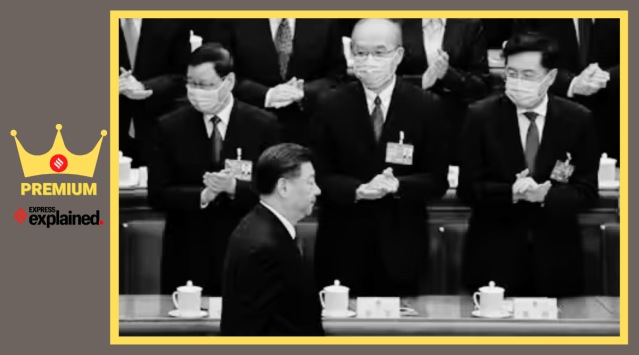 Qin Gang (far right) was seen as a close aide of President Xi Jinping (centre). (Reuters)
 The biggest puzzle — and question — in international relations this week was not about the war in Ukraine or the protests in Israel: it was about the mysterious change at the top of China’s foreign ministry.
Qin Gang, the man who had been appointed foreign minister in December last year, has not been seen in public since June 25. He was notably absent when Henry Kissinger, 100, the former United States Secretary of State who brokered America’s rapprochement with the People’s Republic more than a half century ago, called on President Xi Jinping in Beijing this week.
Qin was also missing at the ASEAN foreign ministers’ meeting in Jakarta last week. Wang Yi, Qin’s predecessor in the post, had stepped in, and had met with External Affairs Minister S Jaishankar on the meeting sidelines. Days later, National Security Advisor Ajit Doval met Wang on the sidelines of the BRICS NSAs’ meeting in Johannesburg.
On July 25, Wang officially returned as China’s top diplomat, replacing Qin.
The 69-year-old former career diplomat, a member of the Communist Party of China (CPC) Political Bureau and Director of the Office of the CPC Foreign Affairs Commission, served as Beijing’s ambassador in Tokyo and as Director of the Taiwan Affairs Office before becoming foreign minister in March 2013. He served in the post for almost a decade until December 2022.
Qin’s six-month tenure is the shortest for any Chinese foreign minister. The fact that Wang has been pulled back from near oblivion suggests Qin could be kept out of action for an extended period.
Qin’s removal represents a dramatic fall from grace for the man who, at age 57, became one of China’s youngest-ever foreign ministers. Qin had served as President Xi’s Chief Protocol Officer between 2014 and 2018. He was then made ambassador to the US, a position that is reserved for the closest and most trusted aides of the Chinese President.
On Chinese social media, there is feverish speculation on the reasons for Qin’s sacking, according to Indian diplomats and analysts who track that space.
There is talk about allegations of corruption, and chatter linking Qin to Fu Xiaotian, a woman host and anchor with the state-controlled Phoenix TV. Fu too has been missing from public view.
History of disappearances
Transgressions such as political scandals, corruption, and tax evasion have had consequences in Xi’s China over the last decade or so. But while leaders, officials, businesspersons, and even actors have vanished periodically, not every disappearance has had an unhappy ending.
* In November 2021, tennis player Peng Shuai went missing for several months after she levelled allegations of sexual assault on former senior Communist Party mandarin Zhang Gaoli. However, Peng resurfaced and Zhang was not penalised.
* In June 2021, Dong Jingwei, a deputy minister of security, disappeared from public view, which led to rumours that he was in possession of secrets on the use of the Covid-19 virus as a biological weapon, and had defected to a Western country. Dong, however, reappeared seemingly without consequences.
* Between October 2020 and January 2021, Jack Ma, the billionaire founder of the Alibaba Group, disappeared from public. Ma had criticised China’s financial regulators just a few weeks earlier, following which he was called in by the authorities and his planned investments were cancelled. Ma rarely speaks in public now.
* In July 2018, the popular actor Fan Bingbing went missing, but issued a statement after a few months apologising for tax evasion, for which the Chinese tax authorities ordered her to pay more than $127 million in taxes and penalties.
* Back in 2012, Xi Jinping — who was China’s Vice President at the time — had himself disappeared from the public eye for weeks. There were rumours that Xi was ill and that he had suffered a sports injury — however, he was anointed as China’s leader only two months later.
The repeated instances of disappearance — and re-emergence — without explanation over the years underline the fundamental opaqueness of the Chinese system, which is tightly controlled by the CPC, where dissent is not allowed, and no questions are answered. In his book The Party: The Secret World of China’s Communist Rulers, journalist and analyst Richard McGregor quoted a university professor in Beijing: “The Party is like God. He is everywhere. You just can’t see him.”
The Chinese modelled their system on the Soviet Union. Lenin had designed a system in which the party had eyes and ears everywhere. At the top, Lenin advocated as much centralisation as possible, and at the bottom, as much decentralisation as possible.
Xi, who sits on top of the power structure, has three roles — his position as General Secretary of the Communist Party ranks above his two other titles, as President of the People’s Republic of China, and head of the Chinese military. During Xi’s foreign visits, especially to Western countries, the Chinese government makes sure he is addressed as the Chinese President, and not by his other titles.
In a paper published in October 2022, the American think tank Council on Foreign Relations (CFR) explained the process by which the Party chooses its leadership:
“Every five years, the CCP convenes its National Party Congress to set major policies and select top leaders. (This is not to be confused with the National People’s Congress, which is China’s legislature.) During this time, members choose the Central Committee, which comprises around 370 members and alternates including ministers, senior regulatory officials, provincial leaders, and military officers. The Central Committee acts as a sort of board of directors for the CCP, and it is required to hold annual meetings, known as plenums. The Central Committee also selects the Politburo, which has twenty-five members.”
The Politburo chooses the Politburo Standing Committee through secretive, backroom negotiations, the CFR paper said. The Standing Committee, which could have between five and nine members, is the “epicentre of the CCP’s power and leadership”. As the CPC general secretary, Xi is at the top, and the Premier heads the State Council, “China’s equivalent of a cabinet”.
McGregor described the Central Committee as “a kind of enlarged board of directors for the Party in China”. Qin, whose name has been scrubbed off the Chinese foreign ministry website, is currently still listed as a member of the Central Committee.
India’s diplomatic challenge
The functioning of the Chinese system has been perceived as a black box by New Delhi, which was caught unawares by the border transgression amid the Covid-19 pandemic and lockdowns.
Just before he was named China’s new foreign minister, Qin Gang had written that the status quo on the border situation is that both China and India are “willing to ease the situation” and “jointly protect peace along their borders”. (‘How China Sees the World’, in National Interest magazine)
At his meeting with Qin in New Delhi this March, Jaishankar had laid down India’s red lines — making it clear that normalcy in ties cannot be achieved until there was normalcy on the border.
Qin is now gone, and India has to re-engage with Wang who, based on the experience of a decade, is often viewed as being hawkish in his approach. At his meeting with Wang in South Africa, Doval underlined that the situation along the Line of Actual Control since 2020 had “eroded strategic trust and the public and political basis of the relationship”.
It is expected that New Delhi and Beijing will make an attempt to resolve the standoff before Xi’s visit in September for the G20 summit in Bharat Mandapam, just as they had done before the 2017 BRICS summit when the Doklam border standoff was resolved.