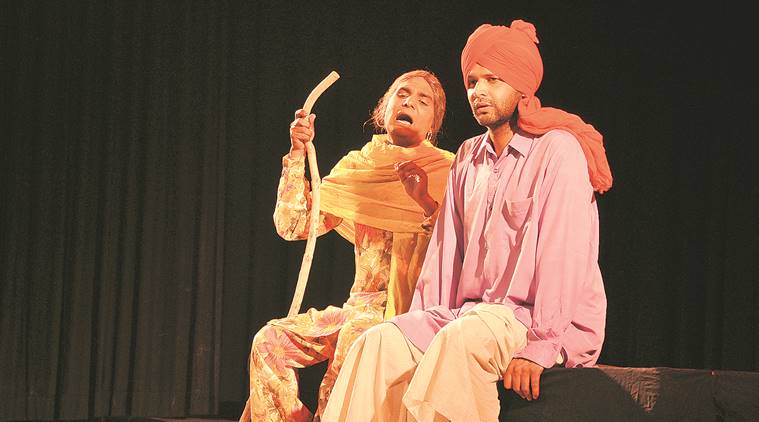
The festival has brought together performances from the tricity and other cities to ensure a varied fare for the audience.
THE energy and enthusiasm is hard to miss. The lawns, amphitheatre and auditorium of Bal Bhawan, the venue for Theatre For Theatre’s (TFT) month-long Winter National Theatre Festival, has undergone a creative and colourful metamorphosis. The festival, to be held till Feb 28, is a platform for varied forms of expressions by groups from across the tricity.
The festival has been curated by theatre director Sudesh Sharma, founder of TFT, with support from cultural agencies. Apart from proscenium plays by various directors, it includes a street theatre festival at the Plaza in Sector 17. Apart from plays by different groups, there will be a puppet exhibition and workshop by Subhashish Neogi of The Puppet Theatre, Chandigarh, workshops on body language, set design and setting, voice modulation and character-building and a painting and photography exhibition by established artists. Members of the public can participate in painting session and be audiences at a kavi sammelan by young poets and a mushaira by senior poets. A folk dance performance, a classical music evening, interaction with eminent theatre directors on the many aspects of the art form .
As many as 1,500 artists are part of the festival, which marks 31 years of TFT. “The festival is designed like an artistes’ meet, with a space for interactions, workshops and debates. Theatre is a complete art form and so, we have strived to showcase dance, music, literature and visual arts,” says Sharma, adding that former and present students of the Department of Theatre, PU, are part of the effort.
The festival also showcases theatre groups from Delhi, Jammu and Kashmir, Manipur and Lucknow, among others. Sharma has selected plays that are different in theme, subjects and treatments. In an effort to pay a tribute to playwright Prof. Ajmer Singh Aulakh, the event will include a staging of his play, Tooma, directed by Lakha Lehri. The story revolves around how greed of money has destroyed humanity and tarnished love and relationships. Another play by Aulakh, Saat Begane (February 6) will be presented by TFT.
Among other important productions is Rashomon, directed by Gorkey Singh. It is based on Akuta Gawa Ryunosuke’s Japanese short story and involves various characters providing subjective, alternative, self-serving and contradictory versions of the same incident. Rashomon reveals the complexities of human nature as four people recount different versions of the story of a man’s murder and the rape of his wife. Macbeth, The Crown of Blood, directed by Abhishek Bharati from Jammu, is designed with modern techniques of body theatre and is a blend of contemporary, folk and tribal music. The rich resources of folk performances, from Yakshgana and Chhau to Gatka, are part of the production, which promises to be rich in metaphors and imagery.
Another evening to look forward to is “Aavartan”, a tribute to Pt Guru Hazari Lal Gangani. Conceptualised and designed by Amit Gangani, the evening will see a kathak performance and a musical presentation, with tabla maestro Ustad Fazal Qureshi here for the event. “Next year, we hope to do a 50-day festival, which will be spread over Chandigarh, Panchkula and Mohali,” says Sharma.
At Bal Bhawan, Sector 23, 6.30 pm with the mornings reserved for other activities
Parul is a Principal Correspondent at The Indian Express in Chandigarh. She is a seasoned journalist with over 25 years of experience specializing in public health, higher education, and the architectural heritage of Northern India.
Professional Profile
Education: Graduate in Humanities with a specialized focus on Journalism and Mass Communication from Panjab University, Chandigarh.
Career Path: She began her career covering local city beats and human interest stories before joining The Indian Express in 2009. Over the last decade and a half, she has risen to the rank of Principal Correspondent, becoming the publication’s primary voice on Chandigarh’s premier medical and academic institutions.
Expertise: Her reporting is deeply rooted in the institutional dynamics of PGIMER (Post Graduate Institute of Medical Education and Research) and Panjab University. She is highly regarded for her ability to navigate complex administrative bureaucracies to deliver student-centric and patient-centric news.
Recent Notable Articles (Late 2024 - 2025)
Her recent work highlights critical reporting on healthcare infrastructure, academic governance, and urban culture:
1. Public Health & PGIMER
"PGIMER expands digital registry: Centralized patient records to reduce wait times by 40%" (Nov 20, 2025): A detailed look at the digital transformation of one of India's busiest medical institutes to tackle patient influx.
"Robotic Surgery at PGI: Why the new urology wing is a game-changer for North India" (Oct 12, 2025): Reporting on the acquisition of state-of-the-art medical technology and its impact on affordable healthcare.
"Shortage of life-saving drugs: Inside the supply chain crisis at government pharmacies" (Dec 5, 2025): An investigative piece on the logistical hurdles affecting chronic patients in the tri-city area.
2. Education & Institutional Governance
"Panjab University Senate Election: The battle for institutional autonomy" (Dec 18, 2025): In-depth coverage of the high-stakes internal elections and the friction between traditional governance and central reforms.
"Research funding dip: How PU’s science departments are navigating the 2025 budget cuts" (Nov 5, 2025): An analysis of the fiscal challenges facing researchers and the impact on India's global academic ranking.
3. Art, Culture & Heritage
"Le Corbusier’s legacy in peril: The struggle to preserve Chandigarh’s Capitol Complex" (Dec 22, 2025): A feature on the conservation efforts and the tension between urban modernization and UNESCO heritage status.
"Chandigarh Art District: How street murals are reclaiming the city’s grey walls" (Oct 30, 2025): A cultural profile of the local artists transforming the aesthetic of the "City Beautiful."
Signature Style
Parul is known for her empathetic lens, often centering her stories on the individuals affected by policy—whether it is a student navigating university red tape or a patient seeking care. She possesses a unique ability to translate dense administrative notifications into actionable information for the public. Her long-standing beat experience makes her a trusted source for "inside-track" developments within Chandigarh’s most guarded institutions.
X (Twitter): @parul_express ... Read More


 4 min read


 The festival has brought together performances from the tricity and other cities to ensure a varied fare for the audience.