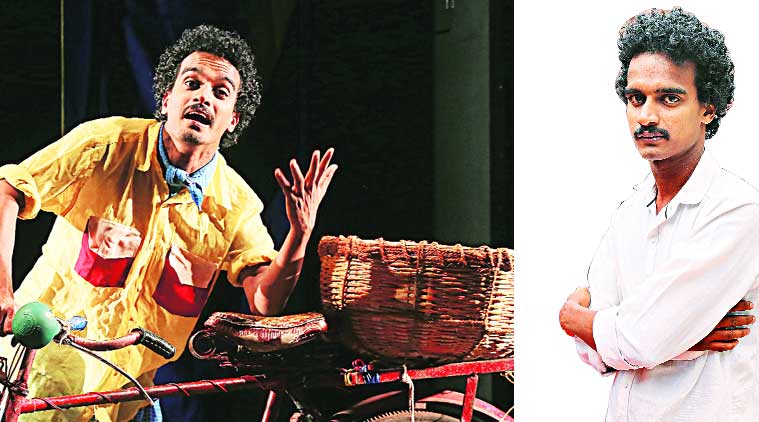
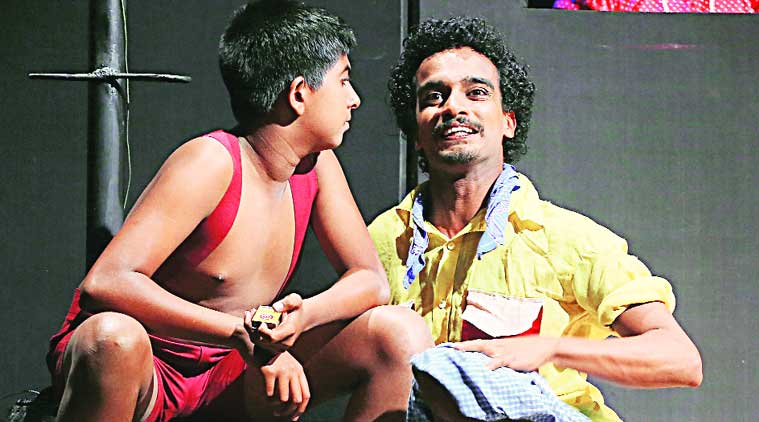
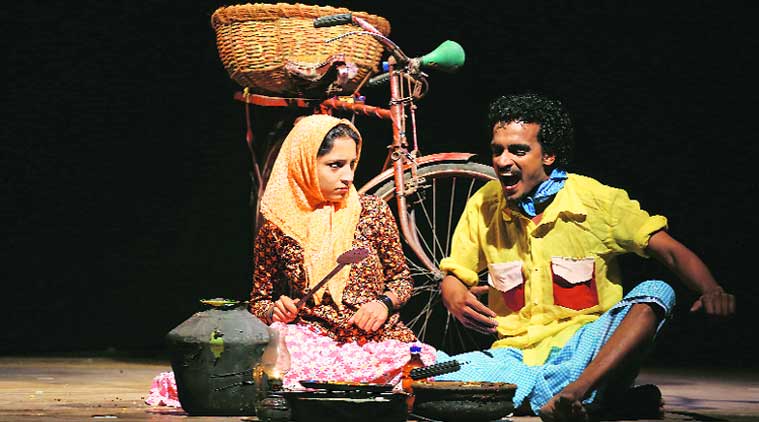
Renji Kankol in scenes from Matthi. (Source: S Thyagarajan)
Sardines never taste the same again to those who watch the play Matthi. Every crunch and bite is now packed with questions of identity and habit. The people who enjoy eating this smelly fish, sold fresh from the waters of Kerala, are united by many other passions and peculiarities of the region. Matthi, which explores the ties that bind individuals into communities, won the Kerala Sangeetha Nataka Akademi award last year. The Best Actor runner-up went to the play’s unconventional actor, a lanky village mason with a disarming grin.
Renji Kankol was cast as fish-seller Rafeeq because director Jino Joseph kept remembering his face, mannerisms and gestures while writing the play. “When the director told me about the role, I found that the age and character of Rafeeq was the same as mine,” says Kankol, 27. Joseph would find out later that Kankol, who dropped out of school after class X, used to carry matthi baskets on his head to distribute to shops in his village.
“I earned Rs 60 a day. My body was full of the smell. Others will not like this smell but we love it,” says Kankol, who won Best Actor at the prestigious Mahindra Excellence in Theatre Awards (META) in 2015. Matthi was also presented at Bharat Rang Mahotsav (BRM), National School of Drama’s (NSD) annual festival, earlier this week.
The play is a snapshot of rural life in which villagers have simple concerns and small jobs. Every rite of passage, from childhood pranks to teenage crushes, from acting in a local play to participating in a political meeting, is flavoured by fish. Tasty, healthy and cheap, matthi is the food of the masses. It is cooked by a girl Rafeeq falls in love with, and by his sister Kunjami for public gatherings. “The period between the ’60s and ’90s marked a big cultural transition in Kerala.
Youngsters and entire families began to migrate out of villages for studies or work, and their place was taken by labourers from Bengal and North India,” says Joseph. The stink of fish from the stage is replaced by the dust of cement mixers. Rafeeq finds that the big fish have swallowed up the small matthi.
Kankol has spent all his life in the Left bastion of Koothuparamba, a town that was once a hub of art and cultural activities and political revolutions but is now better known for a 1994 incident of police brutality, the Koothuparamba Firing. The son of a mechanic, he would participate in folk plays and grew up making props and doing odd jobs around the stage. The role of Rafeeq came a month after his father died and Kankol was struggling to earn a livelihood for his mother and his sister.
“One day, you will be known by the name of Matthi Rafeeq,” Joseph promised the mason. “He is not an actor and that is the positive thing. His sorrow becomes the sorrow of the audience, his pleasure becomes their pleasure,” says Joseph.
Story continues below this ad
“Rafeeq is not a leader or a boss, but he has his own politics. He never sells big fish. He always stands on the side of the marginalised people. He gives up only when he realises that the local sardines are being exported and their place was being taken up by imported fish kept in cold storage,” says Kankol, and adds that he is “pro-communist”. The actor says he was enthusiastic about his first lead role but did not know how to perform. The cast attended a camp in tents they put up and cut out the outside world for 45 days to develop the play. “All the people came together, had their food together, cooked together, ate together and slept together. This togetherness made the play. We started the day by cooking matthi and slowly the play began to take shape,” says Kankol.
In his small house, Kankol has made a wooden shelf to display the awards, appreciations and mementoes coming his way from cultural organisations and events such as International Theatre Festival of Kerala. Matthi is reportedly causing a social revolution in Kerala by bringing back the culture of local clubs where budding artistes can express themselves through theatre. This is important in the context of the nature of the district – a major industry in Kannur is bomb-making and no day goes by without reports of a fatal explosion. He adds, “We cannot say Matthi has made big revolutions and all the social and political problems are solved. Matthi is a celebration of nostalgia, it makes people realise what we miss today. The play is a small reminder of that.”
He still works as a mason, making relief works on cement. “We cannot compare our passion with money. Theatre gives pleasure, it helps us to forget our troubles and reinforces our faith,” he says. Among theatre-goers, however, he is famous. The morning after Matthi was staged at BRM, a campus theatre group pointed out Kankol as he wandered around NSD and called out, “Nice play, Matthi Rafeeq.”
Dipanita Nath is a Senior Assistant Editor at The Indian Express, based in Pune. She is a versatile journalist with a deep interest in the intersection of culture, sustainability, and urban life.
Professional Background
Experience: Before joining The Indian Express, she worked with other major news organizations including Hindustan Times, The Times of India, and Mint.
Core Specializations: She is widely recognized for her coverage of the climate crisis, theatre and performing arts, heritage conservation, and the startup ecosystem (often through her "Pune Inc" series).
Storytelling Focus: Her work often unearths "hidden stories" of Pune—focusing on historical institutes, local traditions, and the personal journeys of social innovators.
Recent Notable Articles (December 2025)
Her recent reporting highlights Pune’s cultural pulse and the environmental challenges facing the city during the winter season:
1. Climate & Environment
"Pune shivers on coldest morning of the season; minimum temperature plunges to 6.9°C" (Dec 20, 2025): Reporting on the record-breaking cold wave in Pune and the IMD's forecast for the week.
"How a heritage tree-mapping event at Ganeshkhind Garden highlights rising interest in Pune’s green legacy" (Dec 20, 2025): Covering a citizen-led initiative where Gen Z and millennials gathered to document and protect ancient trees at a Biodiversity Heritage Site.
"Right to breathe: Landmark NGT order directs PMC to frame norms for pollution from construction sites" (Dec 8, 2025): Reporting on a significant legal victory for residents fighting dust and air pollution in urban neighborhoods like Baner.
2. "Hidden Stories" & Heritage
"Inside Pune library that’s nourished minds of entrepreneurs for 17 years" (Dec 21, 2025): A feature on the Venture Center Library, detailing how a collection of 3,500 specialized books helps tech startups navigate the product life cycle.
"Before he died, Ram Sutar gave Pune a lasting gift" (Dec 18, 2025): A tribute to the legendary sculptor Ram Sutar (creator of the Statue of Unity), focusing on his local works like the Chhatrapati Shivaji statue at Pune airport.
"The Pune institute where MA Jinnah was once chief guest" (Dec 6, 2025): An archival exploration of the College of Agriculture, established in 1907, and its historical role in India's freedom struggle.
3. Arts, Theatre & "Pune Inc"
"Satyajit Ray, Ritwik Ghatak were not rivals but close friends, says veteran filmmaker" (Dec 17, 2025): A deep-dive interview ahead of the Pune International Film Festival (PIFF) exploring the camaraderie between legends of Indian cinema.
"Meet the Pune entrepreneur helping women build and scale businesses" (Dec 16, 2025): Part of her "Pune Inc" series, profiling Nikita Vora’s efforts to empower female-led startups.
"How women drone pilots in rural Maharashtra are cultivating a green habit" (Dec 12, 2025): Exploring how technology is being used by women in agriculture to reduce chemical use and labor.
Signature Style
Dipanita Nath is known for intellectual curiosity and a narrative-driven approach. Whether she is writing about a 110-year-old eatery or the intricacies of the climate crisis, she focuses on the human element and the historical context. Her columns are often a blend of reportage and cultural commentary, making them a staple for readers interested in the "soul" of Pune.
X (Twitter): @dipanitanath ... Read More


 5 min read


 Renji Kankol in scenes from Matthi. (Source: S Thyagarajan)