5 min read
© IE Online Media Services Pvt Ltd



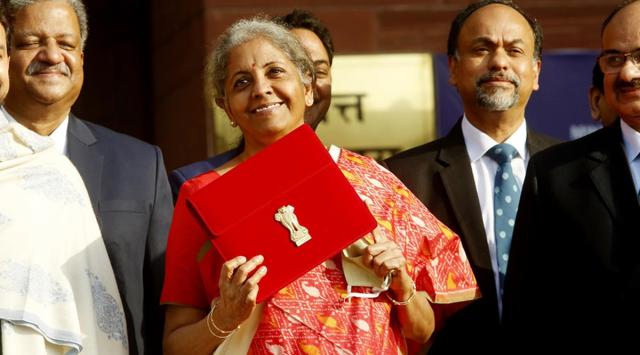 Finance Minister Nirmala Sitharaman said that the total expenditure for the upcoming financial year is estimated to be Rs 39.45 lakh crore, while the total receipts other than borrowings are estimated at Rs 22.84 lakh crore. (File express photo by Praveen Khanna)
Indicating its reliance on economic growth to drive fiscal consolidation, the government has projected a fiscal deficit of 6.4 per cent of Gross Domestic Product (GDP) for financial year 2022-23 — in line with the aim of fiscal consolidation, announced last year, to achieve a fiscal deficit of 4.5 per cent by 2025-26. The government said it will pursue a “fairly steady” decline in deficit levels over this period.
For the financial year 2021-22, the revised estimates in the Budget pegged the fiscal gap at 6.9 per cent against the 6.8 per cent estimated during the 2021-22 Budget. Higher buoyancy in tax collections is helping fund elevated capex, while bringing down fiscal deficit but at a slow pace. Revenue growth targets are realistic for next year while infrastructure spending plan is ambitious.
Finance Minister Nirmala Sitharaman said that the total expenditure for the upcoming financial year is estimated to be Rs 39.45 lakh crore, while the total receipts other than borrowings are estimated at Rs 22.84 lakh crore. “While setting the fiscal deficit level in 2022-23, I am conscious of the need to nurture growth, through public investment, to become stronger and sustainable,” she said Tuesday during the Budget Speech.
Notably, the government increased the gross market borrowings expected to be at Rs 14.95 lakh crore for the upcoming fiscal, compared to Rs 10.46 lakh crore as per revised estimates of 2021-22. Analysts note that this would put pressure on bond yields and which could touch 7 per cent in near future. The 10-year bond yield surged sharply and closed at 6.85 per cent Tuesday, from its previous close of 6.68 per cent. This indicates that overall borrowing costs will rise in future.

The Fiscal Responsibility and Budget Management (FRBM) Act mandated Central Government to limit the fiscal deficit up to 3 per cent of gross domestic product by the 31st March, 2021. However, Covid-19 pandemic and resultant lockdown led to a sharp rise in deficit level as government spending jumped to support economy. The Centre’s fiscal deficit was at an all-time low of 2.5% of GDP in 2007-08.
Government is betting on a virtuous cycle of growth, resulting from higher investments boosting private sector Capex and aggregate demand, to ultimately help in reducing deficit.
Economists believe that the sharp increase in capital expenditure levels and only a moderate rise in revenues points to a less gradual fiscal consolidation path than earlier assumed. “Our own calculation of the primary balance (excluding one-off revenues) suggests a higher 70bps consolidation in the math. For states, a fiscal deficit of 4% of GDP will be permitted again, which includes 0.5% room which hinges on implementation of power sector measures,” Radhika Rao, Senior Economist at DBS noted in a research report.
Even as gross tax revenues increased at 50.3 per cent April-December 2021, the Centre’s net tax collections, after devolution to states, rose at a much higher rate of 64.9 per cent during the same period, budget documents show, reflecting the increasing reliance on cess collections that are not shared with the states.
During April-November 2021, total revenue receipts of the Centre, at about 76 per cent of budget estimates, were significantly higher than last five years moving average of 50.3 per cent of Budget Estimates (BE). Tax revenue (net to centre) and Non-tax revenue receipts achieved 73.5 per cent and 91.8 per cent of their budget estimates, respectively.
Interest payments are the largest component of Centre’s revenue expenditure. In revised estimates of 2021-22, interest outgo is estimated at about Rs 8.14 lakh crore, which is 25.7 per cent of revenue expenditure. For the next year, total interest payments is estimated at about Rs 9.41 lakh crore, or 29.4 per cent of the revenue expenditure.
Expenditure on major subsidies is estimated to increase from Rs 3.36 lakh crore in budget estimates 2021-22 to Rs 4.33 lakh crore in revised estimates of 2021-22. But in BE 2022-23, major subsidies spend is slated to slide down to Rs 3.18 lakh crore, or 1.2 per cent of the GDP.
For the ongoing financial year, against a total expenditure of Rs 34.83 lakh crore projected in the budget estimates 2021-22, the revised estimate is Rs 37.70 lakh crore. The revised estimate of capital expenditure is Rs 6.03 lakh crore. This includes an amount of Rs 51,971 crore towards settlement of outstanding guaranteed liabilities of Air India. In terms of revenue receipts, the total revenue receipts are estimated to be at Rs 22.04 lakh crore for 2022-23, compared with Rs 20.79 lakh crore for 2021-22. Disinvestment targets have been tapered down significantly.