Journalism of Courage
 6 min read


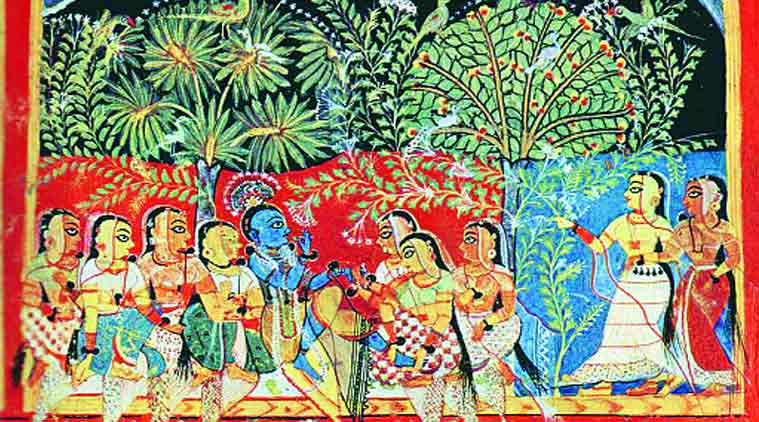 A 16th century painting based on the Gitagovindam.
Book: Innovations and Turning Points, Toward a History of Kavya Literature
Edited by: Yigal Bronner, David Shulman and Gary Tubb
Publisher: Oxford University Press
Pages: 820
Price: Rs 1295
Review By Bibek Debroy
Sanskrit literature has a gigantic corpus and there are multiple ways to slice it. Much of it is technically in poetry (kavya). Within the kavya genre, as opposed to say plays, biographies or satire, there are mahakavyas, great kavyas. There is a specific definition of what constitutes a mahakavya, but one can ignore that for now. The great poets who composed mahakavyas (there is a list of six mahakavyas) are Kalidasa, Bharavi, Magha, Sriharsha and Bhatti. Unless one has a great interest in Sanskrit poetry, most people would probably choose their favourite poet from this list. Just so that it is clear, Valmiki and Vedavyasa belong to a different era. They are pre-classical. This volume is about kavya, lyrical works that fall short of being mahakavyas, but nevertheless have enough in them to transcend the prosaic. For example, Jayadeva’s Gitagovindam is kavya, not a mahakavya. This edited volume, with an excellent introduction, emerged from a conference in 2003-04. The idea is the following: can one identify poets (and their works) that lead to a breakthrough in innovation? “If… we read Sanskrit kavya with an open mind, we see evidence of tremendous vitality and continuous change. What is more, the notion of innovation is a remarkably consistent topos throughout the classical and medieval literature. The poets themselves very often remark on the novelty of their own work as well as that of particular poets who came before them.”
This is a novel idea and the introduction succinctly explains how “change” can be pinned down and rendered less subjective. The 25 papers are divided into seven heads — ‘Introduction’, ‘Kalidasa and Early Classicism’, the ‘Developing Mahakavya’, ‘Masters of Prose’, ‘Sons of Bana’, ‘Poets of the New Millennium’ and ‘Regional Kavyas’. Each paper then covers a specific theme, work or poet.Though the listing of novelty and innovation is never meant to be exhaustive, I do have a complaint about Jayadeva’s exclusion. On several counts, Gitagovindam also broke new ground. A more serious complaint is about the style of some essays. They are written in a dry, boring and academic style. They might have been excellent, seen through the lens of an academic conference. From the point of view of a book that seeks to generate popular interest in Sanskrit kavya, they should have been substantially rewritten. The ‘Introduction’ is what holds the book together. As I have said, it is excellent, learned without being pedantic, a style all other essays should have followed.
As is perhaps inevitable, three essays in Part 2 are about Kalidasa – specifically Kumarasambhavam and Raghuvamsha, with a more general piece about the taxonomy and structure of a mahakavya. Part 3 is about Bharavi, Magha and Bhatti, with an unusual take in the last essay on how Bhatti influenced old Javanese poetry. Part 4 moves on to Bana. Indeed, an underlying strand of the book is the importance given to Bana and the Kannauj period. While Bana represents kavya, this genre is also gadyakavya, since it is almost as if poetry is being written in prose. In Part 5, we move on to the Bana influence, with Abhinanda, Bhavabhuti, Rajasekhara and Murari. By the New Millennium, Part 6 of the book means 1000 CE and the poets covered include Bilhana and Sriharsha. This section also has another unexpected essay on how Indian kavya poetry exerted an influence in Tibet. Since Part 7 is on regional kavyas, it is a lot less homogeneous and is a mixed bag of Sakalya Malla’s Rama story from Telengana, Kavikarnapura from late medieval Bengal and Brajabhasa works from Rajput courts. There is also an essay on innovation and change in East Javanese Kakawin. This doesn’t quite fit and the link with Asvaghosa and Kalidasa is somewhat forced.
When was this corpus composed? Hundreds, if not thousands, of years ago? One specific essay in Part 7 will dispel this illusion, since it is on Vishwanatha Satyanarayana’s play on Yayati (in Sanskrit), composed in 1950. Does excessive dissection help to appreciate the beauty of poetry or ruin it? “Broadly speaking, we can distinguish two major types of commentators on kavya, aiming at two distinct audiences. The most often read commentaries, like those of Mallinatha and Vallabha, are meant for schoolboys…However, a second group of commentaries, somewhat less widely read, presumes a more sophisticated readership; they often ignore the more pedestrian, technical points, which they take for granted, and instead focus on more difficult issues and give more attention to larger structures and themes.”
The essays in this volume are akin to the second class of commentary, underlined by a rather forbidding-sounding title. As I have said, some essays are pedantic and boring. But these are few in number. Deliberately avoiding the mentioning of names, I think nine of the 25 essays are written in this excessively academic style. That still leaves a fair number of essays that work, where dissection helps you appreciate the beauty and nuances better. But this volume belongs to the second category. There will be value addition if you are already familiar with Sanskrit kavya poetry, not otherwise. It is no primer and isn’t meant to be.
Bibek Debroy is a full-time member of the NITI Ayog, and a translator