Journalism of Courage



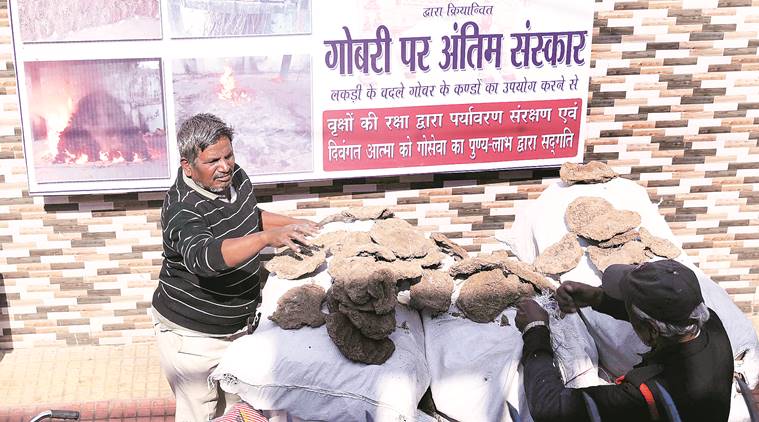 Over 35 families have so far opted for the new service, which KMC officials said is cheaper and faster than wood. Express photo by Partha Paul
A crematorium in Kolkata is now offering the use of cow dung cakes as a “holy, more environment-friendly” alternative to wood and electric cremations. The initiative, a first-of-its-kind in the state, was approved by the Kolkata Municipal Corporation (KMC) for use in Nimtalla crematorium on January 9.
“Cow dung cakes are more environment-friendly. Secondly, there is a religious angle. Some people consider it holy to cremate in cow dung cakes. We have given them an option. They can use electric furnace or wood or cow dung,” Atin Ghosh, member, KMC Mayor-in-Council (Health), told The Indian Express.
Over 35 families have so far opted for the new service, which KMC officials said is cheaper and faster than wood. The KMC has entrusted the upkeep and security of the Nimtolla and Keoratolla crematoriums — the two biggest such facilities in the state — to the Prerna Foundation for the last four years.
Pawan Tibrewal, secretary of the Prerna Foundation, said, “Apart from promoting cow protection and providing employment to people, this option is more environment-friendly compared to wood. One has to cut two trees to cremate a body. Moreover, according to the green bench, the ashes of wood cannot be thrown into rivers since it is a polluting agent. But the ashes of cow dung cakes can be put into the river.”
The NGO had applied to the KMC for permission to start offering this service in November 2016, citing a similar initiative which had been implemented at Nagpur Municipal Corporation in Maharashtra. The KMC had then written to the civic body, following which a team from Nagpur came to Nimtolla crematorium and carried out a successful trial run of cow dung cremation in February 2017.
Nimtolla crematorium has about 8 electric furnaces and four pyres for wood and cow dung cremation. Every day, over 100 bodies are cremated in electric furnaces, and around 25 using wood. While electric furnaces takes 45 minutes and are priced at Rs 250, cremation by wood requires Rs 2,600 and takes 2 hours and 45 minutes and cremation by cow dung is priced at Rs 1,750 and takes around 2 hours and 15 minutes. The NGO is trying to bring down the time required for its newest option by adding camphor and ghee.
“It (use of cow dung) was an ancient practice and according to Vedic norms. Bodies which have more water content take around 2.5 hours to be cremated, while others take a little over 2 hours when using cow dung,” said Puroshottam, a Dom (cremation worker) at Nimtolla for the last 25 years.
Each cremation requires 200 kg of cow dung cakes, foundation officials said. The cakes are brought from Calcutta Pinjrapole Society, a non-profit organisation established in 1885 for cow protection. At present, the organisation has over 2,000 cows on the outskirts of Kolkata.

 3 min read