23 min read

© IE Online Media Services Pvt Ltd



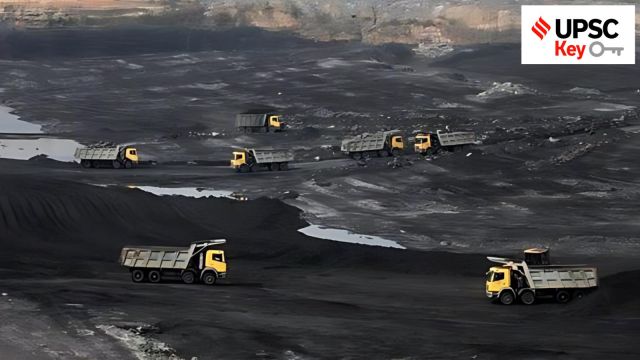 An open cast coal mine of the Central Coalfields (CCL) subsidiary of Coal India Limited, located in Chatra district in Jharkhand. Recently SC has ruled that States have the power to tax mining activities. Know more in our UPSC Key. (Express Photo by Partha Paul).
🚨 Attention: UPSC Key is now all 7 Days a Week!🚨
Important topics and their relevance in UPSC CSE exam for July 26, 2024. If you missed the July 25th, 2024 UPSC CSE exam key from the Indian Express, read it here.
🚨 The Indian Express UPSC Essentials brings to you the July edition of its monthly magazine. Click Here to read. Share your views and suggestions in the comment box or at manas.srivastava@indianexpress.com🚨
UPSC Syllabus:
Preliminary Examination: Current events of national and international importance
Mains Examination: GS-II, III: Government policies and interventions, Economy
What’s the ongoing story- In an 8-1 majority ruling Thursday, a nine-judge Constitution Bench of the Supreme Court upheld the power of states to levy royalty on extraction of minerals from their land and said they can also tax the lands which comprise mines and quarries.
Prerequisites:
— What are the different lists under the constitution?
— What are the constitutional provisions related to the sharing of revenue between the center and the state?
— What is the Seventh Schedule of the Constitution?
— What is the difference between royalty and tax?
Key takeaways:
— The verdict overruled the 1989 decision of a 7-judge Bench in India Cement Ltd vs State of Tamil Nadu which said royalty is tax and state legislatures lack competence to levy taxes on mineral rights because the subject matter is covered by the Minerals and Mines and Minerals (Development and Regulation) Act, 1957, enacted by Parliament in exercise of powers under Entry 54 of List I (Union List) of the Constitution.
— The majority ruling said royalty, as envisaged under Section 9 of the 1957 Act, “is not in the nature of tax”.
— It said Parliament can even prohibit states from taxing mineral rights by virtue of Entry 50 of List II (State List), but pointed out that “there is” however “no specific provision” in the 1957 Act that governs the field “which imposes limitations on the power of the states to tax mineral rights”.
— That being so, “the scheme of the MMDR Act cannot, by a process of stretched construction, be read to limit the taxing powers of the state under Entry 50 of List II,” it said.
— Entry 50 of List II concerns “taxes on mineral rights subject to any limitations imposed by Parliament by law relating to mineral development”.
— On tax on lands containing quarries or mines, the majority ruling said states can do so under Entry 49 of List II which concerns “taxes on lands and buildings”.
For Your Information:
— Royalties refer to the fees paid to the owner of a product in exchange for the right to use that product. For example, if a movie studio wants to use an existing piece of music by a specific artist in their new film, they will have to pay a royalty fee that goes to the artist.
— The majority held that a royalty is not a tax because there is a “conceptual difference” between royalties and taxes. Royalties are based on specific contracts or agreements between the mining leaseholder and the lessor (the person who leases the property) who can even be a private party.
— The court also held that Parliament’s powers under Entry 54 of the Union List do not extend to imposing taxes, as that power exclusively rests with state legislatures. However, Entry 50 allows Parliament to place “any limitations” on states’ power to impose taxes, which the court held “may include even a ‘prohibition’” against imposing taxes.
— The court did not limit states’ power to tax mineral development activities to Entry 50, though. It held that the state also had the power to tax the land where mines and quarries are located.
Points to Ponder:
— Why Indian constitution is called asymmetric federalism?
— What is the difference between Union lists and state lists?
— What is the distinction between the power to levy and collect a tax and the power to appropriate the proceeds of the tax so levied and collected?
Post Read Question:
(1). With reference to the management of minor minerals in India, consider the following statements: (UPSC CSE 2019)
1. Sand is a ‘minor mineral’ according to the prevailing law in the country
2. State Governments have the power to grant mining leases of minor minerals, but the powers regarding the formation of rules related to the grant of minor minerals lie with the Central Government.
3. State Governments have the power to frame rules to prevent illegal mining of minor minerals.
Which of the statements given above is/are correct?
(a) 1 and 3 only
(b) 2 and 3 only
(c) 3 only
(d) 1, 2 and 3
Other Important Articles Covering the same topic:
The nature of ‘royalty’ case: How an alleged typographical error led to 9-judge SC case
UPSC Syllabus:
Preliminary Examination: Current events of national and international importance
Mains Examination: GS-III: Environment
What’s the ongoing story- Paris 2024 is set to be the greenest Games in history. The Games’ organising committee has pledged to halve the Olympics’ carbon emissions — from roughly 3.5 million tonnes each in Tokyo 2020, Rio 2016, and London 2012 to 1.75 tonnes this time around.
Prerequisites:
— How greenhouse gas emissions led to global warming?
— What is carbon neutrality?
— What is carbon offsetting?
Key takeaways:
— All evidence points to the planet being in a climate emergency, driven by anthropogenic emissions of greenhouse gasses (GHG). In this context, mega sporting events, with their massive carbon footprint, might appear to be profligacy humanity can ill-afford.
— Paris 2024 will majorly be powered by renewable energy sources like geothermal and solar power. A number of climate-friendly moves are being implemented.
— Eating: Paris 2024 is trying to promote plant-based, local and sustainable food.
— Transport: Most Olympic venues are easily accessible by public transport. Paris will run special services to ensure that tourists do not have trouble getting around.
— Construction: Unlike London, which built eight new venues for the Olympics, and Tokyo, which constructed 11 new sites, 95% of events in the Paris Games will be held in existing buildings or temporary infrastructure. The competition venue that Paris is building, the Aquatics Centre in Saint-Denis, is solar-powered, and uses recycled, natural bio-based building material.
— Living arrangements: While the high temperatures in Paris have forced organisers to install 2,500 temporary cooling units for athletes… Their mattresses are made from recycled fishing nets, and beds made from reinforced cardboard. Significant amount of the furniture being used during the Games is rented, rather than bought, and will see reuse after the Olympics.
— The organisers have said that Paris 2024 has “developed a funding programme for projects aimed at avoiding and capturing carbon emissions, which will aim to offset unavoidable Games-related emissions”… Many experts however say that offsetting amounts to little more than “greenwashing”.
— Nonetheless, Paris 2024 will still go down as the most climate-friendly Olympics in history, and provide a blueprint for major sporting events in the future.
For Your Information:
— The Food and Agriculture Organization has estimated that the meat and dairy industries account for 18% global GHG emissions.
— The World Economic Forum’s Global Risks Report 2024 says that when a large group of people eat plant-based meals, employ sustainable public transport for travel and make environment- friendly choices, it forces businesses to cater to changing trends.
— Globally, the construction industry is among the highest GHG emitters, responsible for 37% of global emissions.
— Paris has an ambitious plan for curbing its carbon footprint – they are estimating a carbon footprint of 1.58 million metric tons of CO2, less than that of the Covid-hit Tokyo Olympics (1.96 million metric tons of CO2). London 2012 had a CO2 emission of 3.4 million metric tons.
Points to Ponder:
— What are the global initiatives to reduce carbon emissions?
— How do global events like the Olympics and the FIFA World Cup present an opportunity to show climate-friendly initiatives?
Post Read Question:
(2). The ‘Common Carbon Metric’, supported by UNEP, has been developed for (UPSC CSE 2021)
(a) assessing the carbon footprint of building operations around the world
(b) enabling commercial farming entities around the world to enter carbon emission trading
(c) enabling governments to assess the overall carbon footprint caused by their countries
(d) assessing the overall carbon footprint caused by the use of fossil fuels by the world in a unit time
Other Important Articles Covering the same topic:
UPSC Syllabus:
Preliminary Examination: Current events of national and international importance
Mains Examination: GS-III: Science and technology
What’s the ongoing story- In its annual environment report released earlier this month, Google reported a 13% increase in its emissions footprint in 2023 compared with the previous year. The rise was attributed mainly to the increased electricity consumption in its data centres and supply chains.
Prerequisites:
— What is Artificial Intelligence (AI)?
Key takeaways:
— Google said its data centres consumed 17% more electricity in 2023, and added that this trend was expected to continue in the coming years because of greater deployment and usage of its artificial intelligence (AI) tools.
— AI, which is expected to enable transformative changes across several domains, including attempts to find solutions to climate change, has a very heavy emissions footprint, the scale of which is becoming evident only now.
— Studies have shown that a simple AI query, like the ones posted to OpenAI’s chatbot ChatGPT, could be using between 10 and 33 times more energy than a regular Google search. Image-based AI searches could be using even more energy.
— AI models typically work much more than a simple Google search even when the same question is addressed to both… More work also generates and releases more heat, which then requires more powerful air-conditioning or other forms of cooling in the data centres.
— As AI tools are deployed more widely, their impact on energy consumption worldwide is expected to rise sharply. Already, data centres account for between 1% and 1.3% of the global electricity demand. This could double (become between 1.5% and 3%) by 2026, according to recent projections of the International Energy Agency (IEA).
— “It is not just about electricity consumption. There is an increased demand on water resources as well, required for cooling of data centres. There is inadequate data on water consumption of data centres but the centre that serves OpenAI’s GPT-4 model in Iowa (US) is reported to have consumed 6% of the district’s water supply in July 2022,” Rai said.
— “AI is revolutionary technology, and we will see it being used widely in India. But the emerging trends about its environmental impact means that we should plan its expansion in a manner that minimises the adverse impacts…” he said.
— Other estimates suggest that the large-scale deployment of AI could help in significant reductions of emissions globally. A recent study by the Boston Consulting Group found that the application of AI to corporate and industrial practices could result in a 5-10% reduction in global emissions by 2030 while generating a value worth $1.3 trillion to $2.6 trillion through additional revenues or cost savings.
For Your Information:
— While there are several pressing environmental concerns in the use and growth of AI, excessive water consumption stands as the most glaring.
— According to the Yale study, 10 to 50 responses from ChatGPT-3 use up around half a litre of water. The explanation is simple: AI computing systems require large amounts of water to keep the equipment functional – the bigger the AI system, the higher the water consumption.
Points to Ponder:
— How is the data processing in AI work?
— What is the impact of AI on carbon mitigation strategy?
— How can AI be used to rescue global emissions?
— What is sustainable AI?
Post Read Question:
(3). With the present state of development, Artificial Intelligence can effectively do which of the following? (UPSC CSE 2020)
1. Bring down electricity consumption in industrial units
2. Create meaningful short stories and songs
3. Disease diagnosis
4. Text-to-Speech Conversion
5. Wireless transmission of electrical energy
Select the correct answer using the code given below:
(a) 1, 2, 3 and 5 only
(b) 1, 3 and 4 only
(c) 2, 4 and 5 only
(d) 1, 2, 3, 4 and 5
Other Important Articles Covering the same topic:
The dark side of AI: Its growing environmental footprint
UPSC Syllabus:
Preliminary Examination: Current events of national and international importance
Mains Examination: GS-I: History
What’s the ongoing story- Ashutosh Varshney writes: “If the revolution cannot even deliver the petty amenities and minor humanities that animate the struggle of its subjects, then there is not much to be said…” These stirring words were written by James C Scott, Yale professor of political science, who died on July 19, aged 87.
Prerequisites:
— Who are subalterns?
— What is the concept of hegemony?
— What was the Great Leap Forward (1958-61)?
— What was the Cultural Revolution (1966-70) in China?
Key takeaways:
— Antonio Gramsci — a Marxist critic of fascism, who died in Mussolini’s prison in 1937 — had become popular in left circles for his concept of hegemony. Gramsci’s basic idea was that the underprivileged didn’t rebel against the powerful because they shared their worldview. Why would the powerless rebel, which the left expected them to, if they voluntarily subscribed to the dominance of the powerful?
— According to Scott, “There was a vast gulf between the public/collective and private/individual aspects of peasant behaviour. Peasants engaged in no public confrontation for it would have invited “dangerous retaliation”. But resistance was common, and its forms unexpected: “foot dragging, dissimulation, false compliance, pilfering, feigned ignorance, slander, arson, sabotage and so forth”. He called them “everyday forms of resistance”. Such “tenacity of preservation … prevented the worst”.
— A similar strategy was applied to Islamic tithe. Instead of giving only rice as tax, Muslim peasants would add dirt to the rice bags, fulfill the quota of tax, and save some rice for the family. This attack on the theory of hegemony reshaped the studies of development and subaltern resistance. Absence of collective protest did not mean acceptance of the worldview of the powerful. It was simply too hard to rebel. “Petty acts” of resistance served self-preservation better.
For Your Information:
— In the late 1950s, when a young doctoral researcher at Yale University left for fieldwork in a Malaysian village of 70 families, several of his friends and teachers warned that the “unglamorous” move could prove detrimental to his career. About three decades later, the experience would provide James C Scott the basis for his groundbreaking work, The Weapons of the Weak.
— “The greatest emancipatory value for human freedom and the promise for liberty have not been the result of orderly institutional procedures, but disorderly spontaneous action cracking open the society”, Scott.
— Scott’s work has been a major influence on scholars — practitioners of the Subaltern Studies school, for instance — who believe that most resistances do not speak their name. It made social scientists realise that by paying attention only to formal organisations and public protests, they had pushed away a lot of resistance from their radar.
Points to Ponder:
— What is the significance of studying peasant resistance?
— What was the role of the peasant movement in India’s Independence struggle?
Post Read Question:
How did the colonial rule affect the tribals in India and what was the tribal response to the colonial oppression? (UPSC CSE 2023)
Other Important Articles Covering the same topic:
James C Scott showed new ways of studying resistance
UPSC Syllabus:
Preliminary Examination: Current events of national and international significance
Mains Examination: GS-II: Polity
What’s the ongoing story- A joint forum of the Chief Executive Magistrates (CEMs) of all 10 Autonomous District Councils (ADCs) from the Northeast met Union Home Minister Amit Shah on Thursday to push for the passing of a Bill that would amend the Sixth Schedule of the Constitution and increase these councils’ powers and funds.
Prerequisites:
— What are the Autonomous District Councils (ADCs)?
— What is the sixth schedule of the constitution?
— What was the 125th Amendment Bill?
Key takeaways:
— The 10 ADCs under the Sixth Schedule comprise three each from Assam, Meghalaya and Mizoram, and one from Tripura.
— These are elected bodies that have jurisdiction – with limited executive, legislative and financial powers – over specific tribal-majority areas. Their objective is to ensure development in these areas and boost self-government by tribal communities.
— The CEMs of these 10 ADCs met formally in New Delhi on Tuesday and moved to create a joint forum to push for the passing of the 125th Amendment Bill, which was introduced in Rajya Sabha in 2019.
For Your Information:
— Following the repeal of Article 370 in August 2019 and the subsequent enactment of the Jammu and Kashmir Reorganisation Act, 2019, Ladakh has been recognised as a separate Union Territory… demanded that Ladakh be included under the Sixth Schedule.
— Inclusion under this Schedule would allow Ladakh to create Autonomous District and Regional Councils (ADCs and ARCs) — elected bodies with the power to administrate tribal areas.
— This would include the power to make laws on subjects such as forest management, agriculture, administration of villages and towns, inheritance, marriage, divorce and social customs. A majority of the population in Ladakh belongs to Scheduled Tribes.
— The ADCs and ARCs may also constitute village councils or courts to decide disputes between parties from Scheduled Tribes, and appoint officers to oversee the administration of the laws they enact.
Points to Ponder:
— What are the proposed amendments in the 125th Amendment Bill?
— Why Autonomous District Councils were created?
— Who is empowered to organise and re-organise the autonomous district?
Post Read Question:
(4). Consider the following states:
1. Assam
2. Nagaland
3. Tripura
4. Manipur
Which of the following states are covered under the Sixth Schedule of the Indian Constitution?
(a) Only one
(b) Only two
(c) Only three
(d) All four
Other Important Articles Covering the same topic:
Explained: Ladakh, Article 371, and the Sixth Schedule of the Constitution
UPSC Syllabus:
Preliminary Examination: Current events of national and international significance
Mains Examination: GS-II, III: Government policies and interventions, Environment
What’s the ongoing story- Those industries which are practically non-polluting and categorised under the ‘white category’ by the Central Pollution Control Board will now not require prior permission of the state pollution control boards to establish and operate under the Air Act, 1981 and Water Act, 1974, according to two separate draft notifications of the Environment Ministry.
Prerequisites:
— What are white category industries?
Key takeaways:
— These permissions known officially as ‘consent to establish’ (CTE) and ‘consent to operate’ (CTO) are granted to regulate industries that discharge effluents or emit pollutants into the environment. The ministry has also proposed to do away with the CTE permit for “projects/activities” that require prior environmental clearance (EC).
— As per the Water Act, 1974, and Air Act, 1981, the CTE or a NOC is required before the commencement of the construction activities and CTO before starting operation of units like individual establishments from the state pollution control boards concerned.
— White category industries, exempted from the CTO and CTE permit regime, would have to inform the state pollution control boards about their operations through self-declarations, the draft notifications said.
For Your Information:
— Wind and solar power projects, assembly of air coolers, bicycle assembly are some of the projects and activities that come under the white category and are exempted from CTE and CTO permits.
Points to Ponder:
— What are colour-coded categorisation of industries based on their pollution potential?
— What is the purpose of categorising these industries on the pollution index?
— What are the initiatives taken to mitigate industrial pollution?
Post Read Question:
(5). ‘R2 Code of Practices’ constitutes a tool available for promoting the adoption of (UPSC CSE 2021)
(a) environmentally responsible practices in Electronics Recycling Industry
(b) ecological management of Wetlands of International Importance’ under the Ramsar Convention
(c) sustainable practices in the cultivation of agricultural crops in degraded lands
(d) ‘Environmental Impact Assessment’ in the exploitation of natural resources
Other Important Articles Covering the same topic:
UPSC Syllabus:
Preliminary Examination: Current events of national and international significance
Mains Examination: GS-III: Science and technology
What’s the ongoing story- The keenly-awaited NISAR space mission, a first of its kind collaborative exercise between the space agencies of India and the United States, it seems, will not happen this year. NISAR did not figure in the list of missions the Indian Space Research Organisation submitted to the Lok Sabha on Thursday in response to a question on space missions to be launched this year.
Prerequisites:
— What are the recent space exploration missions of ISRO?
Key takeaways:
— NISAR, which stands for NASA-ISRO Synthetic Aperture Radar, is designed to make extremely granular observations of the Earth at regular intervals. The satellite is powerful enough to capture changes as small as one centimetre in size during its repeated observations over the same terrain.
— It will therefore be able to study the dynamic processes happening on Earth’s surface, like retreat of glaciers, changes in vegetation and forest cover, and even the movements during earthquakes and volcanoes. Scientists expect this satellite to provide new insights into our understandings of processes like climate change or natural hazards.
— It listed at least six missions that would be launched in the next five months, including the first unmanned flight under the Gaganyaan programme. The Spadex, or Space Docking Experiment, mission that will demonstrate ISRO’s capability to join or assemble parts of a satellite in space is also expected to be launched. Spadex will lay the groundwork for ISRO’s plans to build a permanent space station by 2030.
— A TDS-01 mission, that is meant to be technology demonstration for an electronic propulsion system designed by Institute for Plasma Research-Gandhinagar, would also be launched later this year, ISRO said.
Points to Ponder:
— What is ISRO’s Gaganyaan mission?
— Why does India want to build a permanent space station?
— India’s lunar mission
Post Read Question:
(6). NISAR mission is related to which of the following?
(a) CSA
(b) ESA
(c) JAXA
(d) ISRO
Other Important Articles Covering the same topic:
NASA-ISRO partnership’s satellite all set to arrive in India: What is NISAR and its mission?
‘Wordly Wise’ from The Editorial Page
Life Is Full Of Misery, Loneliness, And Suffering And It’s All Over Much Too Soon.
-Woody Allen
(Thought Process: Woody Allen, a US movie actor, comedian, and director, uses this quote to reflect on the often mundane and challenging nature of life. One can ask are these feelings inevitable, or have modern lifestyles exacerbated them?
David Robson, in The Laws of Connection, presents compelling evidence that community is crucial for human health and well-being. Yet, as we increasingly rely on technology—working from home, getting essentials delivered, and accessing services like banking and healthcare online—are we sacrificing the deep, meaningful connections that sustain us?
Could our digital conveniences be a double-edged sword, offering ease while isolating us from real human interaction? How can we reconcile our need for community with the realities of a digital age that often prioritizes convenience over connection? Is it possible that the way we live now—disconnected and atomized—clashes with our evolutionary need for communal living? Read more “Make more friends and live long? It’s not that simple”.)
|
ALSO IN NEWS |
|
| Listeria outbreaks in the US and Canada: What you need to know | Two separate outbreaks of listeria, a bacteria which can contaminate food, have been reported in the United States and Canada in recent weeks.
Listeria or Listeria monocytogenes is a type of bacteria found in soil, vegetation, water, sewage and even the faeces of animals and humans. Listeria-contaminated food can lead to an infection called listeriosis. |
| Answer Key |
| (1). a (2). (a) 3. (b) 4. (b) 5. (a) (6). (d) |
Subscribe to our UPSC newsletter and stay updated with the news cues from the past week.
Stay updated with the latest UPSC articles by joining our Telegram channel – IndianExpress UPSC Hub, and follow us on Instagram and X.
https://www.youtube.com/watch?v=nC4ckaj-dJI?si=tFZ-ZbyegjAyWsEK&w=560&h=315

Read UPSC Magazine