© IE Online Media Services Pvt Ltd
Latest Comment
Post Comment
Read Comments
 10 min read


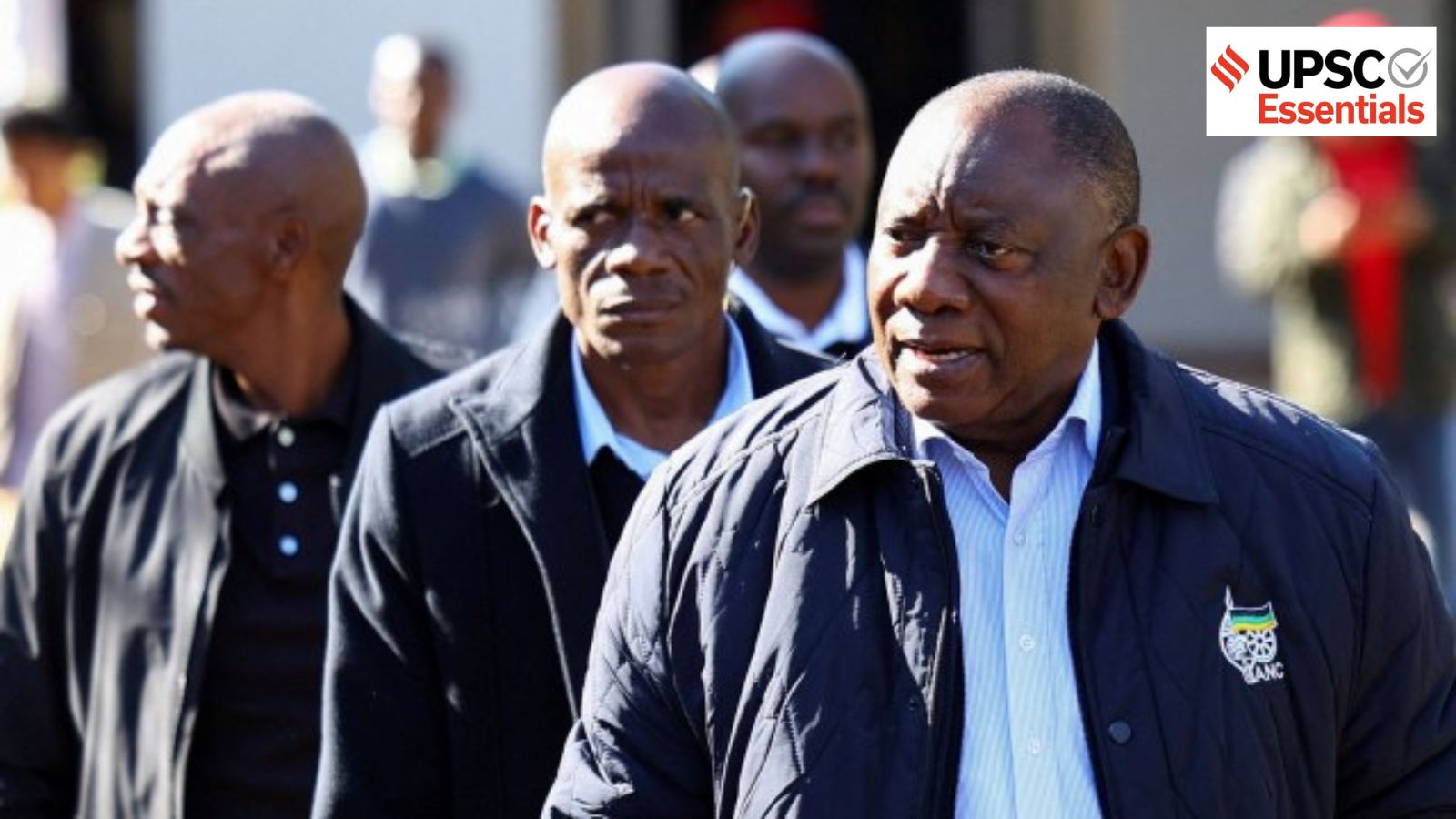 African National Congress'S President Cyril Ramaphosa. (File/ Reuters)
— Shambhavi Anand
(The Indian Express has launched a new series of articles for UPSC aspirants written by seasoned writers and scholars on issues and concepts spanning History, Polity, International Relations, Art, Culture and Heritage, Environment, Geography, Science and Technology, and so on. Read and reflect with subject experts and boost your chance of cracking the much-coveted UPSC CSE. In the following article, Dr. Shambhavi Anand delves into the history of the African National Congress.)
With the echoes of the last general elections (held in May 2024) resonating across Africa’s political landscape, the African National Congress’s (ANC) Foundation Day on January 8 offers an opportunity to reflect on Africa’s journey from colonial rule to self-governance and, most importantly, the end of the apartheid regime – thanks to the ANC’s concerted struggle.
For the past three decades, the ANC has been the dominant political force in South Africa, with its vote share in national elections never dropping below the 50% mark. However, in the 2024 general elections, the ANC, for the first time since 1994 — when the country had its first mixed-race election after the abolition of apartheid — didn’t win a majority of the vote.
What led to the decline of the ANC’s vote share? Does the dispersal of the electoral mandate signify a new era for South Africa, or is it an opportunity for the ANC to redeem itself? Let’s explore the answers by delving into the emergence of the ANC and its enduring legacy.
The African National Congress was founded as the South African Native National Congress (SANCC) on January 8, 1912, in Bloemfontein. Its primary goal was to unite Africans under a single national movement to fight for civil and political rights. Among its founding members were Pixley ka Isaka Seme, John Dube – who served as the first president of the ANC – and Sol Plaatje. The organisation was born during a rather tumultuous time in South Africa’s history, marked by racial segregation and systemic oppression.
By 1910, with the formation of the Union of South Africa, black South Africans were already excluded from political representation in the government. This exclusion was further compounded by restrictions on their land rights. The discovery of diamonds and gold in the late 19th century had already created intense competition for resources, with mine owners continually seeking cheap labour.
The repressive Land Act passed in 1913 prevented black Africans from buying, renting, or using land except for the designated “native reserves”, which constituted only 7% of the country’s total land area. The Land Act dispossessed black Africans and forced them to work in mines in harsh labour conditions with severe restrictions. The infamous Pass Laws controlled their movement and prevented them from leaving their jobs or organising strikes to ensure a steady supply of cheap labour.
Resisting against such oppressions, the SANCC – renamed as the African National Congress in 1923 – began mounting protests. In 1919, it led a campaign against passes in Transvaal and supported a militant strike by the mineworkers in 1920. Such early actions laid the groundwork for the ANC’s long struggle for justice and equality in South Africa.
It was in the 1940s and 1950s that the ANC revived and transformed itself into a mass movement for the liberation of South Africans. A key milestone was the formation of the ANC Youth League in 1944 with prominent figures like Nelson Mandela, Walter Sisulu, and Oliver Tambo. These figures were staunch advocates of African nationalism, believing that Africans could achieve freedom only through their collective efforts. The Youth League began to call for strikes and boycotts and particularly appealed to people who had moved to cities to work in factories.
However, the situation changed dramatically after the National Party (NP) came to power in 1948 and instituted apartheid policies that intensified racial segregation and discrimination. The ANC, wary of the NPC’s oppressive policies, launched a nationwide Defiance Campaign in June 1952. The campaign involved acts of defiance, such as going out without a pass and using “whites only” areas and services. The government responded by arresting many of ANC’s leaders and introducing new laws to prevent public disobedience. The Defiance Campaign was the precursor to mass movements against the apartheid regime and its discriminatory laws, like the Group Areas Act and the Bantu Education Act.
The success of the campaign is reflected in the emergence of new organisations, like the South African Coloured People’s Organisation (SACPO) and the Congress of Democrats (COD). Together with the South African Congress of Trade Unions (SACTU), these organisations formed the Congress Alliance. The ANC with the Congress Alliance together organised the historic ‘Congress of the People’ in Kliptown where the Freedom Charter was adopted on June 26, 1955. The charter articulated the people’s demands, calling for self-governance, free and equal education, housing, healthcare, social security, and land redistribution.
The government rejected the Freedom Charter, labelling it as a communist document. Since the government had banned Communism, the ANC and Congress leaders were arrested on charges of treason. Nonetheless, the Freedom Charter profoundly influenced South Africa’s political discourse, with its ideals of equality, liberty and justice later enshrined in the country’s democratic Constitution.
The ANC, however, was not free from internal struggles. While the struggle against the apartheid regime fostered solidarity among blacks, Indians and whites together, this unity also led to divisions within the group. A small minority within the ANC, who called themselves Africanists, objected to this growing solidarity and viewed whites and Indians as foreigners. In 1959, this group broke away from the ANC and formed the Pan Africanist Congress (PAC).
However, during the anti-pass campaign, the PAC joined hands with the ANC and led the campaign in 1960. On March 21, 1960, both organisations asked people to leave their passes at home and gather in large numbers at Sharpeville in the Vaal to hold a peaceful protest against the oppressive pass laws. But the police responded by opening fire on the peaceful unarmed crowd. The Sharpeville tragedy resulted in the killing of 69 people and 186 were wounded. On March 30, 1960, the government banned the ANC and PAC, arrested the activists and declared a state of emergency.
After this brutal repression, the ANC went underground and began to operate secretly. In 1961, it established its armed wing, Umkhonto we Sizwe (MK) (Spear of the Nation). The MK carried out several acts of sabotage against the apartheid regime and faced severe repression. During the Rivonia Trial, key ANC leaders, including Nelson Mandela, were imprisoned, dealing a significant blow to the movement.
The apartheid regime became more oppressive but the resistance persisted. In 1976, thousands of students in Soweto protested against the compulsory imposition of Afrikaans as a medium of instruction in schools. Slowly, the students’ uprising spread to other parts of the country. The police brutally suppressed the students’ protest and opened fire on marching students, leaving over 1,000 dead. The ANC via its underground activities began to issue pamphlets and garner support for national liberation both domestically and internationally. A breakthrough came in 1977 when the United Nations imposed an arms embargo on South Africa, signalling global condemnation of the apartheid regime and its policies.
During the 1980s, the liberation struggle reached new heights. Different groups, including students and youth organisations, women’s movements and civic bodies, began to rise against the regime. The period was marked by massive boycotts, strikes and protests by different civic bodies. In response, the government declared a national emergency in 1985 and detained over 30,000 people. Despite this, the mass movement shook the very foundation of the apartheid regime. The ANC had infused people with a sense of solidarity in the liberation struggle.
The people now demanded the lifting of the ban from the ANC. In 1991, the ANC was unbanned, and Nelson Mandela was elected as the president of the organisation and Oliver Tambo as chairperson. The liberation struggle eventually culminated in the 1994 general elections in which the ANC secured a historic victory. Nelson Mandela was elected as the first black President of South Africa. Since then, the ANC remained the ruling party and a dominant political force in the country.
However, in May 2024, the ANC suffered a major setback when it lost the majority in the Parliament for the first time in 30 years. The ANC received 40.18% of votes and had to form a coalition government to remain in power. The result of the general election is reflective of the people’s mandate and the government’s failure to deal with rampant poverty, unemployment and corruption. While the ANC’s rich legacy as a liberation movement remains significant, it appears increasingly insufficient to sustain its hold on power. The electoral outcome raises critical questions: Is this a new era of South Africa or is it an opportunity for the ANC to rectify its past mistakes and redeem itself?
What were the primary goals of the African National Congress (originally the South African Native National Congress) when it was founded in 1912?
How did the political and social context of South Africa in the early 20th century influence the founding of the SANCC?
How did the SANCC’s early campaigns, such as the protests against passes in Transvaal and the support of mineworker strikes, set the stage for its later activism?
What was the Defiance Campaign of 1952, and how did it serve as a precursor to later mass movements against apartheid?
What factors contributed to the ANC’s decline in voter support, as reflected in the 2024 election results?
(Dr. Shambhavi Anand works as a Research Assistant at Vivekananda International Foundation.)
Share your thoughts and ideas on UPSC Special articles with ashiya.parveen@indianexpress.com.
Subscribe to our UPSC newsletter and stay updated with the news cues from the past week.
Stay updated with the latest UPSC articles by joining our Telegram channel – IndianExpress UPSC Hub, and follow us on Instagram and X.

Read UPSC Magazine