23 min read

© IE Online Media Services Pvt Ltd



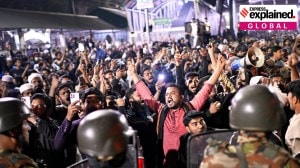
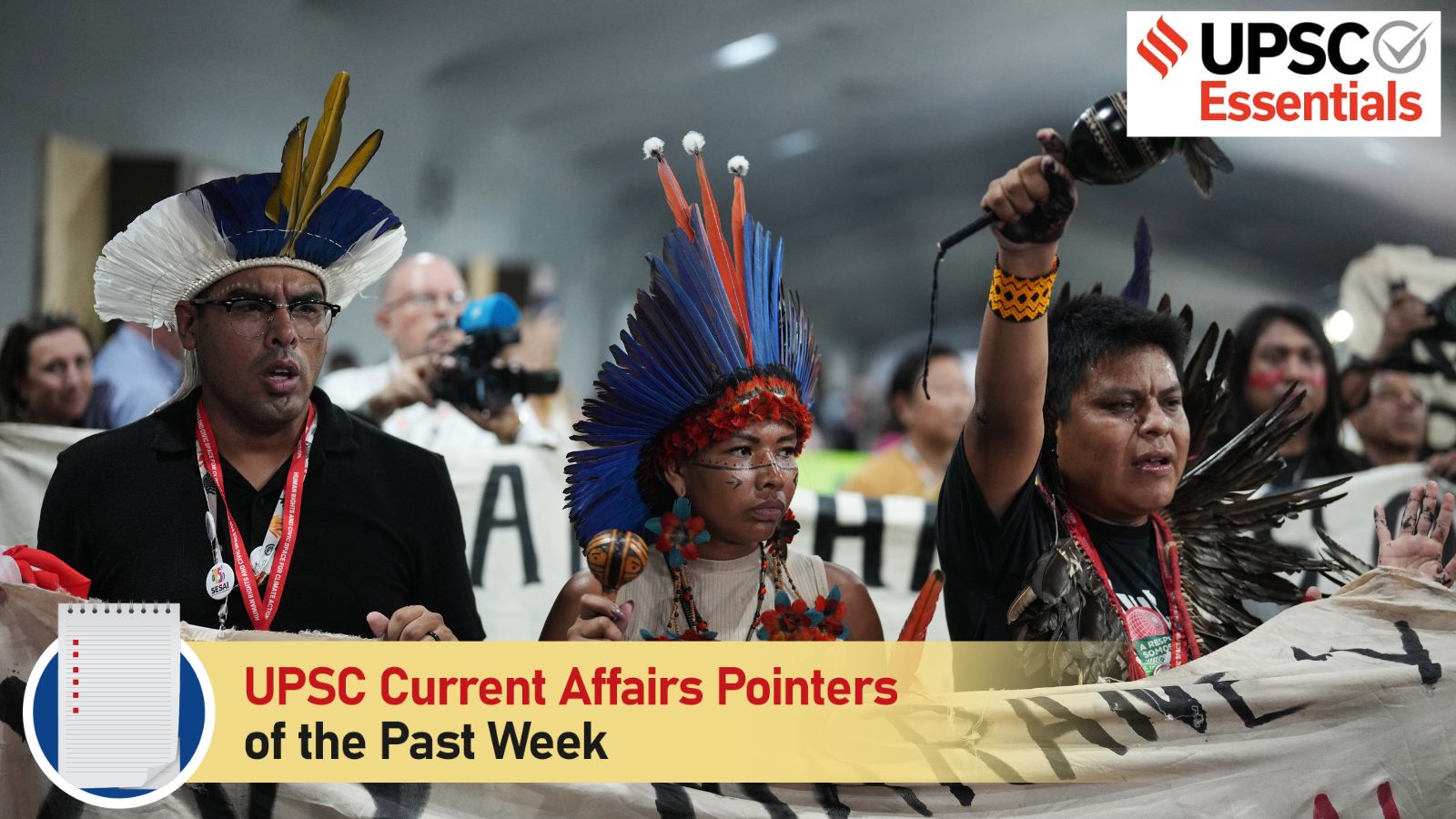 Indigenous activists participate in a protest at the COP30 U.N. Climate Summit, Friday, Nov. 21, 2025, in Belem, Brazil. (AP Photo)
UPSC Current Affairs Pointers brings you essential current affairs of the past week, every Monday, to aid you in your Prelims and Mains preparation of UPSC, State PCS, and other competitive examinations.
If you missed the UPSC Current Affairs Pointers of the past week | November 10 to 16, 2025, read it here.
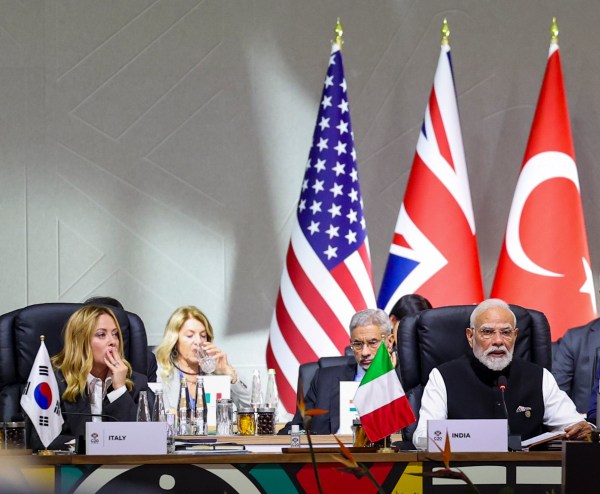 Prime Minister Narendra Modi during the G20 Summit in Johannesburg, South Africa. (PMO via PTI Photo)
— Prime Minister Narendra Modi went to Johannesburg, South Africa, to attend the 20th G20 Leaders’ Summit. This is the first time a G20 Summit is being held on the African continent.
— He proposed the formation of a G20 Global Healthcare Response Team, creation of a Global Traditional Knowledge Repository, an Open Satellite Data Partnership, and a Critical Minerals Circularity Initiative.
— The G20, or the Group of Twenty, is an informal grouping of 19 countries (Argentina, Australia, Brazil, Canada, China, France, Germany, India, Indonesia, Italy, Japan, Republic of Korea, Mexico, Russia, Saudi Arabia, South Africa, Turkey, United Kingdom, and the United States), European Union, and African Union.
— Notably, the African Union, a grouping that represents 55 countries, was admitted as a new member of the G20 in June 2023.
— On the sidelines of the G20 summit, Prime Minister Narendra Modi, Brazilian President Luiz Inácio Lula da Silva, and South African President Cyril Ramaphosa meet for the IBSA leaders’ meeting.
— Modi told the leaders of Brazil and South Africa that the IBSA grouping can send a message of “unity, cooperation and humanity” at a time when the world appears fragmented and divided.
— PM Modi proposed setting up an IBSA fund to promote climate-resilient agriculture and a digital innovation alliance to enable sharing of digital public infrastructure such as the unified payments interface (UPI), health platforms such as CoWIN, cybersecurity frameworks, and women-led tech initiatives.
— IBSA is a unique Forum which brings together India, Brazil, and South Africa, three large democracies and major economies from three different continents, facing similar challenges.
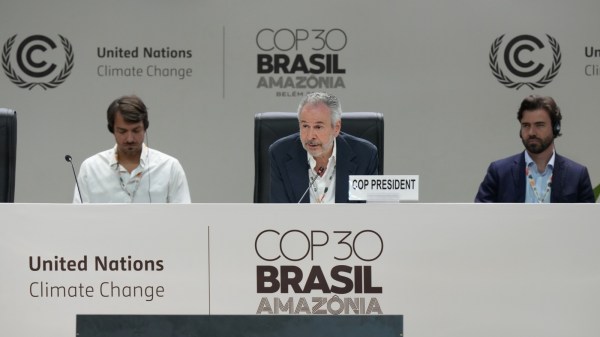 COP30 president André Corrêa do Lago speaks during a plenary session at the climate summit in Belem, Brazil, on Friday. (AP)
— The 30th edition of the Conference of the Parties to the UN Framework Convention on Climate Change (COP30) concluded in Belem, Brazil, on 22nd November. The conference ended with the adoption of the Belem Political Package.
— The Presidency has framed this year’s conference as the “implementation COP,”—was meant to focus less on what the world must do, rather on how to make it all happen.
— Belem Health Action Plan: It is a flagship outcome of Brazil’s COP 30 Presidency, which was unveiled on the dedicated Health Day of COP30 – 13 November 2025. It is aimed at strengthening global health systems to cope better with the impacts of climate change.
— Tropical Forests Forever Facility (TFFF): Brazil, on 6th November, formally launched the TFFF, which is designed as a “payment-for-performance” model that uses agreed satellite monitoring standards and systems to reward tropical forest countries with a continuing source of funding as long as they preserve their forests.
— Santa Marta conference: In a move to push for a global phaseout of fossil fuels, Colombia announced an international conference on Just Transition Away from Fossil Fuels, to be co-hosted with the Netherlands, in Santa Marta on April 28-29, 2026.
Read about other major outcomes of the conference here.
— Around 100 people from Brazil’s Munduruku Indigenous group staged a protest November 14, blocking the main entrance gate to the Blue Zone — the restricted area set aside for negotiators — at the ongoing COP30 in Belém.
— The Munduruku, who live primarily in the Amazon states of Amazonas, Mato Grosso and Pará, are demanding an end to projects and extractive activities that threaten Indigenous territories, particularly in the Tapajós and Xingu River basins.
— At COP30, Brazil has announced the demarcation of 10 new Indigenous lands, covering almost 1,000 square miles. And about a fifth of the TFFF forest fund is set to go to Indigenous peoples protecting forests.
— The Audit Diwas is observed on November 16 as India’s first auditor-general assumed the office on this day in 1860.
— Sir Edward Drummond took charge as the first Auditor General.
— After India became independent in 1947, the Comptroller and Auditor General of India was established as a constitutional authority with the adoption of the Constitution of India in 1950.
— The World Toilet Summit (WTS) is an annual event organized by the World Toilet Organization (WTO) to address the global sanitation crisis.
— This year, the World Toilet Summit (WTS) was held in New Delhi from November 19 to 21, 2025, hosted by Sulabh International.
— It is coinciding with the United Nations-designated World Toilet Day (19 November). The theme is ‘Sanitation in a changing world’, reminding us that no matter what the future holds, we’ll always need the toilet.
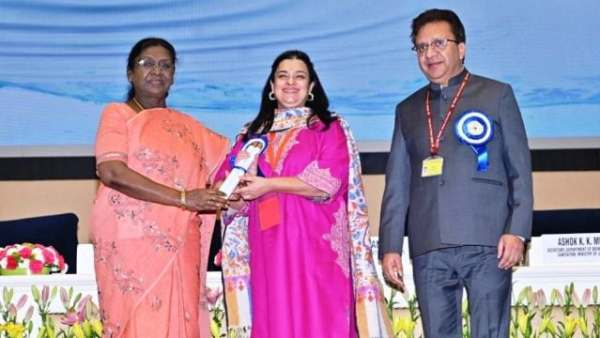 Officials said that Haryana’s achievement reflected its Integrated Water Resources Management approach, which combines scientific planning, community participation, and technological innovation to ensure long-term water security. (Special Arrangement)
— Maharashtra has bagged the first prize for the Best State in the 6th National Water Awards which were given out by President Droupadi Murmu at Vigyan Bhawan in Delhi.
— Gujarat emerged in the second position, and Haryana was in the third.
— Instituted by the Department of Water Resources, River Development, and Ganga Rejuvenation (DoWR, RD &GR), under the Ministry of Jal Shakti, the awards are a part of a campaign to spread awareness about water management and water conservation on a national level.
— It focuses on the “good work and efforts made by individuals and organisations across the country in attaining the government’s vision of a Jal Samridh Bharat.
— President Droupadi Murmu presented the first-ever Jal Sanchay Jan Bhagidari (JSJB) Awards, with Telangana emerging as the top performer among states and UTs in the construction of water conservation structures.
— Telangana topped the list with the construction of 5.2 lakh water conservation structures under JSJB 1.0 initiative, followed by Chhattisgarh (4.05 lakh) and Rajasthan (3.64 lakh).
— The Jal Sanchay Jan Bhagidari Awards, launched in 2024 under Jal Shakti Abhiyan: Catch the Rain (JSA: CTR) campaign, honor outstanding community-driven water conservation efforts.
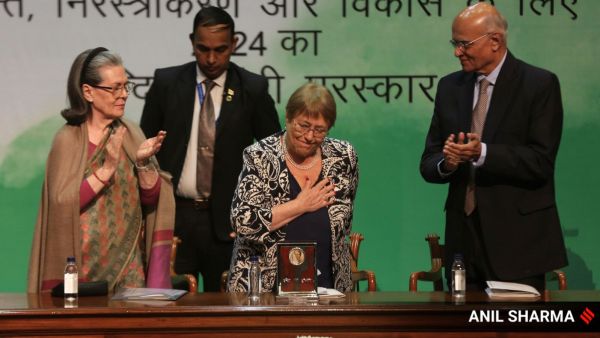 Congress Parliamentary Party chairperson Sonia Gandhi with Indira Gandhi Prize for Peace, Disarmament and Development 2024 winner Michelle Bachelet (centre) in New Delhi. Bachelet is the first and only woman President of Chile and former Chief of UN Human Rights. (Express Photo by Anil Sharma)
— The Indira Gandhi Prize for Peace, Disarmament and Development for 2024 was presented to Michelle Bachelet, the first and only woman President of Chile and a former chief of UN Human Rights. Bachelet is a two-term President of Chile (2006-2010 and 2014-2018).
— The prize consists of an award of Rs.10 million and a trophy with a citation. The trophy is made of Haematite Jasper, the same stone which is used at the samadhi of Indira Gandhi at Shakti Sthala, New Delhi. Haematite Jasper is one of the hardest varieties of stone found in India and is estimated to be 2000 million years old.
(Source: Indiragandhi.in)
— The Supreme Court on 19th November struck down key provisions relating to the appointment process in the Tribunals Reforms (Rationalisation and Conditions of Service) Act, 2021, as unconstitutional and violative of the separation of powers and judicial independence.
— The Court underlined that “the Constitution is what the Court says it is” and Parliament’s “discretion is broad but not absolute.”
— The ruling is the latest in a series of five judgments since 2010 in which the Supreme Court has struck down government interference in the regulation of tribunals. The judiciary’s rationale is that since the executive is often a party to litigation before tribunals, it cannot be permitted to play a dominant role in appointing their members.
— Tribunals are quasi-judicial bodies set up to provide speedy and specialised resolution of disputes in areas ranging from taxation and corporate law to administrative matters, thereby reducing the caseload on other courts.
Read in detail about the discord between Supreme Court and the Centre over tribunals.

—The Centre government has implemented the four long-pending labour codes covering wages, industrial relations, social security, and working conditions. They will replace 29 fragmented laws with a unified, modern framework.
— The Parliament had cleared the Code on Wages in 2019 and the rest of the three codes in 2020 — Industrial Relations Code; Code on Social Security; and Occupational Safety, Health and Working Conditions Code.
— Labour is a Concurrent List subject, and while most states have finalised rules aligned with the four Codes, central-level implementation remains pending.
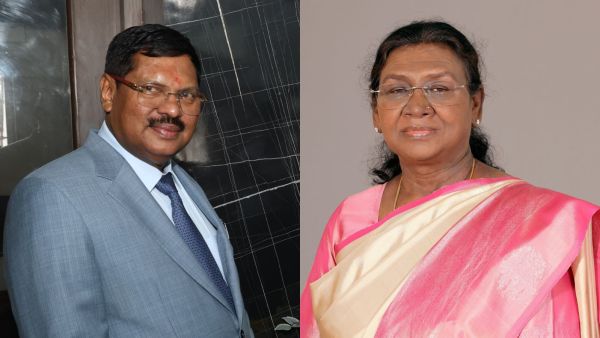 President Droupadi Murmu (right) had made the reference under Article 143 of the Constitution, and the verdict will be delivered by a five-judge Constitution Bench headed by Chief Justice of India B R Gavai (left). (File Photo, Facebook/President of India)
— A five-judge Constitution Bench of the Supreme Court has delivered an advisory opinion to the Presidential reference. This is in the 16th Presidential Reference since the Court’s establishment.
— The President sought the reference in the Court’s judgment in State of Tamil Nadu v. Governor of Tamil Nadu (2025) where the court has invoked Article 142 to prescribe timelines for the Governor and President to act on Bills.
— The SC’s advice to the President states that while timelines cannot be set and “deemed assent” cannot be granted by the SC itself, states have a right to approach the Court when there is a delay. The advice seeks to protect a line in the sand on the separation of powers between the executive and the judiciary.
— The court clarified that if the Governor sits on the bill forever, it would invite “limited judicial scrutiny” though courts cannot go into the merits of the action.
Know about the Supreme Court’s answer to all 14 referred questions here.
— For the first time, the Army is planning to induct women soldiers in its Territorial Army (TA) battalions, aimed at gradually opening up greater opportunities for women in the force.
— According to the TA website, there are 11 TA Home & Hearth (H&H) battalions, eight of which were raised for Jammu and Kashmir and three for the North-East, in 2004-05.
— The TA H&H battalions, comprising the local population, have been raised in the northern and eastern theatres for counter-insurgency and counter-terrorism operations.
— They assist the regular Army and civil administration in multiple tasks, such as intelligence gathering, road opening, and assistance in case of natural calamities, among others.
— The TA is a citizen’s army of volunteers who willingly enroll in this army to contribute to the nation’s defence.
— The TA provides the volunteers an ideal opportunity to receive military training in their spare time and to serve the nation in times of national emergency and internal disturbances.
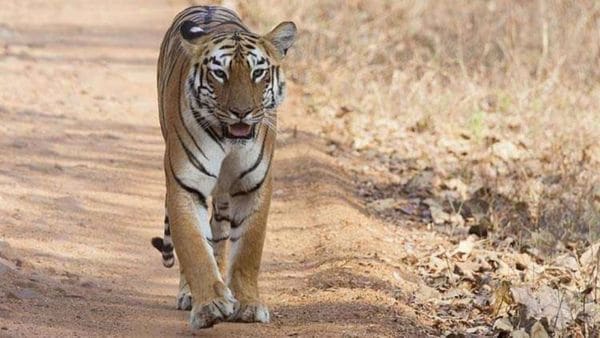 The IBCA was conceived by India and PM Modi launched it in April 2023 during the 50th-year celebrations of Project Tiger to secure the future of seven big cats – the tiger, lion, leopard, snow leopard, puma, jaguar and cheetah. (File photo)
— India’s Environment Minister Bhupender Yadav while speaking at a high-level ministerial segment at COP30 conference, announced India’s decision to host a ‘Global Big Cats Summit’ in New Delhi next year.
— 17 countries were already formally associated with the International Big Cat Alliance (IBCA), with over 30 more expressing willingness to join.
— The IBCA is an initiative launched by Prime Minister Narendra Modi in April 2023 in Mysuru commemorating the 50th anniversary of Project Tiger.
— The objective of the IBCA is to ensure cooperation for the conservation of seven big cats: lion, tiger, leopard, cheetah, snow leopard, jaguar, and puma, and enhance knowledge exchange and threats associated with them.
|
MAINS VALUE ADDITION ‘Solar Mamas’ by Barefoot College International Barefoot College International, established in 1972, by Sanjit “Bunker” Roy has been training marginalised illiterate and semi-literate women from the Global South to become Solar Engineers and provide access to clean solar energy even in the remotest of regions. They learn how to design, make, install and repair solar lanterns and home-lighting systems and have become affectionately known as “Solar Mamas”. Alongside its flagship solar power course, Barefoot College International offers programs for women in tailoring, beekeeping and sustainable agriculture. Every woman who completes a program is trained in general health knowledge that they are expected to take back to their villages. The “solar mamas” are health catalysts in another way, by replacing harmful light sources like kerosene. In recent years, Barefoot College International has scaled up across Africa, with other campuses in Madagascar and Senegal. In Tanzania’s semi-autonomous archipelago of Zanzibar, this programme has lit 1,845 homes. |
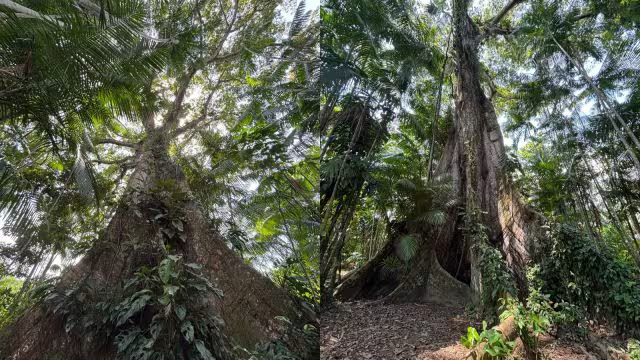 Over the past decade, several Samaúma trees have fallen prey to deforestation, which has been a key issue of concern in the Amazon region. (Express Photo)
— At COP30 in Belem, Brazil where policymakers, leaders and administrators have gathered to discuss ways to combat the global climate crisis, members of Brazil’s indigenous communities and local residents are trying to bring to light various aspects of their culture, including the existence of the Samaúma.
— Samauma, known by the Portuguese nomenclature, is a 50-metre tropical tree of the Malvaceae family.
— It is considered to be sacred and the queen of the entire tropical forest that covers 40 per cent of Latin America, including large parts of Brazil, Bolivia, Colombia, Ecuador, Peru, and Venezuela, among others.
— It is also known as the Kapok tree which can grow up to a height of 70 metres or a 20-storeyed building, forming a natural canopy and towering over other trees in the rainforest.
— These trees have an average lifespan varying from 300-400 years, their buttress roots sturdy in nature and taller than a full-grown human. Due to their heights, the tree has expansive capacity for carrying out photosynthesis leading to an increased production of oxygen, which is then fed to the world.
— This tree plays a huge role in maintaining the rainfall cycle of the world. The crown of the tree releases large amounts of water vapour daily through the process of evapotranspiration, which leads to the formation of clouds, leading to rainfall.
| Samaúma: The ‘Queen of the Forest’ that guides the lost
“It is very easy to get lost inside the rainforests. So, whenever any of us gets lost or if there is any emergency situation inside the forest, the first thing we do is find a Samaúma tree. Then we pick up a stick and start beating its roots. In the silence of the forest, the sound of the stick hitting the tree’s roots echoes, and locals can easily understand that someone is lost in the woods or is in some danger, and is sending signals for help,” Luciene Kaxinawà, a local resident who also hails from the indigenous Kaxinawà community, told The Indian Express. |
 Dugongs are listed as Vulnerable on the IUCN Red List of Threatened Species. (Wikimedia Commons)
— At the International Union for Conservation of Nature (IUCN) Conservation Congress, a report titled ‘A global assessment of dugong status and conservation needs’ was launched, highlighting the growing threat to the dugong population in India.
— The IUCN World Conservation Congress took place in Abu Dhabi, United Arab Emirates, from 9 to 15 October 2025.
— The report said that the marine mammal’s long-term survival in the Gulf of Kutch and the Andaman and Nicobar Islands was “highly uncertain” and “challenging” respectively. Meanwhile, in the Gulf of Mannar-Palk Bay, its population appears to be “much lower” than in the recent past.
Know in details about the importance of Dugong and threats to their existence
|
About Dugongs * Dugongs (Dugong dugon) are a marine mammal that are believed to have inspired ancient seafaring tales of mermaids due to their gentle, seemingly benign disposition. * The mammals are exclusively herbivorous, and seagrass meadows are their main source of food — the reason why they are also called sea cows. * In the IUCN Red List of endangered species, sea cows are listed as a species vulnerable to extinction. * In India, they are listed under Schedule I of the Wildlife (Protection) Act, 1972, which grants the species the highest legal protection against hunting and trade. * In the Convention on International Trade in Endangered Species of Wild Fauna and Flora (CITES), it is listed in Appendix I which prohibits the trade of the species and its parts. * They are found in over 30 countries. In the South Asian region, dugongs are primarily found in the Gulf of Kutch, the Gulf of Mannar–Palk Bay region (located between India and Sri Lanka), and the Andaman and Nicobar Islands. |
Humboldt penguins
— Recently, Chilean scientists warned of further risks to the world’s shrinking population of Humboldt penguins.
— Chile’s Pacific coast is home to 80% of the world’s remaining Humboldt penguins, and scientists at the Universidad de Concepcion estimate that their numbers have dwindled to fewer than 20,000 from around 45,000 in the late 1990s.
— Last month, Chile’s Environment Ministry classified it as “endangered.”
— Competition for food from commercial fishing as well as habitat loss, pollution, bird flu, and the worsening impacts of climate change have contributed to declining numbers.
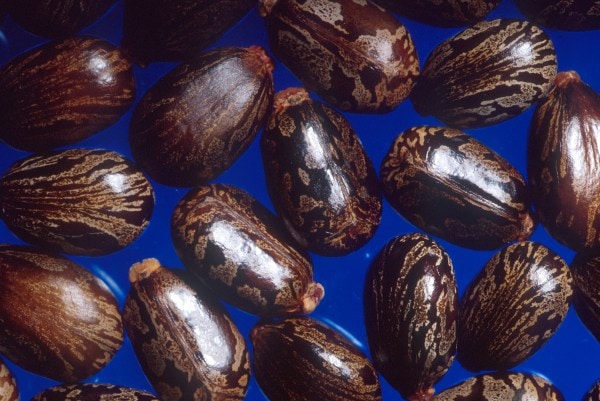 Ricin is essentially a protein that can be extracted from the castor bean. (wikimedia commons)
— Recently, the Gujarat Anti-Terrorist Squad arrested three men — including a doctor with a “Chinese medical degree” – for allegedly trying to produce a lethal chemical compound called Ricin.
— Ricin is essentially a protein that can be extracted from the castor bean, largely grown industrially for the production of castor oil in countries such as India, Brazil, and China.
— The seeds typically contain 30 per cent to 60 per cent castor oil, with ricin accounting for 1 per cent to 5 per cent of the weight of the solid residue.
— Once consumed, ricin attaches itself to ribosomes. They are cell organelles made up of RNA and protein. They are responsible for reading genetic code and synthesising proteins.
— Once the poison binds with the ribosome, it stops protein synthesis in cells. And, depending on which cells absorb the poison, a person can suffer multi-organ failure and even death
— There is no antidote or specific treatment for ricin poisoning, and the treatment is symptomatic.
— Forensic analysis of explosives that led to the November 10 blast outside the Red Fort has confirmed the use of a mixture of ammonium nitrate and triacetone triperoxide (TATP), highly potent chemicals whose sale and handling are heavily regulated.
— Ammonium nitrate, commonly used as agricultural manure, is legally sold only through registered vendors. Its access is highly regulated: a district magistrate can permit possession of up to 30 metric tonnes, while larger quantities require PESO (Petroleum and Explosives Safety Organisation) approval.
— Buyers must state the purpose of use, and the government’s System for Explosive Tracking and Tracing (SETT) monitors all licensed transactions. Despite this, large-scale illegal sales and purchases still persist.
— Ammonium nitrate can be turned into a powerful explosive when mixed with a fuel oil to create ANFO (Ammonium Nitrate-Fuel Oil).
— A compound used as an explosive should contain oxygen atoms. Ammonium nitrate has three oxygen atoms, RDX contains many oxygen atoms, and trinitrotoluene (TNT) has nine oxygen atoms.
— TATP, which is formed from a combination of several chemical compounds, also contains oxygen and can detonate. The accused in the November 10 blast likely created an Improvised Explosive Device (IED) with a detonator by mixing ammonium nitrate and TATP.
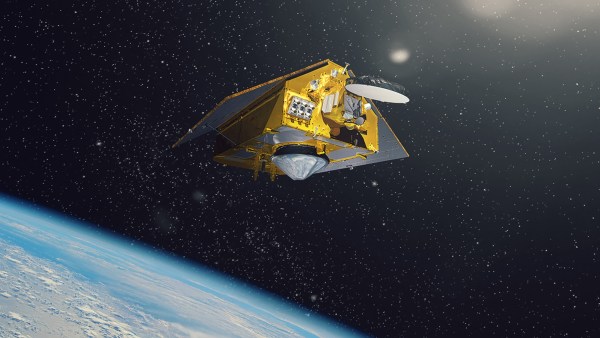 An artist’s impression of Sentinel-6B. (Image: NASA/JPL-Caltech)
— Sentinel-6B, a joint mission between the United States’ NASA and NOAA, and the European Space Agency, was launched on November 16 from the Vandenberg Space Force Base in California.
— It is an ocean-tracking satellite with six onboard science instruments that will measure the rising sea levels and its impacts on the planet.
— Data from Sentinel-6B is expected to improve the accuracy of weather forecasts, including storm and flood predictions, enabling administrators to make better real-time decisions to safeguard public property and protect coastal infrastructure.
— Recently, the Indian Council of Agricultural Research (ICAR) has received a patent for genome-edited (GE) technology that deploys the so-called TnpB or Transposon-associated proteins.
— It is a “miniature alternative” to the proprietary CRISPR-Cas proteins-based technology to precisely cut and tweak the DNA of plants.
— Similar to commonly used CRISPR-associated Cas9 and Cas12a proteins, TnpB act as “molecular scissors” to cleave the DNA of a gene at a predetermined target site and change its sequence.
— TnpB is only 408 amino acids long and sourced from an extreme environment-surviving bacterium called Deinococcus radiodurans.
 Sickle cell disease is a genetic condition that leads to the body’s red blood cells becoming rigid, sickle-shaped, and less capable of carrying oxygen. (Getty Images)
— Recently, the government has launched India’s first indigenous “CRISPR” based gene therapy for Sickle Cell Disease, which particularly affects India’s tribal population.
— The therapy, named “BIRSA 101” is dedicated to Bhagwan Birsa Munda, whose 150th anniversary was observed on November 15.
— Sickle cell disease is a genetic condition that leads to the body’s red blood cells becoming rigid, sickle-shaped, and less capable of carrying oxygen. The shape of the blood cells can also lead to blockages in blood flow, leading to acute episodes of pain, chronic pain, organ damage, anaemia, infections, and strokes.
— To cure the condition, Birsa-101 precisely corrects the mutations in the genetic code that cause the disease. The therapy has to be given as a one-time infusion, after which the body should start producing normal red blood cells instead of sickle-shaped ones
— The same therapy can be used for the treatment of thalassaemia — another inherited blood disorder where the body produces little or no haemoglobin.
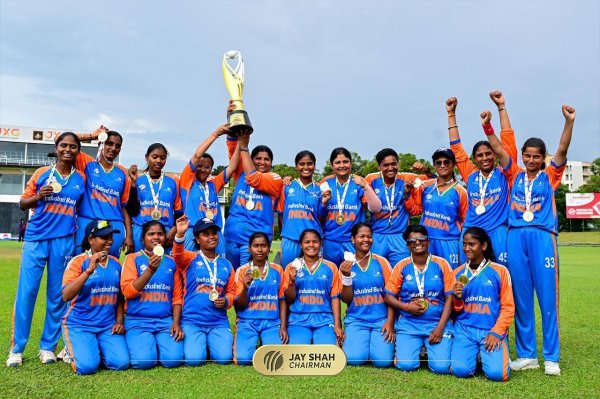 The Indian team posing with the cup after winning the first-ever Blind Women’s T20 World Cup. (X/@JayShah)
— India won the inaugural Blind Women’s T20 World Cup after defeating Nepal by seven wickets in the final played at the P Sara Oval in Colombo.
— After electing to field, India restricted Nepal to 114 for 5. In response, India chased down the target in 12.1 overs, with Khula Sharir unbeaten on 44 off 27 balls.
— India and Sri Lanka co-hosted the event, with fixtures in Delhi, Bengaluru, and Colombo.
(Note: The best way to remember facts for UPSC and other competitive exams is to recall them through MCQs. Try to solve the following questions on your own.)
(1) With reference to ‘dugong’, a mammal found in India, which of the following statements is/are correct? (UPSC CSE 2015)
1. It is a herbivorous marine animal.
2. It is found along the entire coast of India.
3. It is given legal protection under Schedule I of the Wildlife (Protection) Act, 1972.
Select the correct answer using the code given below.
(a) 1 and 2
(b) 2 only
(c) 1 and 3 only
(d) 3 only
(2) Consider the following statements:
1. The Tropical Forests Forever Facility (TFFF) was launched at COP30.
2. Ethiopia’s capital Addis Ababa, has been confirmed as the host of COP32.
Which of the above-mentioned statements is/are correct?
(a) 1 and 2 only
(b) 1 only
(c) 2 only
(d) None
| Prelims Answer Key |
| 1. (c) 2. (a) |
For your suggestions and feedback, write to khushboo.kumari@indianexpress.com
Subscribe to our UPSC newsletter. Stay updated with the latest UPSC articles by joining our Telegram channel – IndianExpress UPSC Hub, and follow us on Instagram and X.
🚨 Click Here to read the UPSC Essentials magazine for October 2025. Share your views and suggestions in the comment box or at manas.srivastava@indianexpress.com🚨

Read UPSC Magazine