3 min read
© IE Online Media Services Pvt Ltd



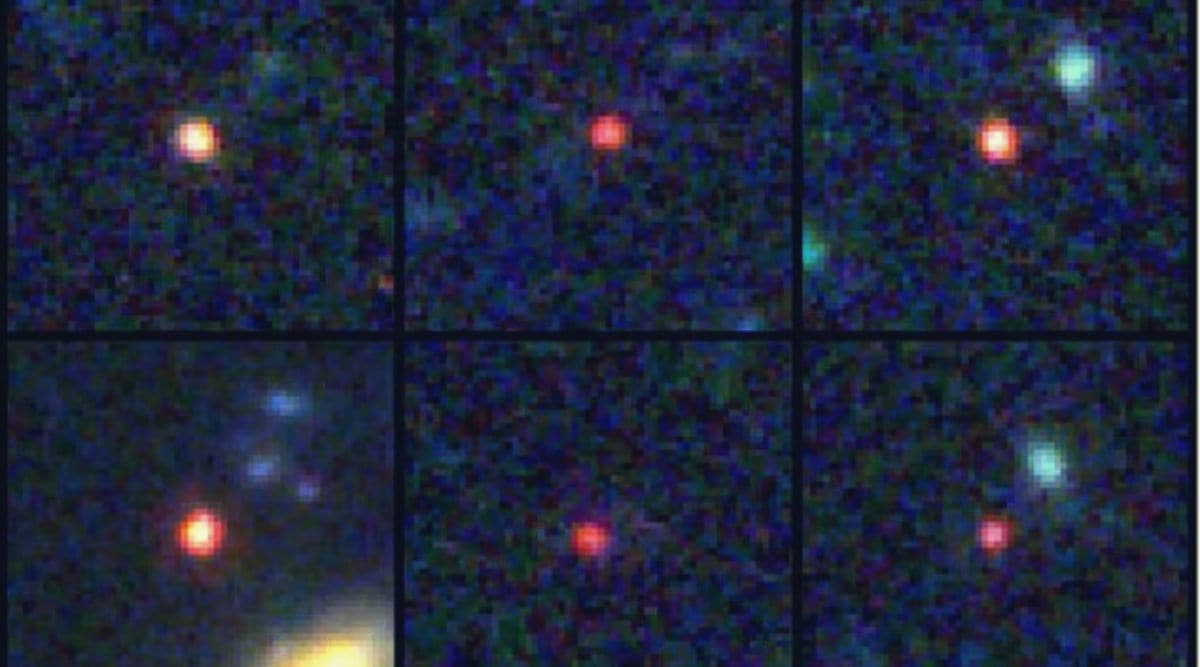 These galaxy candidates contradict the existing ideas of how the universe evolved in its initial years. (Image: Nasa)
 The James Webb Space Telescope seems to be finding galaxies that grew too big too soon after the Big Bang, according to new research. This could mean that scientists will need to rewrite what we understand about the universe.
In a new study published in Nature Astronomy, astronomers found that six of the earliest and most massive galaxy candidates studied by the Webb so far contradict the standard model of cosmology.
The researchers estimate that each of these galaxies is seen between 500 and 700 million years from the Big Bang. This is because the light from them is travelling for such a long distance that we are seeing them as they were billions of years ago.
But despite existing so early in the cosmic timeframe, these galaxies measure more than 10 billion times the mass of our Sun. In fact, one of them even appears to be more massive than the Milky Way in spite of the fact that our galaxy had billions more years to grow.
“If the masses are right, then we are in uncharted territory. We’ll require something very new about galaxy formation or a modification to cosmology. One of the most extreme possibilities is that the universe was expanding faster shortly after the Big Bang than we predict, which might require new forces and particles,” said Mike Boylan-Kolchin, the author of the paper, in a press statement. He is an associate professor of astronomy at The University of Texas at Austin.
If galaxies have to form so fast and to such a size, they will also need to be converting nearly 100 per cent of their available gas into stars.
“We typically see a maximum of 10% of gas converted into stars. So while 100% conversion of gas into stars is technically right at the edge of what is theoretically possible, it’s really the case that this would require something to be very different from what we expect,” explained Boylan-Kolchin.
The James Webb Space Telescope is an outstanding scientific tool that is helping scientists understand more about the universe than was ever possible before with other observatories. But now, it seems like it is also putting astronomers in an unsettling predicament–they will have to question the very fundamentals of what they know about cosmology.
The current reigning theory of cosmology is called the ΛCDM (Lambda-CDM) paradigm and it has guided astronomers since the late 1990s, according to the University of Texas at Austin.
If galaxies can form faster than ΛCDM or if there is more matter for forming stars and galaxies in the early universe than understood previously, astronomers will need to rethink the very foundations of the science.