Premium
This is an archive article published on May 29, 2022

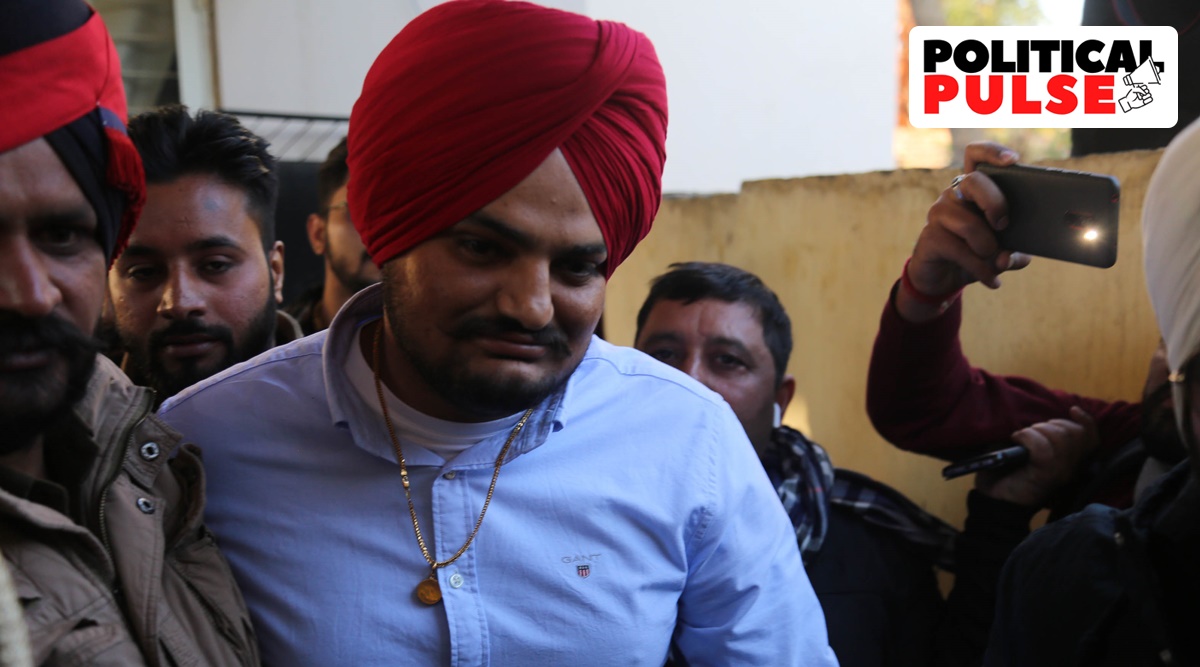
The ballad of Sidhu Moose Wala: Self-made, temperamental, the man from Moosa

While campaigning during the Assembly polls earlier this year, Sidhu Moose Wala would often say: ‘I am not going anywhere. I will live here, I will die here.’

Punjabi Singer Sidhu Moose Wala. (Express File Photo)Punjabi Singer Sidhu Moose Wala. (Express File Photo)

“I am not going anywhere. I will live here and I will die here”: This is a line that Shubhdeep Singh Sidhu, who liked being known as Sidhu Moose Wala, would repeat at every rally and every roadside meeting while campaigning for the Punjab Assembly elections held in February this year.

Moosewala, 27, was the only child of his parents. He was shot dead near Mansa, three days after his security was downgraded.

Sidhu Moose Wala was shot at least 10 times while he was in his car.
Sidhu Moose Wala: Self-made pop sensation

Moose Wala was a self-made pop sensation. He could be petulant and temperamental and had frequent run-ins with the law. Among several cases, he was booked under the Arms Act for firing an AK-47 rifle at a shooting range during the lockdown. He was also booked for promoting violence and gun culture with his song “Sanju”.

But his heart beat for his village Moosa. “That is why I chose to be known not by my name but by that of my village,” he would tell people as he went from village to village to seek votes. He got the Congress ticket from Mansa, where he was pitted against the Aam Aadmi Party’s (AAP) Vijay Singla.

Surprisingly, he ran a very different campaign shorn of any tall promises. Instead, he made a clean environment his poll plank. “We need to clean up the air we breathe, the water we drink, the food we eat, and our political system,” he would say.

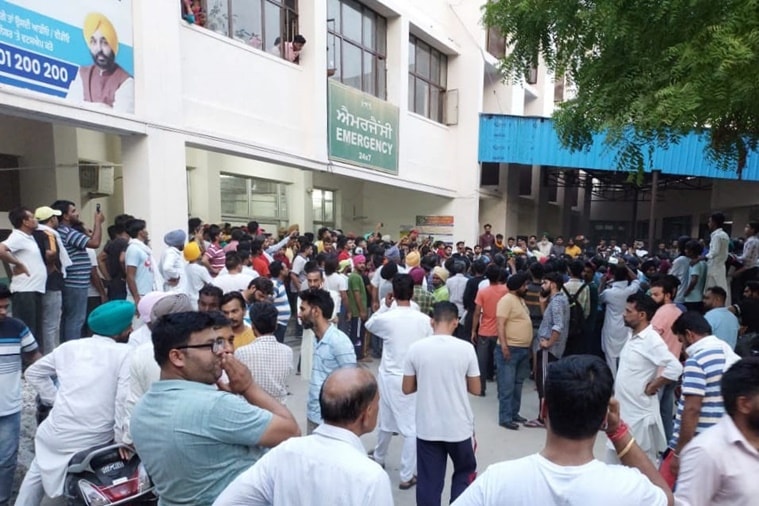
People gather at Mansa Civil Hospital where Sidhu Moose Wala was taken to after being shot.
Speaking at a gathering at Khiwa Khurd village about why he joined politics, he had said: “When I was 23, I chose a profession (music) to transform the life of my parents. At 27, I have fame and money to give to my parents, but I can’t buy the air… Rich or poor we breathe the same air.”

Cancer was another cause which Moose Wala worked for. He used to organise an annual free cancer camp in his village. “We are a small village of 2,800 people but every year, at least six to eight people get diagnosed with cancer. It’s all because of the toxins in our soil and air,” he said.

Story continues below this ad

He also fancied himself as a farmer and had invested in land using his handsome earnings from music. He had his life figured out — he would win the elections, play the messiah of Mansa, and continue to roll out chartbusters.

An engineer from the Guru Nanak Dev Engineering College, Ludhiana, one of the oldest engineering institutions in the region, he started his career as a songwriter in 2016. A canny marketeer, Moosewala made the most of the social media to market his songs. He was among the first leading singers in the state to start releasing his songs independently on his YouTube channel. He would also plan his tours, often tying up with international rappers such as Fredo and Morrison in London for the maximum impact, and was written about by papers such The Guardian. Most of his singles had an English title even though the songs would be mainly in Punjabi with a touch of English and Hindi.

His mega-hit titled ‘Jatt da mukabla’, best epitomises his bluster. And the lines “Ucha udh ke itna itraao matt parindo, Mai aukaat pai aageya toh aasmaan khareed loonga (Don’t flutter so high, you birds, for if I want, I can buy the sky)” became one of the most mouthed by his fans.

Ironically, his latest track released on May 15 was titled ‘The Last Ride’.

Story continues below this ad

🚨 Limited Time Offer | Express Premium with ad-lite for just Rs 2/ day 👉🏽 Click here to subscribe 🚨

His songs which he wrote and composed himself — he made it to the Top 5 in the UK charts last year — frequently got him into trouble both with the police and the clergy.  Things came to such a pass that once his mother Charan Kaur asked him to take a vow that he would only sing hymns from gurbani.

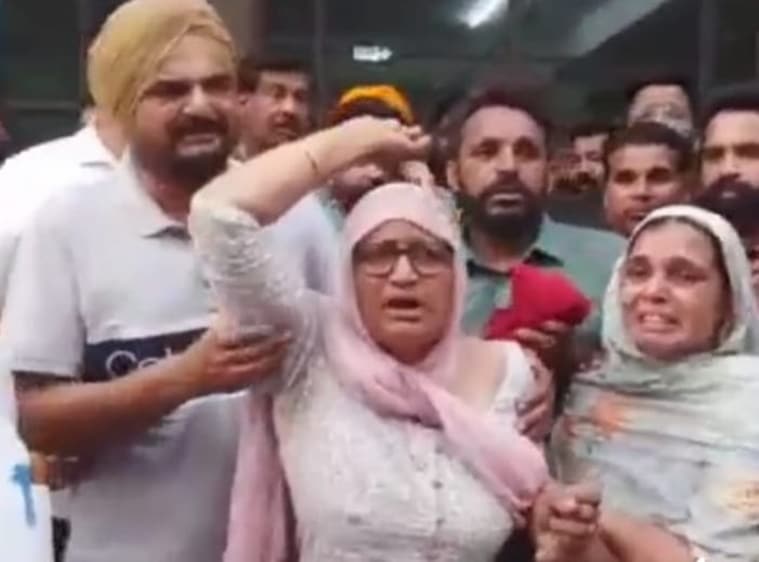
Sidhu Moose Wala’s mother mother Charan Kaur.

If there is one person that he was scared of, it was his mother. He had gone from house to house to seek votes for her in the 2018 Panchayat elections. Needless to say, she won.

Later, he would crow about how he he had not distributed any money or promises. “They voted for us because they knew we were honest.”

Story continues below this ad

He tried to do that in his maiden election as well. His events never had any lavish pomp and grandeur, ending with simple pakoras at the end.

Many sniggered are his naïveté as he dug his heels in and said he would not fritter away his hard-earned money on any kind of freebies. He fought the elective against the advise of his mother. And seeing the response — he drew more children than adults — he would often wonder if his mother was right.

When defeated by Vijay Singla, he raged against the voters, calling them anti-national. But that was Moosewala. More recently, when Singla was sacked, he addressed a press conference. It turned out to be his last. He lived and died. Just a few kilometres from his beloved village.

Manraj Grewal Sharma is a senior journalist and the Resident Editor of The Indian Express in Chandigarh, where she leads the newspaper’s coverage of north India’s most politically and institutionally significant regions. From Punjab and Haryana to Himachal Pradesh and the Union Territory of Chandigarh, she oversees reporting at the intersection of governance, law, politics and society. She also reports on the diaspora, especially in Canada and the US. With a career spanning journalism across several countries, academia and international development, Manraj brings a rare depth of perspective to regional reporting. She is widely regarded as a leading chronicler of Punjab’s contemporary history and socio-political evolution, particularly its long shadow of militancy, federal tensions and identity politics. Her book, Dreams after Darkness, remains a definitive account of the militancy years and their enduring aftermath. Professional Background & Expertise A gold medalist in mass communication and a post-graduate in English literature, Manraj has a multifaceted career spanning journalism, academia, and international development. She was also awarded a fellowship by National Foundation of India and did several in-depth pieces on Manipur. Internationally, she has reported from Israel, US, UK, Myanmar, and Mauritius Her key focus areas include: Regional Politics, History, Agriculture, Diaspora, and Security. Of late, she has started focusing on Legal & Judicial Affairs: Much of her recent work involves reporting on high-stakes cases in the Punjab and Haryana High Court, ranging from environmental policy to civil rights. International Consulting: She previously served as a consulting editor for the Asia Pacific Adaptation Network and a publishing consultant for the Asian Development Bank (ADB) in Manila. Academia: For five years, she was the managing editor of Gender, Technology and Development, a peer-reviewed international journal at the Asian Institute of Technology, Bangkok. Recent Notable Articles (Late 2025) Her recent reportage focuses heavily on judicial interventions and regional governance: 1. Environment & Governance "‘NGT can’t test legality of policy’: HC hears challenge to Punjab’s ‘Green Habitat’ plan" (Dec 22, 2025): Covering a critical legal battle over whether the National Green Tribunal has the authority to strike down a state policy regularizing farmhouses on delisted forest land. "High court pulls up Punjab poll panel over audio clip probe" (Dec 10, 2025): Reporting on judicial concerns regarding the transparency and fairness of local body elections. 2. Legal Rights & Social Welfare "HC issues notice to Punjab, Haryana over delay in building old age homes" (Dec 22, 2025): Reporting on a contempt petition against top officials for failing to establish government-run homes for the elderly as promised in 2019. "Victims can appeal acquittals in sessions court without seeking special leave" (Dec 19, 2025): Highlighting a significant procedural shift in criminal law following a Supreme Court ruling. "HC upholds benefits for Punjab FCI officer acquitted in 20-year-old bribery case" (Dec 19, 2025): A report on the concept of "honourable acquittal" and its impact on employee benefits. 3. Human Rights & Identity "As Punjab denies parole to MP Amritpal Singh, HC asks it to submit ‘foundational material’" (Dec 1, 2025): Covering the legal proceedings regarding the radical preacher and sitting MP's request to attend Parliament. "Protecting life paramount: HC backs Muslim woman in live-in after verbal divorce" (Nov 6, 2025): Analyzing judicial protections for personal liberty in the context of traditional practices. Signature Beats Manraj is recognized for her ability to decode complex judicial rulings and relate them to the everyday lives of citizens. Whether it is a 30-year-old land battle in Fazilka or the political implications of Kangana Ranaut’s candidacy in Mandi, her writing provides deep historical and regional context. Contact @grewal_sharma on X manrajgrewalsharma on Instagram ... Read More

 

Latest Comment
Post Comment
Read Comments
Advertisement
Advertisement
Advertisement
Advertisement