6 min read


© The Indian Express Pvt Ltd



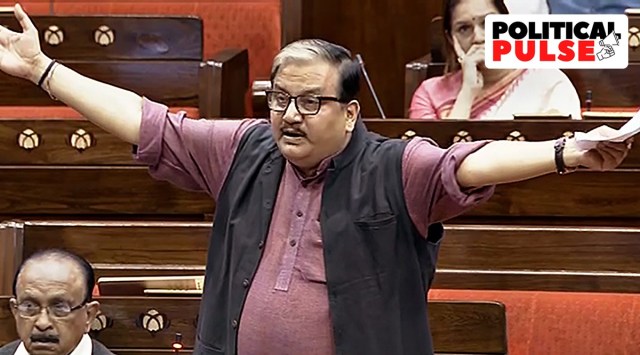 Jha mentioned the poem, which seeks to capture upper caste dominance over all aspects of life in a village, during the debate over the women's reservation Bill. (PTI)
 THE JD(U) and BJP appear to have found common ground over the mention of Om Prakash Valmiki’s poem Thakur ka kuan by RJD MP Manoj Kumar Jha in a speech during the recently concluded special session of Parliament.
While JD(U) MLC Sanjay Singh has warned that Rajputs should not be “incited”, the BJP has claimed that sentiments of the upper caste community had been hurt.
Jha mentioned the poem, which seeks to capture upper caste dominance over all aspects of life in a village, during the debate over the women’s reservation Bill. The RJD, which had earlier opposed a women’s quota without provision of reservation for backward classes, voted for the Bill this time, but sought that the government also bring in OBC quota in it, like for SCs/STs.
Jha has clarified that he did not intend to insult anyone with the poem, but meant to highlight “a tendency to dominate” through the Thakur reference.
As word spread regarding the speech, BJP Bihar leader and Rajya Sabha MP Sushil Kumar Modi demanded that RJD leader and state Deputy Chief Minister Tejashwi Yadav apologise on Jha’s behalf. “Jha has hurt the sentiments of Rajputs,” Modi said.
JD(U) MLC and Rajput Leader Sanjay Singh said: “Rajput is like fire. No one should try to fan it.”
Fellow Rajput leader Anand Mohan, who recently got out from jail where he was serving sentence for a murder conviction due to a Bihar government order, said: “I would have pulled out the tongue (of Jha) and thrown it towards the chair of the Rajya Sabha presiding officer.”
Anand Mohan’s son and RJD Sheohar MLA Chetan Anand wondered if this was the way “the RJD was seeking to do inclusive, A to Z politics”.
Valmiki’s poem, inspired by a Premchand story having the same title, starts with the lines: “Chulha mitti ka, mitti taalaab ki, taalaab Thakur ka / Bhookh roti ki, roti baajre ki, baajra khet ka, khet Thakur ka (Oven is made of mud, mud is from the pond, the pond belongs to the Thakur / Hunger is for bread, the bread is made of millet, the millet is produced in the field, the field belongs to the Thakur).” And goes on in the same vein.
Jha, who is a professor at Delhi University, recited the poem towards the end of his speech on the women’s Bill, adding the disclaimer that he was not referring to any caste, and that he wanted to “kill the Thakur within himself” as well.
What has put the RJD in a spot is that the latest row comes amidst a controversy involving another party leader, and Bihar Education Minister, Chandrashekhar. The minister has made frequent remarks targeting “offensive” portions in the Ramcharitmanas, and the RJD’s failure to act against him – despite the JD(U) displeasure on the issue – is seen as tacit support to Chandrashekhar’s stand, and a bid by the RJD to bolster its credentials as a party of the backward classes.
The BJP has called out the RJD silence on the issue, calling it a bid for caste polarisation ahead of the 2024 Lok Sabha elections.
Jha’s use of Thakur ka kuan is now alleged to be part of the same effort.
A JD(U) leader said: “Jha is known for this. He also got the RJD to oppose the EWS quota, when most parties supported it.” Parties like the RJD saw the horizontal EWS reservation, cutting across castes, as contrary to the concept of quota as envisaged in the Constitution.
The JD(U) leader added that Jha, whose Rajya Sabha term is ending, might also be “trying to keep his bosses in good humour through remarks suiting the party, and keeping himself politically relevant”.
Jha told The Indian Express: “Everyone should listen to my speech carefully. I started with the disclaimer that I was not referring to any caste but meant it to symbolise the tendency to dominate… I meant to say that so long as we do not get over this tendency, we cannot think about the welfare of subalterns.”
However, the RJD would be wary of alienating the upper castes completely. The party’s backward-forward politics of initial years notwithstanding, the 2009 Lok Sabha elections saw its Rajput leaders win three of the four seats the party bagged – Buxar (Jagdanand Singh); Maharajganj (Umashankar Singh); and Vaishali (Raghuvansh Prasad Singh). Lalu won the fourth.
Jagdanand Singh, a veteran socialist, is currently the RJD Bihar president.
Even in the RJD second rung, there are important Rajput leaders, including MLC Sunil Singh and former agriculture minister Sudhakar Singh.
In the 2020 Assembly elections, Tejashwi had indicated an expansion from the RJD’s “social justice” theme to “economic justice”, by making the promise of 10 lakh jobs the centrepiece of his campaign. The theme cutting across castes had seen the RJD emerge neck-and-neck with the BJP and way ahead of the JD(U).
However, the RJD knows that Lok Sabha elections are a different ball game, with Prime Minister Narendra Modi a big OBC factor himself, and perhaps feels the need for a different social template.
The only senior RJD leader who has come to the defence of Jha is RJD national vice-president Shivanand Tiwari, who said: “I am also a fan of the Om Prakash Valmiki poem mentioned by Jha. The Thakur reference in it is in the context of authoritarianism and feudalism. Jha also made it clear that he was not referring to any caste. The brouhaha over his remarks is unnecessary.”