4 min read


© The Indian Express Pvt Ltd



 According to the Women and Men in India 2022 report, the presence of female police officers in the country was recorded at just 8.21 per cent. (Express file photo by Gurmeet Singh)
 While both Houses of Parliament have passed the women’s representation Bill, The Constitution (One Hundred and Twenty-Eighth Amendment) Bill, 2023, providing 33 per cent reservation for women in the Lok Sabha and state Assemblies, there are multiple sectors of government and economy in the country – including executive, judiciary and police – where the presence of women continues to be very low. Here are 5 charts showing women’s representation in some key decision-making institutions and other organisations.
The Union Council of Ministers headed by the Prime Minister is the top decision-making body in the country. However, the representation of women in the Union Ministry has always remained low, rising only marginally over the last two decades.
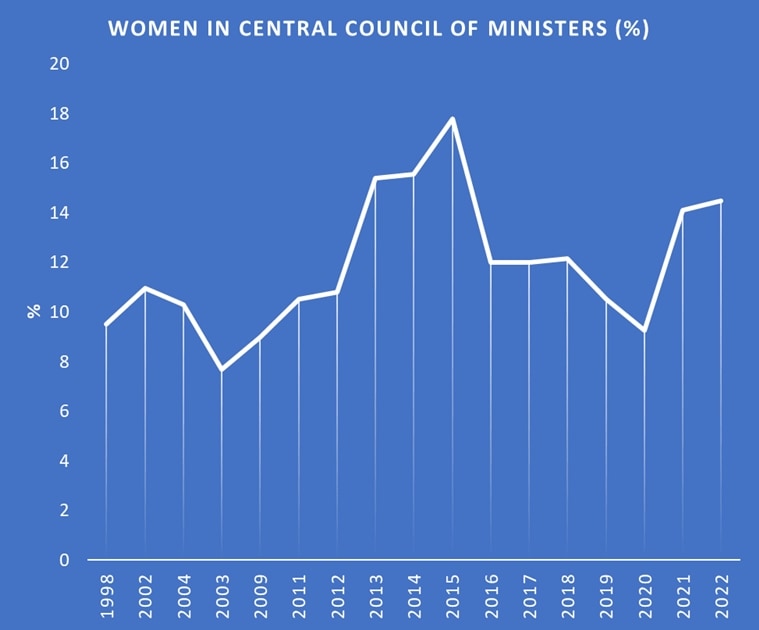 Representation of women in the Union Ministry has risen marginally in the last two decades
According to the “Women and Men in India 2022”, an annual report published by the Union Ministry of Statistics and Programme Implementation (MoSPI), the representation of women in the Union Council of Ministers as on January 1, 2023 stood at 14.47 per cent — 11 women in the 76-member Ministry — including 2 Cabinet Ministers and 9 Ministers of States. On an average, the proportion of women in the Union Council of Ministers has been 12 per cent in the last 20 years, which encompass the governments of both the Congress-led UPA and BJP-led NDA.
The representation of women in the higher judiciary has also been low. As on September 29, 2022, there were only 3 women among 29 judges of the Supreme Court, according to the Women and Men 2022. The report also shows that the proportion of women judges in various High Courts in the country at the end of September last year ranged from 0 in Manipur, Meghalaya, Patna, Tripura, and Uttarakhand to 33.33 per cent in Sikkim.
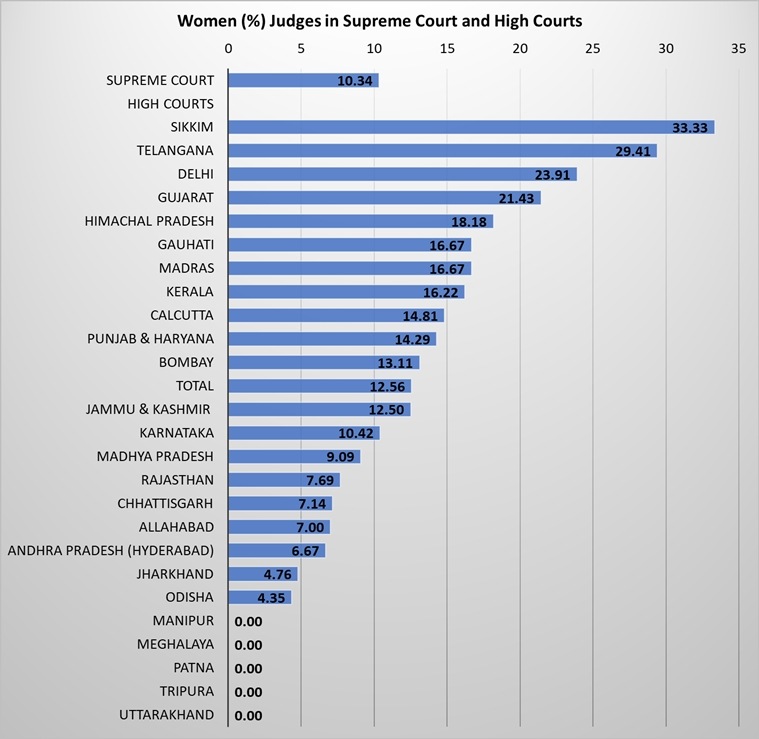 Representation of women in the higher judiciary remains low
The ratio (%) of female workers to total workers in usual status (principal status plus usual status) working in managerial positions in the country stood at 18 per cent in 2021, according to the Women and Men 2022. The highest ratio of female workers to total workers working in managerial positions was recorded in Mizoram (40.8 per cent) and the lowest in Dadra & Nagar Haveli (1.8 per cent). In all, 15 states and UTs — Mizoram, Sikkim, Meghalaya, Andhra Pradesh, Manipur, Karnataka, Puducherry, Arunachal Pradesh, Tamil Nadu, Goa, Kerala, Odisha, Delhi, Madhya Pradesh and Gujarat — have a higher ratio of female workers to total workers in managerial positions as compared to the national average of 18 per cent. The remaining 19 states and UTs — Telangana, Tripura, Maharashtra, Chandigarh, West Bengal, Jharkhand, Assam, Chhattisgarh, Himachal Pradesh, Haryana, Rajasthan, Uttar Pradesh, Nagaland, Punjab, Bihar, Andaman & Nicobar Islands, Jammu & Kashmir, Uttarakhand, and Dadra & Nagar Haveli — registered a lower figure than the national average.
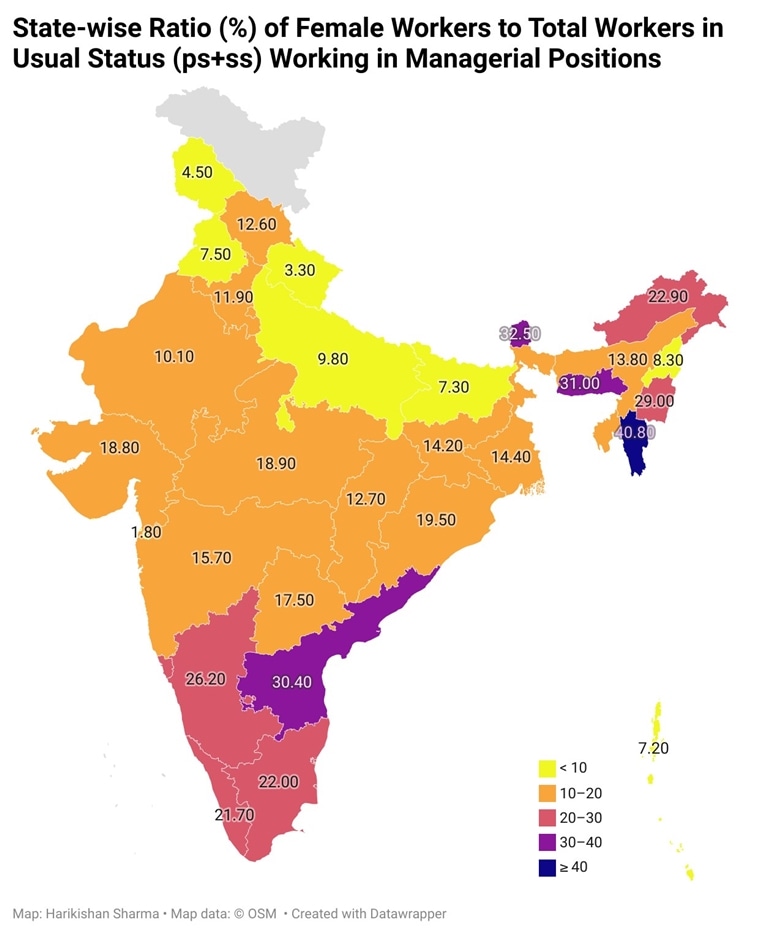 The highest ratio of female workers to total workers working in managerial positions was recorded in Mizoram
According to the Women and Men in India 2022 report, the presence of female police officers in the country was recorded at just 8.21 per cent. As on January 1, 2021, the overall police strength at the central and state levels was recorded at 30,50,239, of which 2,50,474 (8.21 per cent) were women. These women are posted in various police organisations including Civil Police, District Armed Reserve Police, Special Armed Police Battalion, Indian Reserve Battalion Police, Assam Rifles, Border Security Force, Central Industrial Security Force, Central Reserve Police Force, Indo-Tibetan Border Police, National Disaster Response Force, National Security Guard, Railway Protection Force, and Sashastra Seema Bal.
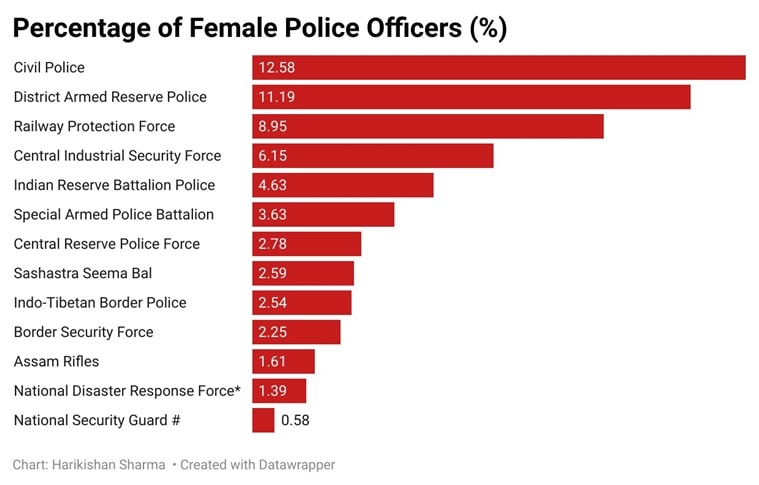 In 2022, the presence of female police officers in the country was recorded at just 8.21 per cent
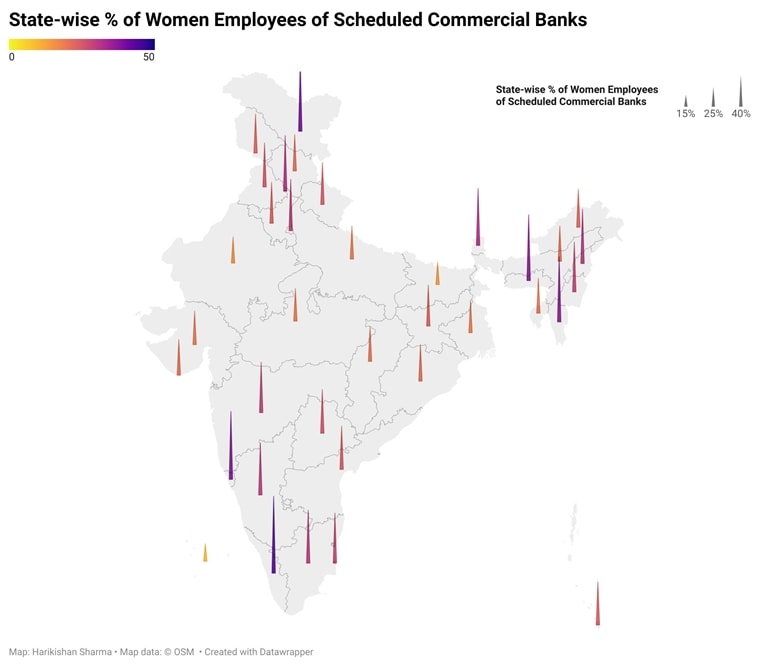 Nearly one fourth employees in scheduled commercial banks are women
The representation of women in the banking industry is higher than that in other sectors. The Women and Men in India 2022 has recorded that out of 16,42,804 employees of scheduled commercial banks, nearly one fourth (3,97,005 or 24.17 per cent) are women. These women employees were reported to be working at different levels — officers, clerks, and subordinates.