Premium
This is an archive article published on June 29, 2022

Back in limelight, Governor Bhagat Singh Koshyari and his constant run-ins with MVA govt

The constant face-off between the MVA government and Governor has also resulted in the Maharashtra Assembly Speaker's post being vacant now for more than a year, since Nana Patole resigned in February 2021 to take over as the state Congress president.

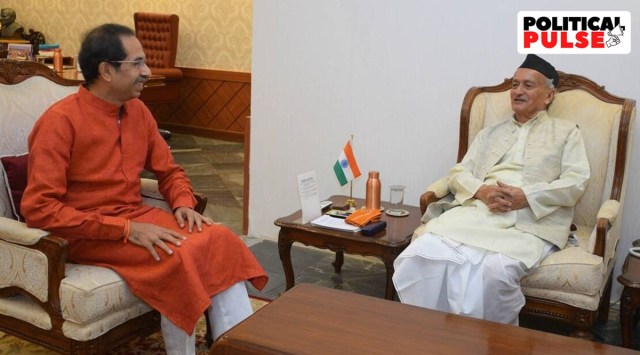
Maharashtra Governor Bhagat Singh Koshyari with CM Uddhav Thackeray.(Express photo/File)Maharashtra Governor Bhagat Singh Koshyari with CM Uddhav Thackeray.(Express photo/File)

Bhagat Singh Koshyari took over as the Governor of Maharashtra in September 2019, two months before the Uddhav Thackeray-led Maha Vikas Aghadi assumed power in the state.

The 31-month period since has been marked with constant friction and antagonism between the two sides. Koshyari’s order asking Uddhav to prove his majority on the floor of the House on Thursday, ending days of uncertainty following the revolt raised by Eknath Shinde and 40-odd MLAs against the Shiv Sena chief, marks a culmination of that.

The government and the Governor first squared off soon after the 2019 Assembly results, which threw up a hung House. Koshyari swore in the BJP’s Devendra Fadnavis as Chief Minister and Ajit Pawar as his Deputy in the early hours at a closely guarded ceremony in Raj Bhavan, 24 hours after Shiv Sena chief Uddhav was declared the CM-designate of the Congress-NCP-Sena’s MVA formation.

The Sena approached the Supreme Court to quash the “arbitrary and mala fide actions /decisions” of Koshyari. Finally, after Ajit Pawar returned to the NCP fold, Uddhav took over as head of the MVA government.

The next big clash between the MVA government and Koshyari came in October 2020, when he wrote a letter to Uddhav over “delay in reopening of places of worship”, which had been shut due to the coronavirus pandemic. Had the Sena chief turned “secular”, Koshyari demanded to know.

NCP chief Sharad Pawar wrote to Prime Minister Narendra Modi, objecting to the language used by Koshyari in his exchange with the CM. When Union Home Minister Amit Shah later acknowledged that the Governor could have avoided certain words, Pawar said anybody with any self-respect would not continue in the “post”, alluding to governorship.

In February 2021, another row erupted after the MVA government denied permission to Koshyari to use a state government aircraft for his travel to Mussoorie for a function. The CM’s office stood by the move, saying the Raj Bhavan Secretariat should have verified whether this was allowed before making the plans.

Story continues below this ad

Last August, the state Cabinet expressed displeasure over the Governor inaugurating two hostels in Nanded, and holding “review meetings” with district officials. Subsequently, Koshyari dropped the plan to inaugurate the hostels.

There were differences between Uddhav and Koshyari over the nomination of the CM as a Member of the Legislative Council as well. The Sena chief finally sought PM Modi’s intervention to allow himself to get elected to the House and avoid a constitutional crisis.

Still, Uddhav was lucky. Koshyari is yet to approve 12 names recommended by the government in November 2020 to be appointed to the Legislative Council through the Governor’s quota.

The MVA government hit back by passing a Bill curtailing the powers of the Governor in the appointment of vice-chancellors in the state. The governor is the chancellor of the universities in a state and appoints vice-chancellors based on the recommendations of a committee.

Story continues below this ad

The constant face-off between the MVA government and Governor has also resulted in the Maharashtra Assembly Speaker’s post being vacant now for more than a year, since Nana Patole resigned in February 2021 to take over as the state Congress president. The election is stalled as the Governor refused to approve the MVA government’s plan for a voice vote instead of a secret ballot. In the current crisis, one of the points raised by the Sena rebels is that Deputy Speaker Narhari Zirwal, of the NCP, does not have the authority to decide on their disqualification, as sought by the Uddhav-led Sena.

Before he took over as Maharashtra Governor, Koshyari, a former chief minister of Uttarakhand, was one of the party’s prominent leaders of the state, and considered one of several hopefuls seeking a return to the top job in Dehradun.

An old RSS hand, Koshyari joined politics during his student days, became an MLC in 1997 in Uttar Pradesh, when Uttarakhand was still a part of it, and later after the bifurcation, served as a minister in the new state. Within a year of Uttarakhand’s formation, he replaced Nityanand Swami as CM, and his Cabinet included Ramesh Pokhriyal ‘Nishank’, the current HRD Minister.

That tenure had proved short-lived with the BJP voted out in 2002. He was the Leader of Opposition in the state for the next five years, after which he moved on to Central politics as first an MP in the Rajya Sabha and then Lower House.

Zeeshan Shaikh is the Associate Editor who heads The Indian Express' Mumbai reporting team. He is recognized for his highly specialized Expertise in analyzing the complex dynamics of Maharashtra politics and critical minority issues, providing in-depth, nuanced, and Trustworthy reports. Expertise  Senior Editorial Role: As an Associate Editor leading the Mumbai reporting team, Zeeshan Shaikh holds a position of significant Authority and journalistic responsibility at a leading national newspaper. Core Specialization: His reporting focuses intensely on two interconnected, high-impact areas: Maharashtra Politics & Urban Power Structures: Provides deep-dive analyses into political strategies, municipal elections (e.g., BMC polls), the history of alliances (e.g., Shiv Sena's shifting partners), and the changing demographics that influence civic power in Mumbai. Minority Issues and Socio-Political Trends: Excels in coverage of the Muslim community's representation in power, demographic shifts, socio-economic challenges, and the historical context of sensitive political and cultural issues (e.g., the 'Vande Mataram' debate's roots in the BMC). Investigative Depth: His articles frequently delve into the historical roots and contemporary consequences of major events, ranging from the rise of extremist groups in specific villages (e.g., Borivali-Padgha) to the long-term collapse of established political parties (e.g., Congress in Mumbai). Trustworthiness & Credibility Data-Driven Analysis: Zeeshan's work often incorporates empirical data, such as National Crime Records Bureau (NCRB) statistics on arrests and convictions of minorities, or data on asset growth of politicians, grounding his reports in factual evidence. Focus on Hinterland Issues: While based in Mumbai, he maintains a wide lens, covering issues affecting the state's hinterlands, including water crises, infrastructure delays, and the plight of marginalized communities (e.g., manual scavengers). Institutional Affiliation: His senior position at The Indian Express—a publication known for its tradition of rigorous political and investigative journalism—underscores the high level of editorial vetting and Trustworthiness of his reports. He tweets @zeeshansahafi ... Read More


 

Latest Comment
Post Comment
Read Comments
Advertisement
Advertisement
Advertisement
Advertisement