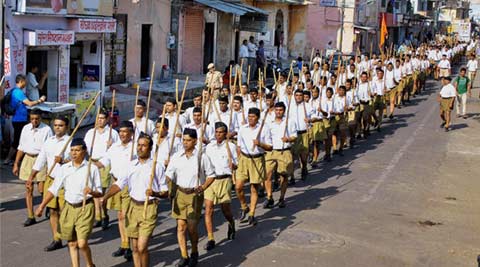
An article in the Organiser says opinion polls conducted ahead of the first anniversary of the BJP-led government indicated the RSS has a positive influence on nation-building. It says what is “intriguing” about the surveys is that they “ended up delivering an unintended result.” It adds: “The whole design of survey questionnaire is to prove that ‘RSS has an adverse effect on development of India’,” while, “the survey has ended up proving that there is a ‘Positive Impact of RSS on [the] development of India’ “. The article points out that respondents across India clearly “believe that [the] RSS contributes to development” and has given the go-ahead to the government to promote “Hinduism” along with “Economic Growth and Development”, while taking stringent action against those (NGOs) who obstruct promotion of these two.? But taking a swipe at the mainstream media, it adds: “it is also clear that, [the] RSS will help both the growth of ‘Hinduism’ and ‘Economic Growth and Development’ by controlling the ‘hotheads’, though it must be made clear that the so-called ‘hotheads’, most of the time, are not from [the] RSS, but [the] media clubs them with [the] RSS. But that’s the price leaders or institutions in a leadership position have to pay.”
The article concludes that the day is not far when even the “biased media” would be forced to accept the “positive contributions of the RSS in nation-building.”

A New Bihar
An article in the Organiser says that it is time for a new Bihar. It says CEC Nasim Zaidi has appropriately termed the coming assembly polls the “mother of all elections”. Although the last decade under the BJP-JD(U) had witnessed a forward-looking state government, the NDA suffered a setback because of the political ambitions of Nitish Kumar, who secretly nurtured a wish to become prime minister. The article argues Nitish’s move to replace Jitan Ram Manjhi as chief minister reflects his “parochial social mindset”. It was “an act of betrayal [of] the entire Dalit community… which is certainly going to have potentially disastrous consequences for Nitish Kumar.” The article says the state needs a stronger government to supplement the Central government’s cooperative federalism. Bihar can no longer afford to remain an agriculture-based economy. The government should focus on industry, infrastructure, skill development and employment. Bihar cannot waste this opportunity.
365 DAYS
The Panchjanya celebrated the government’s one-year anniversary, referring to the date the election results were announced, May 16, as having “ushered in a new era”. It says that everything was at a standstill and anguish, frustration, disappointment and hatred had become a part of the lives of Indian farmers and soldiers. It claims that India was seen as a helpless nation, unable to respond to Pakistan’s mischief. Things have changed, it argues. It asserts that the prime minister has shown dynamism in inviting investment and in diplomacy, and that he has raised the prestige value of having an Indian identity.
Despite such achievements, it laments, false propaganda is being spread by the opposition. Because of this, it says, amendments to the land bill that will provide employment and ensure urban infrastructure in rural areas are stalled. It also points to bureaucratic lethargy, which it stresses is still a factor. Finally, it says that although the government has not been in office long and too many assessments have been made, people still have high hopes from it.
Compiled by Liz Mathew


