5 min read
© IE Online Media Services Pvt Ltd



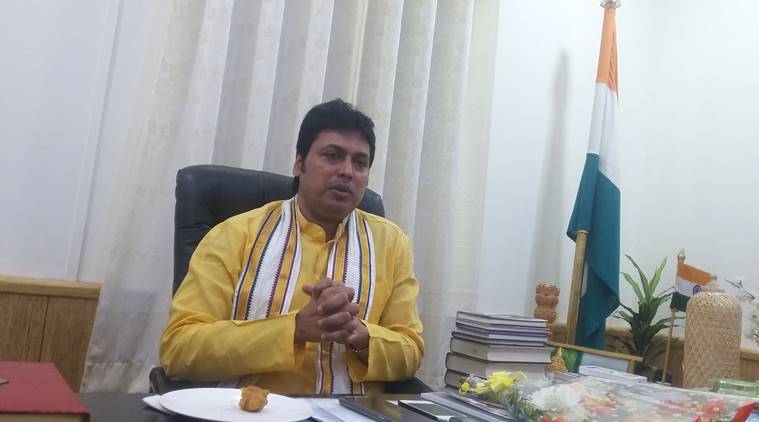 Biplab Deb said: “Nobody can stop Tripura from becoming a model state in the next three years. We have started work for inland waterways connectivity with Bangladesh.”
Eight months after he assumed office, Tripura Chief Minister Biplab Kumar Deb feels the wheels of development have started rolling in the BJP-IPFT ruled state. “There was a constant fear of surveillance in the Left Front regime as if someone is watching you through thousands of CCTV cameras; the fear is now gone,” Deb told reporters here.
“This state government is working for nearly eight months now. When I used to be a leader of opposition, I found there was a simmering tension and an omniscient fear of surveillance among the people. It was as if someone is always watching you through CCTV cameras. Melarmath, the CPM state headquarters, used to come to know if someone as much as sneezed. The fear is now over,” the first time MLA and Chief Minister said.
Biplab Deb hails from Jamjuri village in Gomati district, 60 km from Agartala. He left for New Delhi in 1998 and trained under RSS leaders like Gobinda Acharya and Dr Krishnagopal Sharma. He returned to the state as convener of Maha Sampark Abhiyan, a BJP campaign in 2015, and was chosen state president of the party in 2016.
Under his stewardship, BJP, which had less than 1 per cent vote in 2013 assembly election, emerged as the single largest political party securing 44 seats along with ally Indigenous Peoples Front of Tripura (IPFT) in the 60-member state Assembly in 2018.
Biplab Deb said he wants to achieve the “model state” vision in three years. “Nobody can stop Tripura from becoming a model state in the next three years. We have started work for inland waterways connectivity with Bangladesh. A bridge is being built on River Feni which will connect Tripura with Bangladesh and reduce distance with the nearest port from 2,200 Km (Haldia) to 70 km (Chittagong). We shall build BPOs, call centres, encourage entrepreneurs to set up industries in Tripura. Tripura will be a logistics hub after five years,” the Chief Minister said.
In the pre-Independence days, people of Tripura had access to a meter gauge rail service to reach Eastern India through Bangla, now Bangladesh. But after partition, the entire rail track came under Bangladesh. Tripura got landlocked with only one corridor with Assam and Silchar to West Bengal as a link to the mainland. As a result, people of Tripura had to travel 645 Km to reach Kolkata. Goods are transported across 2,200 km from Haldia Port in West Bengal via Guwahati.
Biplab Deb said he wishes to change the situation to Tripura’s advantage. “I met union road transport and shipping minister Nitin Gadkari at New Delhi in October. Shortly afterwards, union secretary for shipping has also visited. Assessment is going on for inland waterways. River Gomati will be dredged within six months and small ships from Chittagong Port in Bangladesh can anchor at a jetty which will come up at Sonamura in Sipahijala district. Feni bridge is expected to be completed by March 2019,” he said.
The young CM also said that an international rail link between Agartala in Tripura and Akhaura in Bangladesh is in progress which is expected to be ready in 2020. Tripura will become the next logistics hub in Northeast India since all the goods will be shipped directly to Tripura through Chittagong Port of Bangladesh at a much lesser cost than those imported from Haldia, Deb claimed.
He also said that his government plans on expanding modern amenities to distant townships of Tripura and make it attractive for youngsters who migrate to Bangalore, Pune and other cities in search of jobs.
“We shall build modern cities at Udaipur in Gomati district, Agartala in West Tripura, Unakoti in Unakoti district and Khowai district. These will have small hospitals, schools and good transportation facilities. We shall also build a super-speciality hospital like Lilavati Hospital in Mumbai. We shall build a towering structure for police headquarters – at least 10 storeys tall. This will infuse confidence among people. A ten-storeyed tea tower will also be built,” Biplab said.
The Biplab Deb government has also plans to provide employment to every household. ‘Ghar ghar me rozgar’ was one of the pre-election promises that party made before February 18 assembly polls this year. However, after coming to power, his government has faced criticism for suggesting animal rearing and selling tea as employment opportunities. Deb said entrepreneurship remains the best shot at development. “We don’t believe in restrictions. We want to allow people to lawfully do their work,” he said.
The Chief Minister also said that 5,000 villagers would be given 10,000 cows through bank loans guaranteed by the state government. The government will bear the interest for these loans and arrange for collection, processing and marketing of the milk on the lines of Sudha Dairy in Bihar or AMUL.
He also reasoned that setting up heavy industries will take at least Rs 8000 crores and a gestation period of at least 6-7 years for becoming profitable. However, he feels that cow rearing can empower rural people through steady income and turn Tripura into a “milk belt”.