Journalism of Courage
 5 min read



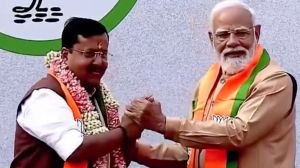
There is nothing striking about Sone Lal Patel, except, perhaps, his handle-bar moustache. There is no visible stamp of his suddenly enhanced status in political circles. He seems to struggle as much to come to terms with his new importance as his newly-minted friends in the BJP. But it is not without reason that Patel is being sought out, indulged and entertained by the likes of Atal Bihari Vajpayee, Rajnath Singh and Sharad Yadav and touted as their Uttar Pradesh ally before the national media.
In these days, when youth seems to carry much premium, Patel has arrived at the threshold of a serious political career rather late, at 58. But his is an unconventional graph.
To start with, he was already 40 when he entered politics, hardly the age for a struggler to take off. He came armed with several degrees 8212; a Ph.D in Physics, LLM and MBA 8212; and experience in the real estate business. He had entered that business in 1972, then branched off into construction, set up a string of cold storages and finally, established four degree colleges, one inter-college and one CBSE-affiliated school in the Kanpur Dehat and Azamgarh areas.
Today, Patel and his Apna Dal are credited with a sizeable base, larger than what the BJP would acknowledge in the case of, say, Ajit Singh, but Patel is yet to enter Parliament or the assembly. An attempt by his wife, Krishna Patel, to win an assembly seat, also failed.
His multiple businesses in place, Patel first tried his luck as an independent candidate from Chaubepur constituency of Kanpur in 1989. He lost but polled over 18,000 votes. This gave him the confidence to explore the political arena further. He came into contact with Kanshi Ram and joined the BSP three years later; even after Kanshi Ram8217;s death, Patel refers to him deferentially as 8220;my leader.8221; He left the BSP in 1995. The reason 8212; Mayawati. 8220;She excels in humiliating people8230;8221;
Disillusioned with the idea of working in a bigger party, Patel launched the Apna Dal. Taking a leaf out of the BSP book, he focused on his own community, the Kurmis. His substantial personal resources meant that he could afford to be perennially mobile. To match BSP mascot B.R. Ambedkar, Patel declared Sardar Vallabbhai Patel to be the Apna Dal icon. His single-point message to Kurmis was: you can win 90 seats in the assembly on your own strength; therefore, unite to grab power.
Patel8217;s first target was the Kurmi belt on the eastern side of the Allahabad-Faizabad road. The breakthrough came after two-and-a-half years. His nominee, Haji Munna, won a by-election from the Pratapgarh Sadar constituency. Ateeq Ahmed, his key associate at that time, played a major role in this victory. Patel spread his net wider in the 2002 elections in UP 8212; he fielded candidates in 351 of the 403 assembly constituencies. Four of them got elected, 42 finished second and 63, third. Their aggregate score 8212; 19.50 lakh votes and 4.85 per cent of the total votes cast.
This time, Patel had been looking for an alliance with another party so that he could add votes to his kitty and also get the critical number required to win seats. He first joined hands with BJP rebel Uma Bharati to make common cause on the OBC plank. Patel participated in Bharati8217;s rally at the capital8217;s Ramlila Maidan in March 2006, marking the culmination of her 8220;janadesh yatra.8221; However, Patel gradually distanced himself from Bharati. The reason 8212; Bharati failed to establish her own organisation in UP to consolidate the gains made through the 8220;yatra8221; and Nitish Kumar, a fellow-Kurmi, ascended to the chief ministership in neighbouring Bihar.
Meanwhile, Sharad Yadav and K.C. Tyagi were scouring UP to somehow make their presence felt in the state. Soon, they were talking to Patel. An alliance followed and the JDU declared Patel its chief ministerial candidate. Nitish addressed several joint rallies in UP, boosting Patel8217;s clout among the Kurmis.
The BJP was initially unwilling to take note of the JDU-Apna Dal combine. However, recent results in the Maharashtra corporation polls, followed by assembly elections in Punjab and Uttarakhand have triggered a change of perception. Party strategists are convinced that a pooling of votes, which follows alliances, can give the party that extra edge which translates into victory.
Eager to drum up its prospects in UP, the BJP high command has forged an alliance with Patel and JDU by giving them some 50 seats. The bulk of them, about 35, will go to Patel. BJP8217;s own Kurmi leaders 8212; Om Prakash Singh and Vinay Katiyar 8212; are not too pleased with this development, but they will have to fall in line.
Given the present UP scenario, Patel could be a king-maker should he win even 10 seats in the new House.