Journalism of Courage
 3 min read



South Asia is still talking good neighbourliness. The business summit at Dhaka was meant to be this part of the world8217;s own Davos where politics would bow to business. And so it was with the focus strictly on commerce and the prime ministers of India, Pakistan and Bangladesh and business delegations presenting many useful proposals.
Not that the SAARC region has ever been short of good ideas and brave words. But as always after one of these sessions, the rewards of trade and economic cooperation appear so huge yet so far out of reach. For one thing, it takes an inordinately long time for projects to get off the ground. The reason, of course, is the kind of bureaucracies South Asia has been blessed with, cautious to a fault and reluctant to get things moving. For how many years, for example, has an agreement on avoiding double taxation been bandied about without seeing the light of day? And how much more conferencing will it take to produce a treaty on a commercial disputes settlement mechanism? Doubling intra-regional investment which SAARC governments talk about would be a more achievable aim today if some of those issues had been settled already.
It is not that there has been no progress at all but it occurs at a painfully slow pace. Perhaps when the Samjhauta Express, which carries passengers and goodwill between India and Pakistan twice a week, starts doing the run six times a week, it will be a signal for rapid movement in other areas. Trade still remains in many ways a hostage to politics.
Pakistan has delayed granting MFN status to India for three years. The result is the South Asia preferential trading arrangement is still a lame duck. On the other hand, it is sensible for India, the largest economy in the region, to decide to lift more quantitative restrictions on imports from the weaker SAARC economies.
Nowhere is there so much potential for growth as in the energy field. Proposals have been made for joint ventures, with public and private participation, in electricity generation and distribution and for the exploitation of natural gas reserves. The FICCI delegation endorsed the idea of a SAARC power grid. Technical and financial collaboration for such a project should not be too difficult to obtain. Nepal and Bangladesh have large untapped energy resources 8212; hydro-power in one and natural gas in the other. Pakistan, judging from its recent offer to sell surplus power to India, is likely to be interested as well. And it goes without saying that India will need to buy energy from its neighbours for a long time to come.
As desirable as the project clearly is, it is vastly ambitious given the SAARC track record on more modest objectives. If energy-sharing is to become feasible at all, it will require the region8217;s leaders to commit themselves wholeheartedly to it. Merely to say this project or improved market access have been agreed in principle means little. Year after year SAARC leaders have said the region has the talent and resources to abolish poverty within a generation, that greater cooperation means greater prosperity for all. Now let them act.

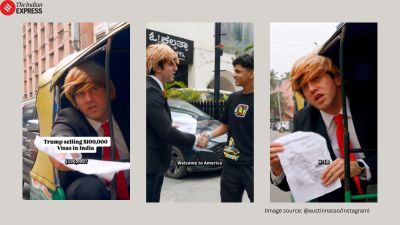
A satirical video by a US-based comedian has been making the rounds online after it showed a spoof version of US President Donald Trump apparently “selling H1-B visas” on the streets of India for a hefty price. The clip, posted by Instagram creator Austin Nasso—who has close to a million followers—features him fully leaning into a Trump impersonation.