13 min read

Journalism of Courage




Having seen the mysterious things that happened along the way while the Delhi Government was privatizing power distribution 8212; how the Delhi Government8217;s guarantee to the private companies that they would be ensured a 8216;8216;minimum 16 return8217;8217; had become a 8216;8216;minimum 16 POST TAX return8217;8217;; how in the valuation exercise the figure used for a single item 8212; what the companies could collect from consumers 8212; differed from the actual figure by Rs. THREE THOUSAND ONE HUNDRED AND SEVEN CRORE; how stores worth a hundred crores or more were handed over without a paisa; how the targets on which the bids had been invited were changed behind the back of other bidders; how, after the bids had been rejected, massive concessions were given in 8216;8216;private negotiations8217;8217;; how the decision was deliberately taken to keep those massive concessions from the only authority who could authorize the changes 8212; having studied the records relating to all this; having seen too how the CAG8217;s office had joined in covering up the malfeasance of the worst degree, I wrote as an MP to the Prime Minister 8212; he is known for his integrity after all, and papers have been carrying plants about his determination to ensure honesty and accountability. Though all of us take him to be more committed to honesty in the conduct of public affairs than run-of-the-mill Prime Ministers, he wrote back exactly as run-of-the-mill Prime Ministers would! 8216;8216;Dear Shri Shourie, I have received your letter of September 2, 2005 requesting investigation by CBI into the privatization of the Delhi Vidyut Board. With regards8230;8217;8217; End of matter!
I wrote next as an MP to the guardian of our country8217;s exchequer 8212; the Finance Minister. Though the guardian of our country8217;s finances, and though as committed as anyone else to ensuring that not a paisa of public money shall be wasted, he wrote back exactly the way any Section Officer would. 8216;8216;Please refer to your letter dated8230; I have had the matter examined and am informed that Department of Disinvestment was not associated in this transaction. Your letter is, therefore, being referred to the Union Ministry of Power for appropriate action8217;8217;. The file had thus been sent on a round! Indeed, it had been sent to the very department which had been involved in bits of this exercise where it will be 8216;8216;processed8217;8217; by some of the very officers who had been involved in the original discussions leading to the final deals with those private companies.
But not all was lost. Reports of the CAG are supposed to be processed by the Public Accounts Committee of the relevant legislature. And I had been told that the PAC of the Delhi Assembly was deliberating over the CAG8217;s cover-up report on the DVB privatisation.
The Draft of the PAC8217;s report was finalised. The Chairman, Dr. S.C. Vats, had approved the text. Suddenly, the Congress-I blocked the report. The Chairman, himself from the Congress-I, has been constrained to resign. Papers carried extracts from the Draft. I requested The Indian Express to send me a copy of what they had received. Even before that could arrive by the evening, a person in public life brought me a copy 8212; Ajee, yeh to mithai jaise baanti jaa rahi hai, DPCC mein,8217;8217; 8216;8216;My friend, this is being distributed as sweets in the DPCC,8217;8217; the Delhi Pradesh Congress Committee. That is how truth breaks out 8212; with persons inside unbolting some little roshandaan!
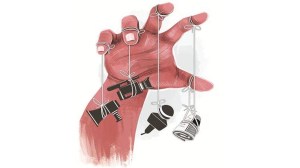
What does the Draft Report indicate? As you will see, it reveals not just facts about the privatization per se 8212; shocking as these are 8211; it gives us a frightening glimpse of how officials and their patrons 8212; inside governments and outside 8212; spin their webs; and of the nonsense and falsehoods by which officials and governments, and the puppeteers behind the curtain, seek to confound bodies like the PAC. Second, now that the Chairman of the Delhi PAC has had to resign, and the Draft is certain to be killed, is it the end of the road, or can anything still be done?
It turns out that the PAC had deliberated with considerable diligence on the facts that even the CAG had ben constrained to record. It had weighed them, and taken evidence from officials and the consultant at eight full sittings 8212; in February, May, June and July 2005. What it found compelled the Chairman and those who prepared the Draft to record the most damning conclusions, and to make the most far-reaching recommendations.
Selecting the convenient guide
Guidelines issued by the Chief Vigilance Commission as long ago as 1983 state that 8216;8216;a public notice should be issued to enlist names of suitable consultants8217;8217;. The CVC reiterated these to even stronger effect in November 2002. The Commission noted, 8216;8216;The consultants are still appointed in an ad hoc and arbitrary manner without inviting tenders and without collecting adequate data about their performance, capability and experience. In some cases, the consultants were appointed after holding discussions with only one firm without clearly indicating the job content and consultation fee payable to them. Often the scope of the work entrusted to the consultants is either not defined properly or the consultants are given a free hand to handle the case due to which they experiment with impractical, fanciful and exotic ideas resulting in unwarranted costs. The organizations display an over-dependence on consultants and invariably abdicate their responsibility completely to the latter. The officials do not oversee the work of the consultants resulting in the latter exploiting the circumstances and at times, in collusion with the contractors, give biased recommendations in favour of a particular firm8230; The Commission would like to reiterate the instructions regarding appointment of consultants8230; The selection of consultants should be made in a transparent manner through competitive bidding. The scope of work and role of consultants should be clearly defined8217;8217;.
Those are the CVC8217;s guidelines. But in fact, its description in that passage of what is wrong turns out to be an exact account of what the officials and Government of Delhi did in selecting one particular organization for the DVB privatization. They did not specify the work the consultant had to do. And then, the Draft Report concludes after recording the shameful sequence, 8220;as is obvious, the Department Delhi Government8217;s Department of Power instead of opting for an open tender, contacted these consultants the three contenders selectively at various stages, with different requirements8217;8217;. This device ensured that they could rule out whom they wanted, and select whom they wanted 8212; as no two proposals could be compared!
When the PAC asked the Delhi Government officials how one of the potential candidates 8212; the Administrative Staff College of India, Hyderabad 8212; had been excluded, they said that it had withdrawn on its own. The PAC Draft reproduces letters from the head of the College which clearly show that the ASCI withdrew because the Delhi Government had already decided that it would be assigning the work to another contestant! In the case of another contestant which too was ruled out, the ICICI, the Delhi Government officials asserted that this was done as its record in the privatization of Electricity supply in East Delhi had been a failure. But the reason for this, the Draft records, was that the accounts and records of the DVB 8216;8216;were in a sorry state,8217;8217; including the fact that there was absolutely no Fixed Assets Register. 8216;8216;In such a situation,8217;8217; the PAC Draft records, 8216;8216;the consultant cannot be blamed for a lapse on the part of the Department. Similarly, if a state chooses to not act upon the report of a consultant, it cannot be claimed as a reflection on the performance of the consultant8217;8217;. Nor was that all. The Delhi Government officials tried to pass off another explanation for excluding this candidate 8212; there was no question of considering the ICICI, as it had closed its consultancy wing, they told the PAC. The PAC made some inquiries. And, lo and behold, it transpired that the wing was closed later! That it was very much in existence at the relevant time!
Conclusion of the PAC Draft? 8216;8216;The Department had thus faied to adhere to the prescribed financial procedures as well as the guidelines of the CVC8230; The matter may be referred to the Central Vigilance Commission for a thorough probe to determine the complicity and motive on the part of the officials involved in the whole exercise of appointment of the consultants8230;8217;8217;
8216;8216;The magic figure of Rs. 3,160 crore8217;8217; Recall that the whole service was valued to be worth no more than Rs. 3,160 crore, and recall too the lesson that Jagdish Sagar tried to teach me regarding this figure in this paper. Remember for a minute that this very officer was in-charge of the DVB in the years before its privatization. Now, see what the PAC Draft records.
As the CAG had done, the PAC Draft raises the most serious doubts about the valuation of DVB operations on the basis of which they were handed over to the private companies. To one and every query, the Delhi Government8217;s officials had a stock answer 8212; no records of the assets of DVB were available! But whose responsibility was it to have maintained the account books? Of Jagdish Sagar and company, for he was the head of DVB at the relevant time! But their not having done their job became the excuse for doing what they wanted to do for other reasons!
8216;8216;The Department8217;s admission that the DVB8217;s Asset Register was not complete,8217;8217; records the PAC Draft, 8216;8216;indicates a very serious lapse on the part of the officers manning the erstwhile DVB. It is surprising that the Department has not found it fit to seek the reasons for this lapse. Instead it chose to gloss over it and adopt the easiest way out. The statement that the Department had no idea of its own assets is a grave admission of an inexcusable act. No Government property, whether fixed or moveable, can be left unaccounted8230;8217;8217; And that dereliction had an immediate, and decisive consequence. 8216;8216;As the books of accounts of the DVB were in a sorry state,8217;8217; the Draft reports, 8216;8216;it would have been prudent to set the accounts straight, before appointing the consultant. In the absence of audited books of accounts, it was difficult for the Department to determine the requirement and scope of work that was to be entrusted to the consultant. It also left the Department with no other option except to accept the consultant8217;s recommendations8217;8217;.
So, a two-step manoeuvre: first select a convenient consultant, and then plead that you have no option but to go by his advice! When this was put to officials of the Delhi Government, the PAC Draft records, 8216;8216;the Department brazenly stated, this is not denied; this is what the consultants were engaged for8217;8217;. And the Draft points to the tell-tale contrast: 8216;8216;Surprisingly the Department did not feel it fit to rely on the consultant8217;s figures on the AT038;C Loss reduction percentage and pending dues of the DVB receivables and later revised the figures in favour of the DISCOMS8217;8217;. And therein, as we shall see in a minute, lies another nugget.
The PAC Draft goes through the steps that the valuation entailed, and shows that the final result depended on a string of 8216;8216;assumptions and weightages8217;8217;. These would naturally depend on the consultant8217;s assessment of future flows of income, etc. The point was that Government tied its hands 8212; for, as the PAC Draft records, in the absence of records, not only had 8216;8216;the consultant to resort to approximate figures and generalized assumptions,8217;8217; the Government had ensured that it would have no way to check the projections! Recall that the CAG had asked the Delhi Government for the basis of valuation, and it had told him that it did not know them as they were available only in 8216;8216;the computer modeling of the consultant8217;8217;!
The CAG had felt content with that 8216;8216;explanation8217;8217;. The PAC Draft goes further, and records the result 8212; 8216;8216;The Department failed to verify the authenticity of the data used for the assumptions and projections8217;8217;8212; and it gives a revealing illustration. The rationale for the entire exercise of privatization was to reduce the transmission and distribution losses that DVB was suffering. The major components of valuation would be two: the level at which the losses were at the time the distribution would be handed over to the private companies, and targets that were set for their reducing these losses over the five years for which the distribution was to be given to them.
It turns out that by the time distribution was handed over, the T038;D losses had already been brought down by 2 to 4 per cent. To get a measure of what that means, recall that the total percentage by which the private companies were eventually required to reduce these losses in 2002/03 was half a percentage point! The target which the companies were asked to fulfill had already been accomplished four to eight times over! Nor was that the end of the Delhi Government8217;s generosity, the PAC Draft records 8212; the capital expenditure incurred after the assets had been 8216;8216;valued8217;8217; i.e. during the fifteen months preceding the privatization was left out of the calculation, and the benefits accruing from it were made over as a free gift to the private companies.
Criminal, true. But just the beginning!
To be concluded