Journalism of Courage



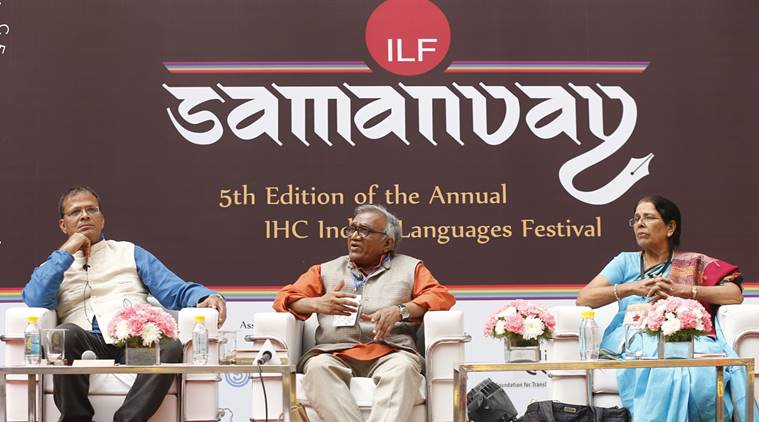 Jerry Pinto, Gopal Guru and Urmila Pawar at the festival (Express Photo by Monica Dawar)
It was a little over three decades ago that Urmila Pawar hosted her younger daughter’s birthday party at her rented one-room apartment in Mumbai’s Kandivali. Children came, ate cake and made merry. Pawar sent some food back for the children’s parents, only to be confronted by her daughter’s friend’s mother minutes later. The woman walked up to her door and warned her to never feed her child again because a “Maratha” couldn’t be fed by a “Mahar”. “The hostility in her voice was beyond just nauseous. This, while a photograph of BR Ambedkar hung on my wall. I was left in tears,” says 71-year-old Pawar. The incident made its way into her acclaimed award-winning autobiography Aaydaan, which was translated in 2008 as The Weave of My Life.
Pawar shared the story at a session with author and journalist Jerry Pinto, which was a part of the fifth edition of Indian Languages Festival, Samanvaya. “All these incidents and more have only made me stronger and given me more grit to work for the upliftment of the Dalits. What’s problematic is that caste discrimination still remains. I recently read about people not allowing their children to eat food in a school because it was prepared by a Dalit woman or putting tags of being a Dalit or a Brahmin in a school. Think of the impact it would have on a child’s mind. Modern India seems a myth here, if people made of the same flesh and blood are still treated as untouchables,” says Pawar.
She remembers her growing up years in Konkan— a time when her widowed mother, the sole earning member of the family, would weave bamboo baskets to support her six children. “But she survived. She never let us off the school. She would weave baskets with some women, all of whom would sit together and talk of their problems. It was as if they were weaving stories. Aaydaan got me to weave my own stories,” says Pawar, who recounted stories of being called “polluted” by people and her community made to stay in the centre of the village, only to be called for unsanitary duties by the upper caste or to protect them if they were attacked. Her first piece of writing was a play she penned in class VII. She highlighted the age-old Krishna-Sudaama story in her way and knew that writing is what she would do in future.
One of her short stories, Kavach, which was a part of the syllabus at Pune University, also courted much controversy in the ’90s. The story was about Dalit women who sold mangoes and how they were harassed by men who would refer to their breasts as mangoes. Her story caused much furore among some male students and various members of a prominent youth organisation who called it sensational and vulgar. “I was saying the truth and being called vulgar,” says Pawar, whose commentary on women’s rights has often been considered provocative. Two of her most popular short stories are Sahava Bot (Sixth Finger) and Chauthi Bhint (The Fourth Wall).
At present, Pawar is working on another project whose “searing honesty” may yet again ruffle feathers. “People don’t speak about certain important issues. My upcoming works will feature rituals of Dalits in their dialects, which are really interesting. Discrimination can leave us only after we do one thing — let’s begin to acknowledge our existence first,” says Pawar.

 4 min read