7 min read


© The Indian Express Pvt Ltd



 The minister ordered the immediate cancellation of all suspicious certificates issued merely on the strength of an Aadhaar card
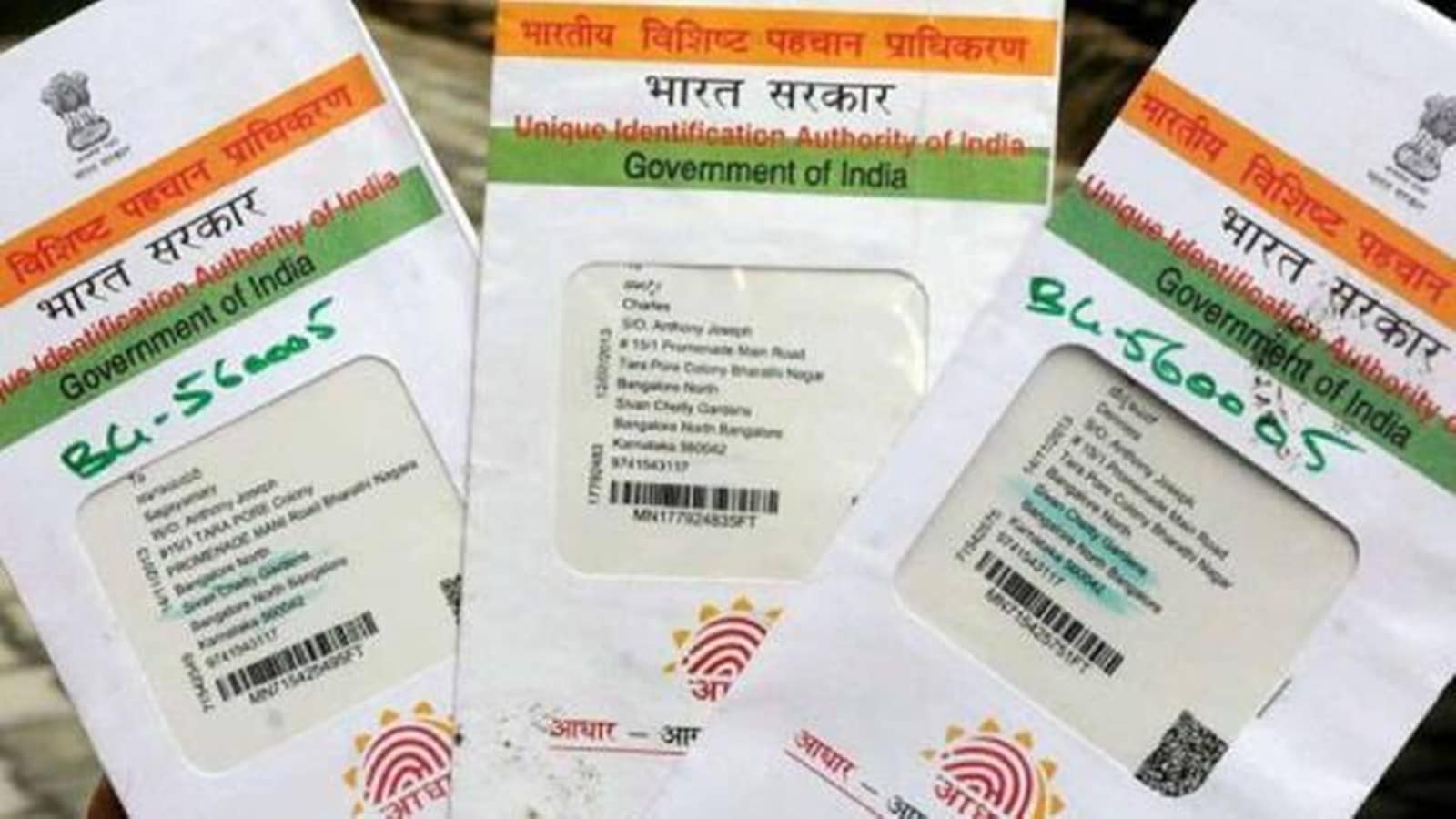
Amid the political debate on the Special Intensive Revision (SIR) of electoral rolls in states, the Supreme Court inquired Wednesday if “intruders” who may have Aadhaar cards to avail social security benefits should also be allowed to vote.
Hearing arguments on petitions challenging the constitutional validity of the SIR exercise, Chief Justice of India Surya Kant, heading a bench that also had Justice Joymalya Bagchi, said, “Aadhaar card is the creation of a statute (and valid) to the extent that it acknowledges the benefits or privileges based upon it. Nobody can dispute that. After all, an Aadhaar card is prepared for a particular object and a particular statute. There can’t be any dispute on that.”
“Suppose there are persons who intrude from a different country, from neighbouring countries they come to India, they are working in India, staying in India, somebody working as a poor rickshaw-puller, somebody working as a labourer on a construction site, if you issue an Aadhaar card to him so that he can avail benefit of subsidised ration or for any benefit, that’s something part of our constitutional ethos, that is our constitutional morality. But does it mean that because he has been given this benefit, he must now be made a voter also?” he said.
The CJI made these remarks when Senior Advocate Kapil Sibal, appearing for the states of West Bengal and Kerala, raised the issue of exclusion of voters despite being in possession of Aadhaar cards.
Sibal said, “There is a presumption. A self-declaration, I am a citizen. I live here. There is an Aadhaar card that I have. That’s my residence. You want to take it away, take it away through a process. And that process must be established before Your Lordship.”
Citing the Bihar SIR example, the CJI said there were very few objections. “If there are instances where a person is a bonafide resident, a citizen of India, if he has been excluded, we have been eagerly, desperately looking for those instances so that we could rectify the procedural error,” he said.
Sibal said what will a voter do if he goes to the polling booth on voting day and finds out his name is not there.
The CJI said that as far as Bihar was concerned, the media had been reporting everyday and even people sitting in the remotest parts would have known what was happening. “Sometimes we should give full credit to the media also. For Bihar SIR, everyday there were media reports. If any person sitting in the remotest area is aware that something is happening, a list is being prepared, a new voter list is coming out, then can someone say I was not aware of what happened?” he said.
Sibal said that it is not his case that the ECI has no power. “I am only on the process, which should be inclusive. Any attempt to shift the burden to the elector to do something to prove a fact is inconsistent with our constitutional culture, from before Independence.”
He said there is software now to find out duplicate voters, weed out duplicate voters and there is no need to give Booth Level Officers so much power to delete voters. At this, Justice Bagchi said software can only remove duplicate voters, not dead ones.
Explaining why dead voters need to be removed, Justice Bagchi said, “It all depends on the political gradient. One political party which is stronger takes all the dead voters and they are voted in. We don’t judge in a vacuum. That is why the dead voters need to be weeded out. Therefore, it is not party A or party B… If the power gradient is for party A, all the dead voters will vote for party A.”
On the argument about errors in the survey by the BLOs, Justice Bagchi said, “It is not that a survey is always 100 per cent correct. That is why the draft electoral roll comes out. Whenever there is an error in that draft roll, someone who has been incorrectly shown as dead, it is the reason, we said, to upload the list of the dead and the shifted persons, not only on the websites, but also in panchayats and others.”
Meanwhile, seeking the response of the Election Commission of India on petitions challenging the SIR exercise in West Bengal and Tamil Nadu, the bench said it can always direct the ECI to extend the deadline for the publication of the draft electoral rolls if the petitioners make a case for it.
According to the SIR second-phase schedule, enumeration forms must be submitted by December 4, and draft rolls will be published on December 9.
“So what? If you make out a case, then we can direct them to extend the date. Can that date be a ground for the court to say that we don’t have any power now? The court can always say,” the CJI said.
The bench asked the ECI to file a counter-affidavit to the petitions and fixed the Tamil Nadu plea for hearing on December 4, and the West Bengal matter on December 9. It also asked the ECI and the Kerala State Election Commission to respond to petitions challenging the SIR exercise underway in the state.
While some of the petitions have sought postponement of the exercise, given logistical issues since Kerala is holding local body polls on December 9 and 11, some others have called the whole exercise unconstitutional.
Opposing pleas to defer the exercise, Senior Advocate Rakesh Dwivedi, appearing for the ECI, said 99 per cent of voters have been supplied with enumeration forms, and 50 per cent of the forms have been digitised.
“The State Election Commission and the Election Commission of India are collaborating with each other. There was a meeting with officials of various districts. There is no problem. We just need a small section of BLOs. The Commissions are not finding any difficulty. The SEC also said our work is not hampered,” he said.
“In any case, it is almost over. Ninety-nine per cent of the voters have been distributed the forms. More than 50 per cent have been digitised. So there is no difficulty at the level of the State Election Commission and the Central Election Commission,” Dwivedi said.
Sibal urged the court to take up the Kerala petitions on priority, given the urgency arising from the scheduled elections. Agreeing, the bench listed the Kerala matter for December 2.