The Centre has received detailed feedback from officers at the district level, identifying loopholes in the implementation of containment, surveillance, and clinical management strategies for Covid-19 in several states. These lapses, sources said, were among the key reasons for the massive spike in cases in recent weeks.
It has moved away from addressing states at the level of their health secretaries, and has instead begun to communicate directly with administrative officials and chief medical officers (CMOs) who are fighting the pandemic at the level of the district.
ExplainedTaking the message to ground
Many months into the pandemic, and with containment and surveillance strategies well known, the continuing high numbers indicate blockages in the percolation of the message to those on the ground. That is why the Centre is now talking directly to them.
India on Sunday recorded 90,802 new infections, the second straight day of 90,000-plus numbers, signalling an extraordinary surge that has seen daily detections rise sharply through the previous week.
On Saturday, central officials had a lengthy video conference with officials from 17 districts in Maharashtra, Andhra Pradesh, and Karnataka, which are currently contributing 46 per cent of India’s national caseload.
A meeting was also held with officials from Delhi, which has reported a second surge in cases.
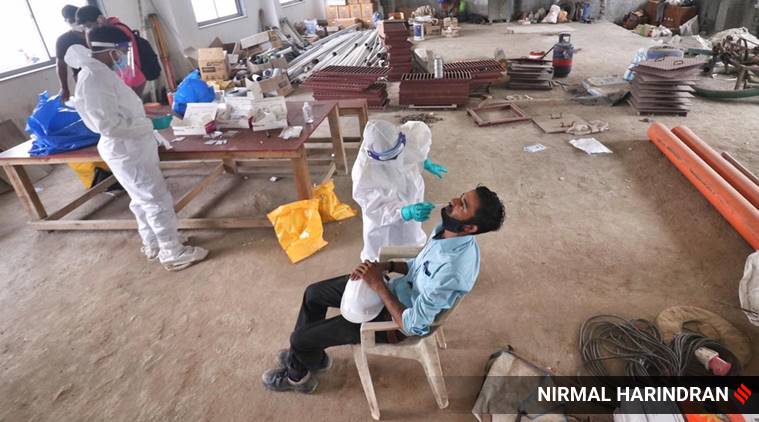
 A healthcare staff collecting swab sample for Covid-19 test at a construction site in Ahmedabad.
(Express photo by Nirmal Harindran)
“There is no denying that the infection is spreading in specific states. It is going to newer areas, but these are also densely populated; it is not going into villages to that extent. The outbreak is still restricted to semi-urban areas because that is where the virus thrives,” a top source said.
Story continues below this ad
While the increase in case numbers in Maharastra, Karnataka, and Andhra Pradesh has been incremental and not exponential, “since their base in terms of population is bigger, the incremental increase is also bigger”, the source said.
Saturday’s meeting was attended by district officers of Pune, Nagpur, Kolhapur, Sangli, Nashik, Ahmednagar, Raigad, Jalgaon, Solapur, Satara, and Palghar in Maharashtra; Prakasam and Chittoor in Andhra Pradesh; and Koppal, Mysuru, Davangere, and Ballari in Karnataka.
“The challenge for us is this: now that the states know how the virus spreads, and are aware of strategies for containment, surveillance, contact tracing, and treatment, why is it that these states are still reporting such high numbers?” top government sources,who are part of the team monitoring the pandemic, told the Indian Express.
“That is why we have had long meetings with district collectors and chief medical officers to discuss these issues,” they said.
Story continues below this ad
In the course of several long meetings with the officials, the Centre found glaring discrepancies in containment and surveillance strategies, the sources said.
“We realised in these meetings that at the district level, they have between 200 and 800 physical teams of ASHA workers, volunteers to do surveillance, containment, and house-to-house searches of active cases. They also have a large number of supervisors to monitor these teams. But a large number of the members of these teams do not actually know what they are expected to do when they go to a containment zone. They have not been trained,” a source said.
“For instance, in the case of contact tracing, these districts have not been told the average number of contacts per positive that needs to be traced. That is important. Therefore, the surveillance officers are missing a large number of infected persons, the source said.
“We found that municipal commissioners and district magistrates have the knowledge but people down the line, who should actually be trained, have not been trained,” the source said.
Story continues below this ad
The Centre has now prepared two separate manuals – one for surveillance officers on the ground, the other for supervisors monitoring the team. “The manuals address finer points, and have been circulated to these districts. We also asked them to translate them in local languages,” an official said.
The CMOs were questioned on bringing down the mortality rate to below 1 per cent. “We realised that even at the level of chief medical officer, there was a feeling that morality cannot be brought below 1 per cent. We questioned them on CFR. Their reply was that most of the patients had co-morbidities and were senior citizens.”
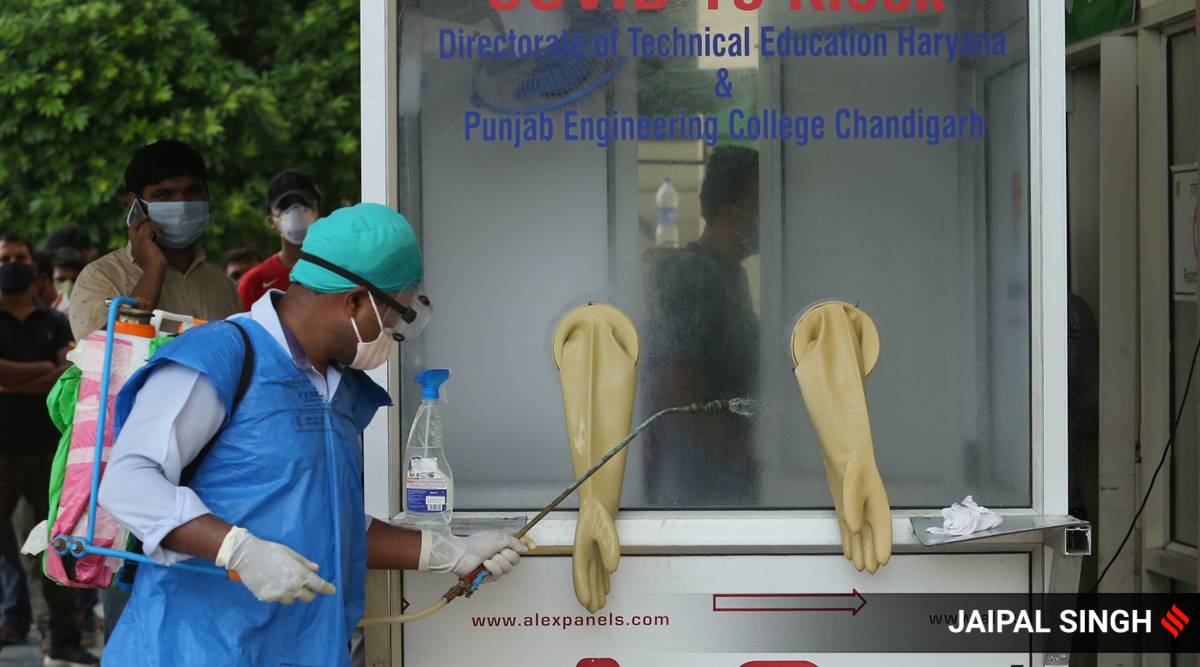
Disinfecting of COVID-19 testing kiosk at Civil hospital in Panchkula (Express photo by Jaipal Singh)
The CMOs were asked to make detailed submissions on measures taken to address issues related to vulnerable groups, the sources said. “We asked if the CMOs had sought the help of AIIMS, New Delhi, on treating co-morbid and elderly patients. The district officers remained silent,” the sources said.
The CMOs have now been directed to avail the services of the AIIMS team that has been holding meetings with doctors heading ICUs across states on effective clinical management of cases.


 5 min read



 A healthcare staff collecting swab sample for Covid-19 test at a construction site in Ahmedabad.
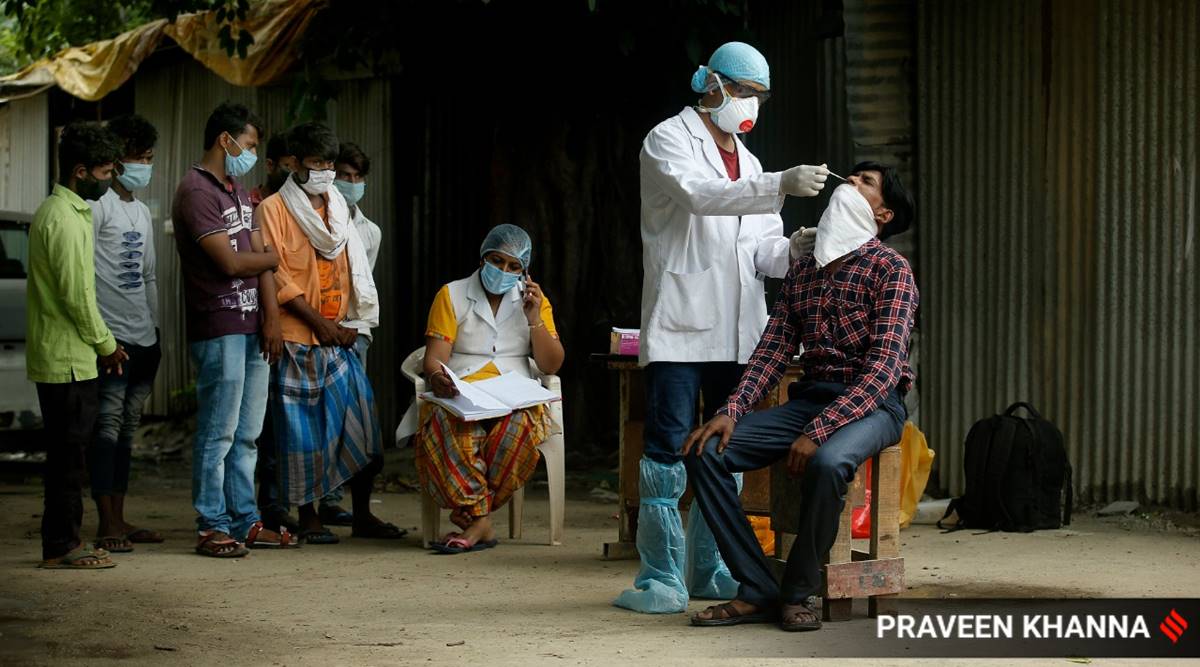 At a testing centre in New Delhi (Express photo/Praveen Khanna)
 Disinfecting of